
How to Do Keyword Research for SEO: Ultimate Guide for Beginners and Pros

Keyword research is the foundation of every successful SEO strategy. It determines what you rank for, who finds you, and whether that traffic converts. Yet, it’s also one of the most misunderstood SEO activities.
Some marketers chase high-volume keywords and never rank. Others target low-competition terms that bring traffic but no business value. The difference lies in how keyword research is done.
This pillar guide breaks down how to do keyword research for SEO in a practical, beginner-friendly yet professional way, combining data, real-world strategy, and modern search behavior. Whether you’re just starting or refining an advanced SEO workflow, this guide will serve as your go-to keyword research guide.
What Is Keyword Research (And Why It Still Matters)
Keyword research is the process of discovering, analyzing, and prioritizing the search terms people use in search engines to find information, products, or services.
Despite AI-driven search and semantic understanding, keywords still matter because:
- Google processes over 8.5 billion searches per day, each starting with words or phrases
- 68% of online experiences begin with a search engine
- Pages ranking on page one receive over 90% of total clicks
It helps you:
- Understand real user demand
- Align content with search intent
- Prioritize topics that drive qualified traffic
- Build scalable content and SEO strategies
In short, SEO without keyword research is guessing.
How Search Engines Interpret Keywords Today
Modern search engines don’t just match words, they interpret meaning.
Google now evaluates:
- Search intent (why the user is searching)
- Semantic relationships between terms
- Content depth and topical authority
- Engagement signals and relevance
This means effective keyword research for SEO is no longer about stuffing exact-match phrases. It’s about topic coverage, intent alignment, and strategic prioritization.
Step 1: Define Your SEO and Business Goals
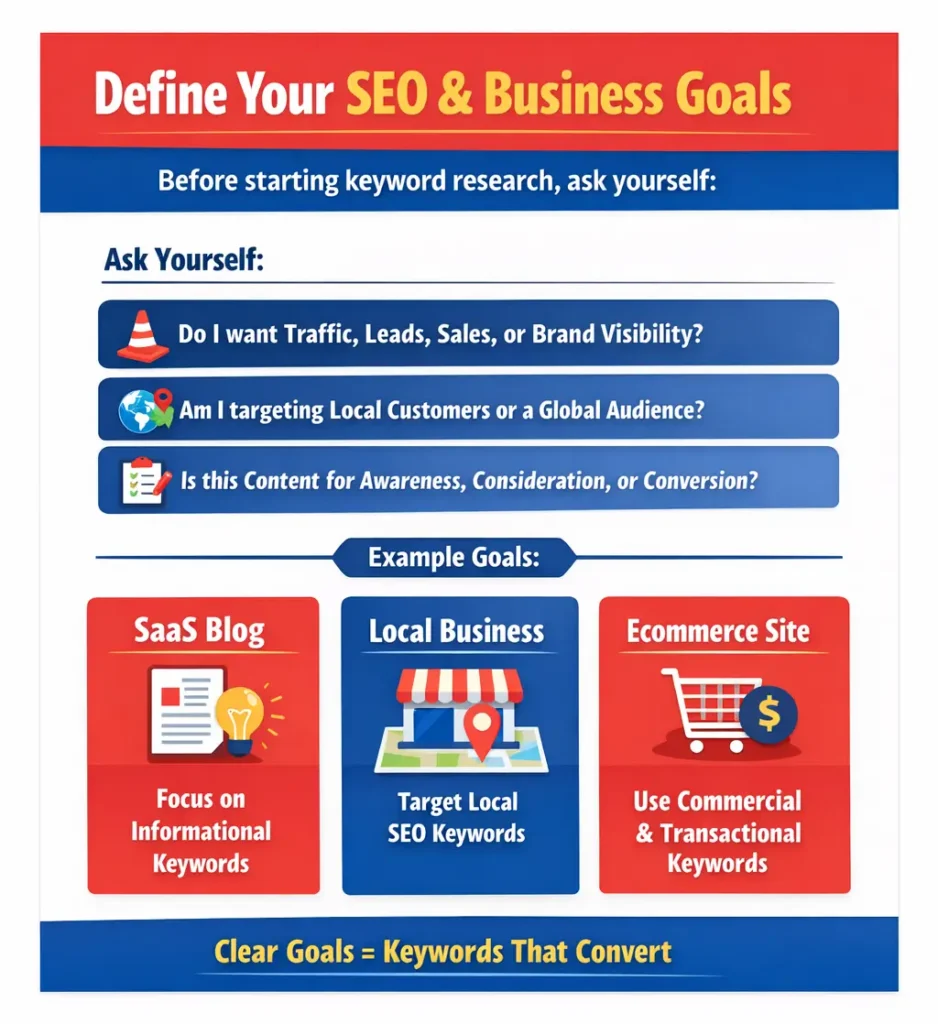
Before opening any keyword research tool, clarify why you’re doing keyword research.
Ask yourself:
- Do I want traffic, leads, sales, or brand visibility?
- Am I targeting local customers or a global audience?
- Is this content for awareness, consideration, or conversion?
For example:
- A SaaS blog may prioritize informational keywords
- A local business needs local SEO keyword research
- An ecommerce site focuses on commercial and transactional terms
Clear goals prevent wasted effort on keywords that don’t convert.
Step 2: Start With Seed Keywords
Seed keywords are the base terms that describe your business, product, or niche.
Examples:
- SEO agency → “SEO services”, “SEO audit”, “local SEO”
- Dentist → “teeth whitening”, “dental clinic near me”
- Ecommerce → “running shoes”, “wireless headphones”
A good starting list usually contains 5–15 seed keywords.
These seeds will be expanded into hundreds or thousands of keyword ideas using a keyword research tool.
Step 3: Use Keyword Research Tools to Expand Ideas
A keyword research tool helps you uncover what people actually search for, not assumptions.
Most tools provide:
- Monthly search volume
- Keyword difficulty
- CPC and commercial value
- SERP analysis
- Related and long-tail keywords
Popular keyword research tools include:
- Ahrefs Keywords Explorer
- Mangools KWFinder
- Google Keyword Planner
- Google Search Console
- AnswerThePublic
Data insight:
- Long-tail keywords (4+ words) account for over 70% of all searches
- These keywords often convert better due to clearer intent
Step 4: Understand Search Intent (The Most Critical Step)
Search intent explains why someone is searching, not just what they are typing into Google. Two people can use similar keywords but want completely different outcomes. If your content doesn’t satisfy that intent, Google won’t rank it, no matter how strong your backlinks or how well-written the page is.
In simple terms, Google wants to rank pages that solve the searcher’s problem in the fastest and most helpful way.
There are four primary types of search intent:
- Informational – The user is looking for answers, explanations, or guidance. They are in research mode and not ready to buy yet. These searches usually start with how, what, why, or guide. Content like blogs, tutorials, and step-by-step articles work best here.
Example: “how to do keyword research”
- Navigational – The user already knows the brand or tool and is trying to reach a specific page. Google acts as a shortcut rather than a discovery tool. These searches usually favor official brand websites.
Example: “Ahrefs keyword tool”
- Commercial – The user is evaluating products or services before making a decision. They want comparisons, reviews, or recommendations to help them choose. This intent sits between learning and buying.
Example: “best keyword research tool”
- Transactional – The user is prepared to take action, such as buying, signing up, or starting a trial. These searches have strong conversion potential. Pages should focus on clear offers and calls to action.
Example: “buy SEO software”
According to multiple industry studies, intent mismatch is the #1 reason pages fail to rank, even with strong backlinks.
Your content must match the dominant intent shown on page one.
Step 5: Analyze Keyword Metrics (What to Look At)
Not every keyword deserves your time or effort. The goal isn’t to target more keywords, it’s to target the right ones. These key metrics help you decide which keywords are actually worth pursuing.
1. Search Volume
Search volume shows how many people search for a keyword each month. While high volume looks attractive, it doesn’t always mean high-quality traffic. Some keywords bring visitors who never convert. A lower-volume keyword with clear intent can often deliver better results.
2. Keyword Difficulty
Keyword difficulty estimates how hard it is to rank on page one. High difficulty usually means strong competition from authoritative websites. If your site is new or growing, focusing on low to medium difficulty keywords gives you a better chance to rank faster and build momentum.
3. Traffic Potential
Traffic potential looks beyond a single keyword. One well-optimized page can rank for hundreds of related search terms. Instead of chasing individual keywords, focus on covering a topic thoroughly to capture more overall traffic.
4. Business Value
Business value measures how relevant a keyword is to your actual customers. Ask whether the searcher could realistically become a lead or buyer. A keyword with 300 targeted searches often outperforms a 10,000-search vanity term that brings the wrong audience.
Step 6: Keyword Research Competitor Analysis
One of the fastest ways to find keywords that actually work is to study what’s already working for your competitors. Instead of guessing, you learn from real data and proven rankings. This approach helps you build smarter content with less trial and error.
Keyword research competitor analysis helps you:
Discover keywords already driving traffic
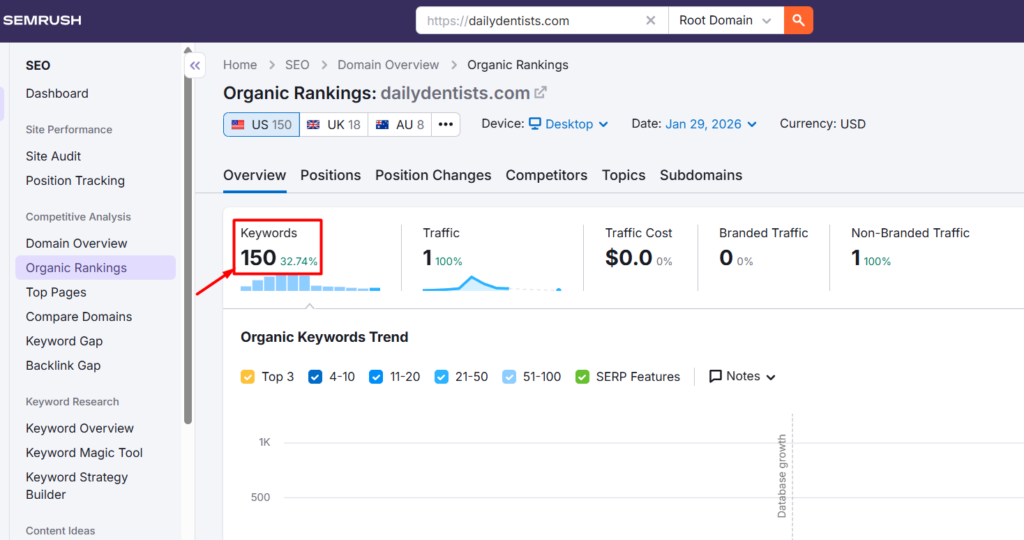
You can use any keyword research tool to figure out what keyword they are ranking for. For example, in SEMrush, you can put your competitor’s URL on the “Organic Ranking” section and then click on the number of keywords to see all the keywords.
Identify content gaps
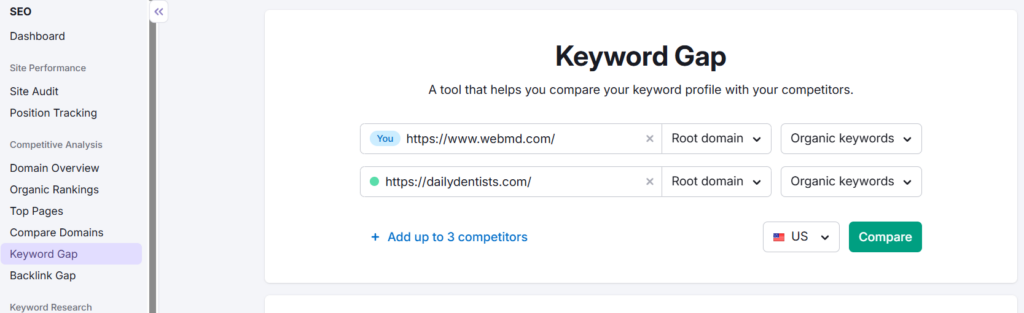
Again in SEMrush, you can simultaneously put your website URL and competitor’s URL, to figure out Keyword Gap and Backlink Gap.
Understand ranking difficulty
By reviewing who ranks and why, you can judge whether a keyword is realistic for your website. This prevents wasting effort on keywords that are too competitive.
Identify Top-Ranking Competitors
Start by searching your main keywords in Google and noting the websites that consistently appear on page one. These are your real SEO competitors, even if they don’t offer the exact same product or service. Google already trusts these sites, which makes them valuable benchmarks.
Export Their Ranking Keywords
Use a keyword research tool to pull the list of keywords your competitors are ranking for. This shows you what’s actually driving their organic traffic. You’re not guessing, you’re working with proven data.
Filter by Relevance and Intent
Not every keyword a competitor ranks for will be useful to you. Remove keywords that don’t match your audience, services, or goals. Focus on keywords that align with the right search intent and business value.
Find Keywords They Rank for, but You Don’t
Look for keywords where competitors already get traffic but your site doesn’t appear at all. These gaps represent opportunities where you can create better, more helpful content and earn rankings faster.
Data insight:
- Websites targeting competitor gaps see up to 30–40% faster ranking improvements than those starting from scratch
Step 7: Local SEO Keyword Research (If You Serve a Location)
Local searches have explosive intent.
Statistics show:
- 46% of all Google searches have local intent
- 76% of local mobile searches result in a visit within 24 hours
Local SEO keyword research focuses on:
- Service + location keywords
- “Near me” searches
- City, neighborhood, and service modifiers
Examples:
- “SEO agency in Austin”
- “dentist near me”
- “plumber in Brooklyn”
Best practice:
Create dedicated location pages instead of forcing local keywords into generic content.
Step 8: Group Keywords Into Topics and Clusters
Modern SEO rewards topical authority.
Instead of creating one page per keyword, group related keywords into clusters.
Example:
Pillar Topic: Keyword Research
- how to do keyword research
- keyword research for SEO
- keyword research tool
- keyword research checklist
- keyword research competitor analysis
This structure:
- Improves rankings
- Enhances internal linking
- Boosts user engagement
Step 9: Build a Keyword Research Checklist
Here’s a practical keyword research checklist you can reuse:
- Define SEO and business goals
- Identify seed keywords
- Use at least one keyword research tool
- Analyze search intent
- Evaluate volume and difficulty
- Perform competitor keyword research
- Include long-tail keywords
- Group keywords into topics
- Prioritize by business value
- Map keywords to content pages
Following a checklist ensures consistency and scalability.
Step 10: Map Keywords to Content
Keyword mapping prevents overlap and cannibalization.
Each page should have:
- One primary keyword
- Multiple secondary and semantic keywords
- Clear intent alignment
Example:
Primary: how to do keyword research for SEO Secondary: keyword research guide, keyword research checklist
This improves topical depth and ranking stability.
Common Keyword Research Mistakes to Avoid
Even experienced SEOs make these mistakes:
- Targeting volume over intent
- Ignoring SERP analysis
- Creating duplicate content for similar keywords
- Skipping competitor research
- Treating keyword research as a one-time task
SEO is iterative. Keyword research should be revisited quarterly.
How Often Should You Do Keyword Research?
Keyword behavior changes due to:
- Market trends
- New competitors
- Algorithm updates
- Product or service changes
Best practice:
- Quarterly for active websites
- Monthly for high-growth businesses
- Before every major content launch
The Future of Keyword Research
Keyword research is evolving, not disappearing.
Trends shaping the future:
- AI-driven SERPs still rely on structured content
- Conversational and question-based searches
- Entity-based optimization
- Greater focus on topical authority
Understanding how to do keyword research will remain a core SEO skill, regardless of how search evolves.
Final Thoughts
Keyword research isn’t really about keywords, it’s about understanding what people are looking for and why. When you focus on real search behavior instead of chasing numbers, your SEO strategy becomes far more effective.
When done right, keyword research helps you attract the right audience, create more meaningful content, and build long-term organic traffic that doesn’t disappear with every algorithm update. It connects SEO efforts directly to business growth, not just rankings.
Use this guide as your foundational keyword research guide, validate your ideas with real data, and tailor the approach to your specific niche and goals. The right keywords open the door, but it’s smart strategy and execution that turn traffic into real results.

