
Content Marketing Strategy: A Complete Guide to Planning, Building, and Scaling Content

Content is no longer “nice-to-have.” It’s a core business asset. Yet many brands still publish blogs, videos, and social posts without a clear system behind them, resulting in inconsistent results, wasted effort, and unclear ROI.
This is where a content marketing strategy becomes essential.
Drawing insights and frameworks from industry leaders like HubSpot, Content Marketing Institute, and MarketMuse, this pillar guide explains what a content marketing strategy is, how to create a content strategy, and how to scale it sustainably.
Whether you’re starting from scratch or refining an existing program, this guide will walk you through content strategy development step by step, using data, real-world best practices, and proven frameworks.
What Is Content Marketing Strategy?
A content marketing strategy is a documented plan that defines:
- Why you are creating content
- Who the content is for
- What value the content delivers
- How content supports business goals
- Where and how it will be distributed, measured, and governed
Unlike a simple editorial calendar, a content marketing strategy connects content creation to measurable business outcomes, such as organic traffic growth, lead generation, sales enablement, or customer retention.
According to Content Marketing Institute, organizations with a documented content marketing strategy are significantly more likely to:
- Consider their efforts successful
- Use content marketing effectively
- Justify higher budgets
In short, strategy turns content from an expense into a scalable growth engine.
Content Strategy vs Content Marketing Strategy vs Content Marketing Plan
One of the most common sources of confusion is terminology. Let’s clarify it.
Content Marketing Strategy
This defines the why:
- Why content exists
- Why your audience should care
- Why your brand is uniquely positioned to help
This is the foundation.
Content Strategy
Content strategy is broader and often organization-wide. It governs:
- Content structure
- Governance
- Lifecycle management
- UX and information architecture
Marketing content is just one part of it.
Content Marketing Plan
A content marketing plan is tactical. It answers:
- What content will be created
- When it will be published
- Who will create it
- Which channels will distribute it
Strategy comes first. Planning follows. Execution comes last.
Why Content Marketing Planning Matters More Than Ever
Content saturation is real. Millions of blogs are published every day, and only a fraction gain meaningful visibility.
Strategic content marketing planning helps brands cut through the noise by ensuring content is:
- Intent-driven
- Audience-focused
- Differentiated
- Measurable
From an SEO perspective, search engines now reward topical authority, depth, and consistency, not just keyword usage.
MarketMuse research shows that brands with well-structured topic coverage outperform competitors who publish isolated, unconnected content pieces.
Without a clear content planning strategy, teams often:
- Chase keywords without intent alignment
- Duplicate topics internally
- Publish content that doesn’t convert
- Struggle to prove ROI
How to Create a Content Strategy (Step-by-Step)
Let’s break down how to build a content strategy that is practical, scalable, and results-driven.
Step 1: Define Business Goals and Success Metrics
Every successful content marketing strategy development process starts with business clarity.
Ask:
- Is the goal brand awareness, leads, sales, or retention?
- Which funnel stage does content primarily support?
- How will success be measured?
Common KPIs include:
- Organic traffic growth
- Keyword rankings
- Engagement metrics (time on page, scroll depth)
- Leads and conversions
- Assisted revenue
HubSpot reports that marketers who define clear goals are far more likely to see positive ROI from content marketing.
Step 2: Understand Your Audience Deeply
A content strategy fails without audience insight.
Effective content strategy development requires:
- Buyer personas
- Pain points
- Search intent analysis
- Content format preferences
High-performing brands map content to the customer journey, aligning topics with:
- Awareness questions
- Consideration research
- Decision-stage validation
This ensures content supports users, not just search engines.
Step 3: Conduct a Content Audit and Gap Analysis
Before creating anything new, evaluate what already exists.
A content audit helps you:
- Identify high-performing assets
- Find outdated or underperforming pages
- Spot keyword cannibalization
- Discover content gaps
MarketMuse emphasizes gap analysis as a core component of developing a content strategy, ensuring your site covers topics comprehensively rather than randomly.
Step 4: Define Your Content Strategy Framework
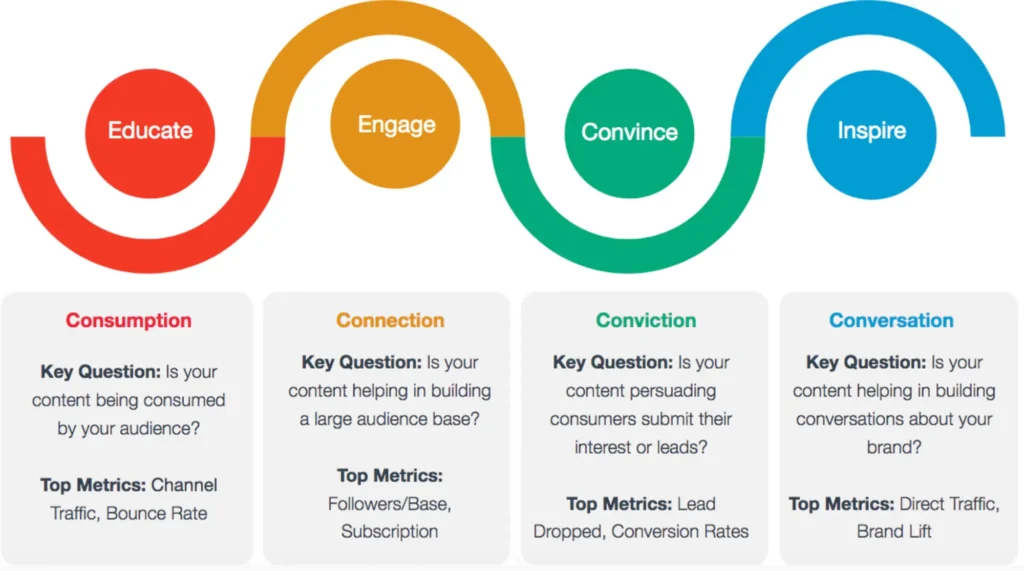
A content strategy framework gives your content clear direction and consistency. It ensures your content is not just created, but consumed, engaged with, trusted, and talked about, just like the stages shown in the image.
The framework moves content through four natural stages:
- Educate → help people understand
- Engage → build interest and connection
- Convince → drive action and trust
- Inspire → create conversations and loyalty
To support this journey, your framework should clearly define:
- Core topics and subtopics
These ensure your content educates users properly by covering subjects deeply and logically. It helps audiences find answers easily and builds topical authority over time. - Content formats (blogs, videos, guides, tools)
Different formats support different stages of the journey. Blogs educate, videos engage, guides convince, and tools or stories inspire long-term brand recall. - Publishing frequency
Consistent publishing helps build connection and trust. When audiences know when to expect content, engagement grows naturally and performance becomes predictable. - Distribution channels
Content only works when people see it. Choosing the right channels ensures your content reaches users where they already spend time and encourages conversation around your brand. - Governance and quality standards
Clear rules for tone, accuracy, and structure keep content trustworthy and consistent. This is critical for building conviction and long-term brand value.
Framework-driven content scales better because teams always know what to create, who it’s for, and which stage it supports. Instead of guessing or starting from scratch every time, the framework turns content into a repeatable system that drives real business impact
Step 5: Choose Content Types and Channels Strategically
Not every audience consumes content the same way.
A strong content planning strategy aligns formats with intent:
- Blogs for education and SEO
- Case studies for decision-stage users
- Videos for engagement
- Email for retention and nurturing
Distribution matters as much as creation. Your content marketing plan should clearly outline:
- Owned channels (blog, email)
- Earned channels (search, PR)
- Shared channels (social platforms)
Step 6: Build a Sustainable Content Creation Process
One-off content doesn’t scale. Systems do.
Effective creating a content marketing strategy involves:
- Defined roles (strategist, writer, editor, SEO)
- Standardized briefs
- Clear workflows
- Editorial guidelines
HubSpot data shows teams with documented workflows publish more consistently and with higher quality.
Step 7: Measure, Optimize, and Iterate
Content strategy is not static.
Track performance regularly and optimize based on:
- Ranking improvements
- Engagement patterns
- Conversion data
- Content decay
MarketMuse highlights continuous optimization as essential for maintaining topical authority and long-term SEO gains.
The Role of SEO in Content Strategy Development
SEO is not something you “add later.” It is built directly into content marketing strategy development. When SEO and content work together from the start, your content is easier to discover, more useful for readers, and more likely to perform well in search results.
Modern SEO-driven content strategies focus on:
- Topic clusters, not isolated keywords
Instead of creating one page for one keyword, topic clusters organize content around a main topic and related subtopics. This helps search engines understand your expertise and gives readers a complete answer in one place. - Search intent mapping
Every search has a purpose, learning, comparing, or buying. Mapping content to search intent ensures your page answers what users actually want, not just what they typed into Google. - Semantic coverage
Search engines look for depth, not repetition. Semantic coverage means naturally covering related ideas, questions, and terms so your content feels complete and genuinely helpful. - Internal linking
Internal links guide readers to relevant content and help search engines understand how your pages connect. This improves crawlability, distributes authority, and keeps users engaged longer.
This approach matches how search engines evaluate expertise, relevance, and usefulness today. Content that is well-structured, intent-driven, and interconnected consistently outperforms pages created just to target keywords.
Data and Statistics That Support Strategic Content Marketing
Let’s look at why strategy-first content works:
- 70%+ of marketers actively invest in content marketing (CMI)
- Companies with documented strategies are significantly more successful
- Long-form, in-depth content earns more backlinks and engagement on average
- Brands that publish consistently see higher organic growth over time
Data consistently shows that developing a content strategy leads to better efficiency, stronger results, and more predictable growth.
Common Mistakes in Content Marketing Strategy Development
Even experienced teams make mistakes when building a content marketing strategy. Being aware of these pitfalls can save time, budget, and frustration.
- Jumping straight to content creation
Creating content without a strategy often leads to random topics that don’t support business goals. Without direction, even good content struggles to deliver consistent results. - Ignoring audience intent
If content doesn’t match what users are actually looking for, it won’t perform well. Understanding whether people want information, comparisons, or solutions is critical to success. - Over-focusing on volume instead of depth
Publishing more content doesn’t always mean better performance. Fewer, well-researched, in-depth pieces often outperform large volumes of shallow content. - Treating SEO as an afterthought
Adding SEO after content is written limits its impact. SEO works best when search intent, structure, and keywords are considered during planning, not after publishing. - Failing to document the strategy
When the strategy isn’t written down, teams lose clarity and consistency. A documented strategy keeps everyone aligned and makes scaling easier over time.
A strong content marketing strategy is intentional and well-planned. It focuses on long-term growth rather than reacting to trends or publishing content without purpose.
Scaling Your Content Marketing Strategy
Once your content foundation is strong, scaling becomes much easier and more predictable. At this stage, the focus shifts from creating more content to creating smarter, connected, and higher-impact content.
- Expanding topic clusters
Build on existing core topics by adding related subtopics and supporting articles. This strengthens topical authority and helps search engines see your site as a trusted resource. - Repurposing high-performing content
Content that already performs well can be refreshed, expanded, or turned into new formats like videos, guides, or email series. This saves time while extending the value of proven assets. - Automating workflows where possible
Automation helps reduce manual effort in tasks like publishing, reporting, and content updates. This allows teams to focus more on strategy, quality, and creativity. - Improving internal linking and UX
Better internal linking helps users discover more relevant content and stay longer on your site. A clean, user-friendly experience also supports stronger engagement and conversions.
Platforms like MarketMuse emphasize scaling through content quality and topical coverage, not by publishing more pages. Sustainable growth comes from depth, relevance, and consistency, not volume alone.
Final Thoughts: Content Strategy Is a Long-Term Asset
A well-executed content marketing strategy is not about quick wins, it’s about compounding value.
By clearly defining what is content marketing strategy, aligning it with business goals, and following a structured content strategy framework, brands can build authority, trust, and sustainable growth.
Content that is planned, purposeful, and audience-centric will always outperform content created without direction.If you’re serious about growth, the real question isn’t whether you should invest in content, it’s how strategically you do it.

