
How Artificial Intelligence in Digital Marketing Impacting in 2026
Artificial intelligence is no longer a futuristic idea in digital marketing. It is infrastructure. It drives ad platforms, recommendation systems, CRM solutions, search engines, and even content creation tools.
A few years ago, artificial intelligence in digital marketing felt like an experimental area. Today, it is a foundation. Every major marketing platform, from ad platforms to CRM solutions, uses artificial intelligence in digital marketing.
According to industry research cited in AI-focused marketing analyses:
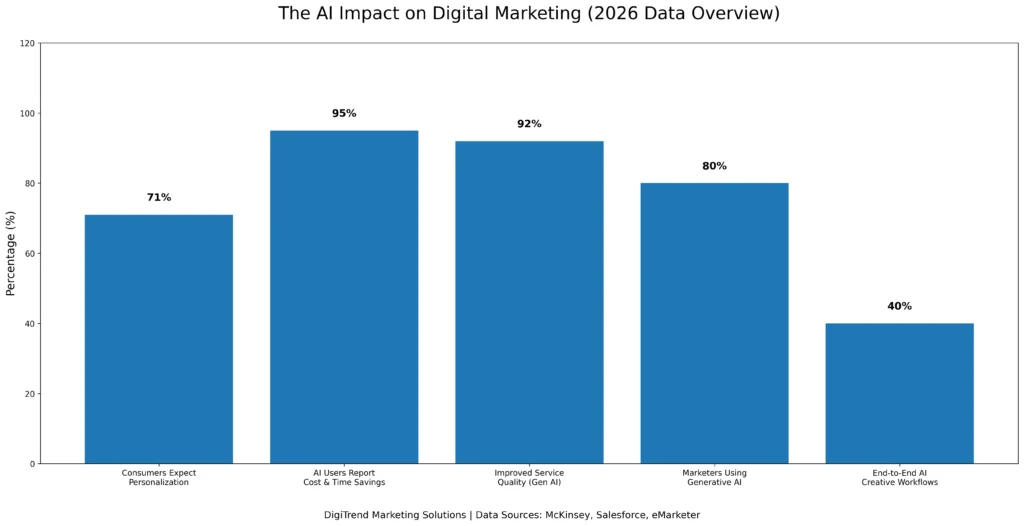
- 71% of consumers expect personalized interactions and become frustrated when experiences feel generic (McKinsey).
- 95% of organizations using AI report time and cost savings (Salesforce).
- 92% say generative AI improves service quality.
- 80% of marketers are actively using generative AI, and 40% use it across the full creative production process (eMarketer).
Those figures point to something more significant than a trend. They indicate a change in structure.
This guide explores:
- What is AI in digital marketing?
- How is AI used in digital marketing?
- The measurable AI impact on digital marketing performance
- How to use AI in digital marketing strategically
- The role of AI and machine learning in digital marketing systems
Let’s start with fundamentals.
What Is AI in Digital Marketing?
At its simplest level, AI in digital marketing refers to technologies that enable machines to analyze data, learn patterns, and make predictions or decisions without explicit programming for every scenario.
But that definition is too technical.
In practical marketing terms, artificial intelligence in digital marketing means:
- Systems that predict which customer is most likely to buy
- Algorithms that decide which ad to show and when
- Tools that generate content drafts in seconds
- Platforms that personalize website experiences dynamically
- Predictive models that forecast campaign outcomes
AI combines several subfields:
1. Machine Learning (ML)
Machine learning allows systems to improve based on data. For example, ad platforms learn which audiences convert best and automatically adjust bidding strategies.
2. Natural Language Processing (NLP)
NLP enables AI to understand and generate human language. This powers chatbots, AI copywriting tools, and voice search optimization.
3. Predictive Analytics
This uses historical data to forecast future behavior, such as churn risk or conversion probability.
4. Generative AI
This creates new content, text, images, video, code, based on learned patterns.
Together, these technologies reshape how marketing decisions are made.
Why AI Became Essential (Not Optional)
The biggest misconception about AI and machine learning in digital marketing is that it’s about automation alone.
It’s not.
It’s about complexity management.
Digital marketing today involves:
- Dozens of acquisition channels
- Cross-device customer journeys
- Massive data volumes
- Real-time bidding environments
- Multi-touch attribution
- Personalization expectations
No human team can process this level of complexity manually.
This is where AI becomes infrastructure.
Marketing analysts emphasise that AI now underpins customer experience design, recommendation engines, and automated segmentation. Meanwhile, Digital Marketing Institute frames AI as a strategic layer that enhances analytics, personalization, and campaign optimization.
The AI Impact on Digital Marketing: What the Data Shows
AI is no longer a future-facing innovation in marketing, it is delivering measurable performance gains right now. The conversation has shifted from experimentation to ROI. Across personalization, operational efficiency, and creative production, data shows that artificial intelligence in digital marketing is driving structural improvements.
Here’s what current industry data tells us about the AI impact on digital marketing:
Personalization Expectations
- 71% of consumers expect personalized interactions (McKinsey research referenced in AI marketing analyses).
- When personalization fails, customer satisfaction drops significantly.
This alone forces adoption. Personalization at scale without AI is nearly impossible.
Operational Efficiency
According to Salesforce research cited in AI Digital’s industry breakdown:
- 95% of decision-makers using AI report time and cost savings.
- 92% report improved service quality due to generative AI.
This suggests AI isn’t just a creative tool—it’s an operational optimization engine.
Creative Production Adoption
eMarketer data shows:
- 80% of marketers use generative AI.
- 40% use it end-to-end in creative workflows.
That means nearly half of marketing teams are integrating AI across ideation, drafting, editing, and deployment. It is improving efficiency, elevating customer experience, and accelerating creative output at scale. The AI impact on digital marketing is measurable, systemic, and growing. The brands that delay integration risk falling behind those already operating with intelligent infrastructure.
How Is AI Used in Digital Marketing? (Core Applications in 2026)
Understanding what AI is in digital marketing is important. But understanding how it is actually used in real campaigns, real platforms, and real customer journeys is where the real value lies.
In 2026, artificial intelligence in digital marketing is not confined to one tool or one department. It operates across the entire ecosystem, from data analysis and audience segmentation to ad optimization, content production, and customer support. Much of it works quietly in the background, analyzing behavior, predicting outcomes, and making micro-decisions in milliseconds.
When someone clicks an ad, opens an email, browses a product page, or abandons a cart, AI systems are processing that information instantly. They’re identifying patterns, updating predictive models, and adjusting future interactions. This is what separates modern marketing from traditional campaign-based execution.
Let’s break down exactly how AI is used in digital marketing across major functions.
1. AI in Data Analysis and Decision Intelligence
Every marketing action generates data:
- Clicks
- Scroll depth
- Purchase behavior
- Email opens
- Bounce rates
- Session time
- Device usage
AI processes millions of data points to detect patterns invisible to humans.
For example:
- Predicting which leads are most likely to convert
- Identifying high-value customer segments
- Forecasting seasonal demand spikes
- Detecting anomalies in campaign performance
Machine learning models continuously refine these predictions.
This transforms reporting from descriptive (“what happened?”) to predictive (“what will happen next?”).
2. AI in Personalization Engines
Personalization is where artificial intelligence in digital marketing creates visible impact.
Examples include:
- Dynamic homepage content
- Personalized product recommendations
- Behavior-triggered emails
- Customized ad creatives
- Smart push notifications
When a customer visits a website in 2026, AI systems often determine:
- Which banner they see
- Which products are prioritized
- Which offers appear
- Which call-to-action is highlighted
This is powered by behavioral data modeling.
Given that 71% of consumers expect personalization, AI-driven customization is no longer premium, it’s baseline.
3. AI in Paid Media Optimization
Modern ad platforms are AI-native.
Algorithms handle:
- Automated bidding
- Audience expansion
- Lookalike modeling
- Budget reallocation
- Conversion prediction
This is one of the clearest examples of AI and machine learning in digital marketing.
Campaigns now adjust in real time based on performance signals.
A human marketer sets objectives. AI handles micro-optimization at scale.
4. Generative AI for Content Production
Generative AI has redefined content velocity.
Marketers use AI to:
- Draft blog outlines
- Generate product descriptions
- Write email sequences
- Create ad variations
- Produce social media captions
- Generate video scripts
But here’s the nuance:
High-performing brands use AI to accelerate production, not replace editorial judgment.
AI handles scale. Humans handle positioning and differentiation.
5. AI in Customer Support and Conversational Marketing
AI chatbots now use natural language processing to:
- Answer FAQs
- Qualify leads
- Schedule demos
- Route support tickets
Unlike early bots, modern AI systems understand intent rather than relying on rigid keyword triggers.
This improves response time, lowers support costs, and increases conversion rates.
Given the 95% efficiency improvements reported by AI adopters, conversational automation plays a major role.
Strategic Question: How to Use AI in Digital Marketing Effectively?
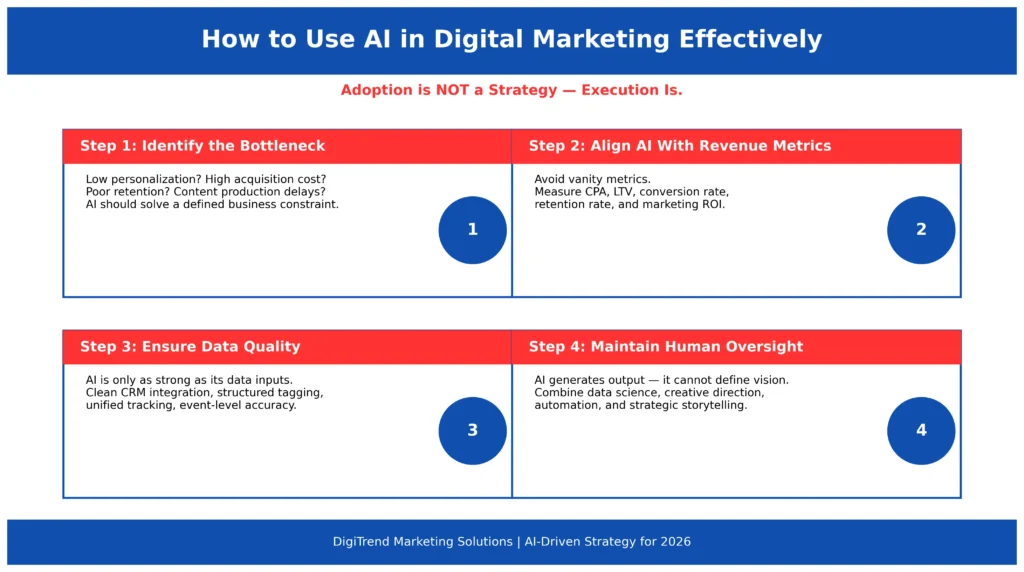
Adoption is not a strategy.
Here’s a structured approach:
Step 1: Identify the Bottleneck
Is it:
- Low personalization?
- High acquisition cost?
- Poor retention?
- Content production delays?
AI should solve a defined business constraint.
Step 2: Align AI With Revenue Metrics
Avoid vanity metrics.
Instead measure:
- Cost per acquisition (CPA)
- Customer lifetime value (LTV)
- Conversion rate
- Retention rate
- Marketing ROI
Step 3: Ensure Data Quality
AI is only as strong as its data inputs.
That means:
- Clean CRM integration
- Structured tagging
- Unified analytics tracking
- Event-level data accuracy
Step 4: Maintain Human Oversight
AI can generate output.
It cannot define brand vision.
In 2026, the most successful marketing teams combine:
- Data science
- Creative direction
- Automation
- Strategic storytelling
Conclusion – AI Is the New Foundation of Digital Marketing
Artificial intelligence in digital marketing is no longer an emerging advantage, it is the foundation modern strategies are built on. From predictive analytics and personalization to automated media buying and generative content, AI is reshaping how brands connect, convert, and scale. The data is clear: higher efficiency, smarter targeting, faster production, and measurable performance gains are no longer optional, they are expected.
But here’s what matters most: AI is a tool. Strategy is still human. The brands that win in 2026 are not the ones blindly adopting automation. They are the ones combining AI and machine learning in digital marketing with strong positioning, clear messaging, and disciplined execution.
At DigiTrend Marketing Solutions, we believe AI should amplify your marketing intelligence, not replace it. The real power lies in knowing how to use AI in digital marketing strategically, ethically, and profitably.And if you want to understand how artificial intelligence is transforming search specifically, we recommend reading our in-depth guide on The Future of SEO: How AI is Changing Search Engine Optimization, where we break down how AI is redefining visibility in modern search ecosystems.

