Local SEO for Beginners: A Step-by-Step Guide
If you run a business that serves customers in a specific city, neighborhood, or service area, your success increasingly depends on how visible you are in local search results. When someone searches for “best bakery near me” or “AC repair in Dallas,” Google doesn’t show random websites, it prioritizes businesses that are locally relevant, trustworthy, and well-optimized.
This beginner’s guide to local SEO is designed to help you understand exactly how local search engine optimization works and how to implement it step by step. Whether you’re a small business owner, marketer, or entrepreneur, this local SEO guide will give you a clear, actionable framework you can start using today.
At DigiTrend Marketing Solutions, we believe local SEO should be practical, data-driven, and user-first. So let’s start at the foundation.
What Is Local SEO?
Local SEO is a specialized branch of search engine optimization focused on improving a business’s visibility in geographically related searches. It helps your business appear when users search for products or services near them or in a specific location.
Unlike traditional SEO, which often targets national or global audiences, local search engine optimization focuses on where the searcher is and how relevant your business is to that location.
Examples of Local SEO Searches
- “Dentist near me”
- “Plumber in Austin”
- “Best coffee shop in Brooklyn”
- “Emergency electrician open now”
In these searches, Google often shows:
- A local map pack (top 3 local listings)
- Google Maps results
- Local organic results below the map
If your business isn’t optimized for local SEO, you’re invisible to high-intent customers who are ready to call, visit, or book.
Why Is Local SEO Important?
Understanding why local SEO is important starts with understanding user behavior and search trends.
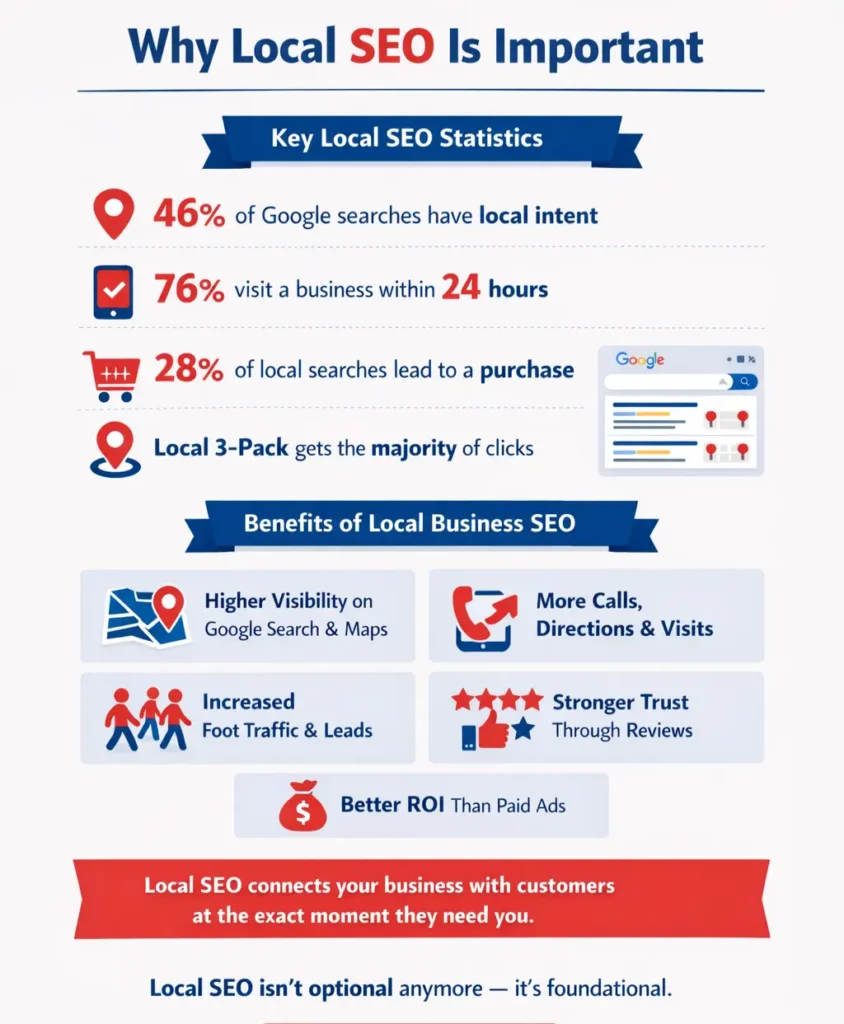
Key Local SEO Statistics
- 46% of all Google searches have local intent
- 76% of people who search for a local business on their phone visit within 24 hours
- 28% of local searches result in a purchase
- Businesses appearing in the local 3-pack receive the majority of local clicks
Local SEO connects your business with customers at the exact moment they need you. For service-based and brick-and-mortar companies, this is often the highest-converting traffic you can get.
Benefits of Local Business SEO
- Higher visibility in Google Search and Maps
- More calls, directions, and website visits
- Increased foot traffic and qualified leads
- Stronger trust through reviews and local authority
- Better ROI compared to many paid channels
In short, SEO for local businesses isn’t optional anymore, it’s foundational.
How Local Search Engine Optimization Works
Local search engine optimization is how Google decides which local businesses to show, in what order, and where (Maps, Local Pack, or organic results) when someone searches with local intent. To make this decision, Google evaluates three core ranking factors. A strong local SEO strategy balances all three, focusing on just one rarely delivers long-term results.
1. Relevance
Relevance measures how closely your business matches what the user is searching for.
- Google looks at your Google Business Profile categories, services, and on-page content to understand what you offer.
- Using the right local keywords on your website and listings helps Google match your business to relevant searches.
- Complete and accurate business information improves your chances of appearing for the right queries, not just more queries.
2. Proximity
Proximity refers to how physically close your business is to the searcher or the searched location.
- Google automatically calculates distance based on the user’s location or the city/area mentioned in the search.
- You can’t control proximity, but you can optimize location signals through accurate addresses and service-area settings.
- For service-area businesses, clearly defining coverage areas helps Google show your business to nearby users.
3. Prominence
Prominence reflects how well-known, trusted, and authoritative your business appears online.
- Google evaluates reviews, ratings, backlinks, citations, and brand mentions across the web.
- Businesses with strong reputations and consistent online signals tend to rank higher in local results.
- Regular reviews, local media mentions, and authoritative links strengthen your local brand presence.
The Core Components of a Local SEO Strategy
1. Google Business Profile Optimization
Your Google Business Profile (GBP) is the single most important asset in local business SEO.
A fully optimized profile includes:
- Accurate business name, address, and phone number (NAP)
- Primary and secondary categories
- Business hours and holiday hours
- High-quality photos and videos
- Services or product listings
- Regular updates and posts
- Customer reviews and responses
A well-maintained GBP dramatically improves your chances of appearing in the local map pack.
2. NAP Consistency and Local Citations
A citation is any online mention of your business name, address, and phone number. These appear on:
- Business directories
- Industry listings
- Review platforms
- Local websites
Consistency is critical. Even small discrepancies (e.g., “St.” vs “Street”) can weaken trust signals.
Best practice:
Audit your citations and ensure your NAP details are identical everywhere.
3. Online Reviews and Reputation Management
Reviews are both a ranking factor and a conversion factor.
- Businesses with more positive reviews rank higher locally
- Users trust reviews as much as personal recommendations
- Responding to reviews signals credibility and engagement
Effective local SEO management includes:
- Asking happy customers for reviews
- Responding to all reviews (positive and negative)
- Avoiding fake or incentivized reviews
4. Local Keyword Research
Local SEO starts with understanding how people search in your area.
Examples of local keywords:
- “Roof repair in Phoenix”
- “Best salon near Union Square”
- “Emergency water damage restoration Chicago”
Tools and methods include:
- Google Autocomplete
- “People Also Ask”
- Google Search Console
- SEO tools with location filters
Local keywords should be used naturally across:
- Page titles
- Headings
- Meta descriptions
- Body content
On-Page SEO for Local Businesses
On-page optimization is still a core part of local search engine optimization.
Key On-Page Elements
- Location-focused title tags
- Geo-modified H1 and H2 headings
- Optimized meta descriptions
- Clear service + location content
- Internal linking to local pages
- Mobile-friendly design
Location Pages
If you serve multiple areas, create unique, high-quality pages for each location. Avoid duplicate or thin content.
How to Do Local SEO: Step-by-Step for Beginners
This section is the practical core of this beginners guide to local SEO. Each step builds on the previous one, helping search engines understand your business, trust your brand, and show you to the right local audience at the right time. When followed in order, these steps form a sustainable and scalable local SEO strategy.
Step 1: Claim and Optimize Your Google Business Profile
Your Google Business Profile is the foundation of local search visibility.
- Complete every available field, including categories, services, business hours, and descriptions.
- Upload high-quality photos and keep your profile updated with posts, offers, and announcements.
- Accurate and active profiles are far more likely to appear in the local map pack and Google Maps results.
Step 2: Perform Local Keyword Research
Local keyword research helps you understand how people search for your services in your area.
- Focus on keywords that include location terms or “near me” intent.
- Evaluate search volume, competition, and relevance to your actual services.
- Use these keywords naturally across your website, content, and business listings.
Step 3: Optimize Your Website for Local SEO
Your website supports and strengthens your local listings.
- Ensure your site is fast, mobile-friendly, and technically sound.
- Optimize title tags, headings, and content with local keywords and service areas.
- Create dedicated service and location pages that clearly explain what you offer and where.
Step 4: Build and Clean Up Citations
Citations help confirm your business information across the web.
- List your business on trusted directories, local platforms, and industry-specific sites.
- Keep your business name, address, and phone number consistent everywhere.
- Remove duplicates and fix outdated or incorrect listings to avoid confusing search engines.
Step 5: Generate and Manage Reviews
Reviews influence both rankings and customer trust.
- Encourage satisfied customers to leave genuine reviews on Google and other platforms.
- Respond professionally to all reviews to show engagement and credibility.
- A steady flow of recent, positive reviews signals reliability and quality to Google.
Step 6: Create Locally Relevant Content
Local content helps you connect with your community and rank for local searches.
- Publish blog posts, FAQs, and guides focused on local problems, events, or services.
- Answer common customer questions using location-specific language where appropriate.
- Locally focused content improves relevance and builds topical authority over time.
Step 7: Track Performance and Adjust
Local SEO success depends on continuous improvement.
- Monitor local keyword rankings, website traffic, calls, and direction requests.
- Use data to identify what’s working and where improvements are needed.
- Regular tracking ensures your local SEO efforts stay aligned with business goals and market changes.
Local SEO vs Traditional SEO
| Aspect | Traditional SEO | Local SEO |
| Target | National / Global | City / Area-based |
| Keywords | Broad | Geo-specific |
| Key Asset | Website | Google Business Profile |
| Reviews | Less critical | Very important |
| Citations | Rare | Essential |
Common Local SEO Mistakes to Avoid
- Ignoring Google Business Profile updates
- Inconsistent NAP details
- Keyword stuffing with city names
- Fake reviews or review spam
- Thin or duplicate location pages
- No tracking or analytics
Avoiding these mistakes is a big part of effective local SEO management.
Local SEO Management: Ongoing, Not One-Time
Local SEO is not “set it and forget it.”
Ongoing tasks include:
- Updating business information
- Posting on GBP
- Responding to reviews
- Monitoring competitors
- Refreshing content
- Tracking rankings and conversions
Businesses that treat local SEO as a continuous process consistently outperform those that don’t.
Measuring Local SEO Success
Key metrics to track:
- Google Business Profile insights (calls, directions, clicks)
- Local keyword rankings
- Organic traffic from local pages
- Conversion actions (forms, calls)
- Review growth and sentiment
Data-driven optimization is what turns SEO for local businesses into real revenue.
Final Thoughts: Putting Your Local SEO Strategy into Action
Local SEO is one of the most powerful growth channels available to small and medium-sized businesses. When done correctly, it puts your brand in front of customers who are actively searching, and ready to take action.
This local SEO guide covered:
- What local SEO is and how it works
- Why local SEO is important for business growth
- How to do local SEO step by step
- Best practices for long-term local SEO management
If you’re just starting out, focus on the fundamentals: Google Business Profile, consistent citations, strong reviews, and locally relevant content. As your foundation grows, so will your visibility, trust, and leads.
Local SEO isn’t about gaming the algorithm, it’s about being the most relevant and reliable choice in your area. Start implementing these strategies today, and your future customers will find you exactly when they need you.