Comprehensive Technical SEO Guide for 2026: Everything Search Engines Need to Crawl, Index, and Rank Your Site
By DigiTrend Marketing Solutions
Search engines have evolved, but one thing has remained constant: if your website has technical issues, your content and links won’t reach their full potential. At DigiTrend Marketing Solutions, we see technical SEO as the foundation of sustainable organic growth. This guide is written to simplify a complex topic and give you a clear, practical understanding of how technical SEO works in real-world scenarios.
This article brings together insights from leading industry resources and our hands-on experience to create one of the most comprehensive technical SEO guides you can use today.
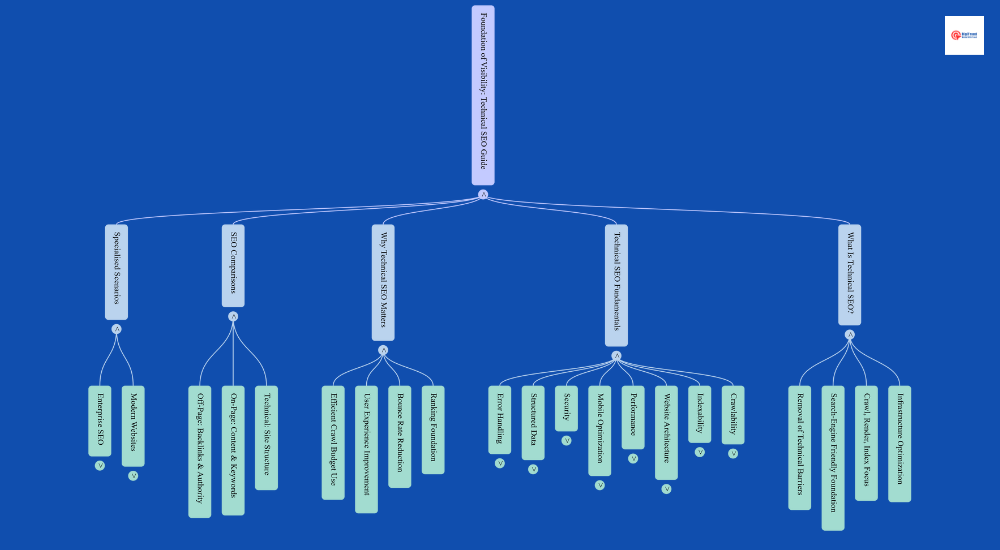
Mind-map For Technical SEO Guide
What Is Technical SEO?
To understand SEO as a whole, it’s important to start with a simple question: what is technical SEO?
Technical SEO refers to the process of optimizing a website’s infrastructure so search engines can easily crawl, render, understand, and index its pages. Unlike on-page SEO, which focuses on content and keywords, or off-page SEO, which focuses on links and authority, technical SEO deals with how your website is built and delivered.
In simpler terms, technical SEO ensures that:
- Search engine bots can access your site
- Important pages are discoverable and indexable
- Your site loads fast and works well on all devices
- Content is structured in a way search engines can understand
If search engines struggle to access your website, even the best content may never appear in search results.
Technical SEO Meaning Explained Simply
The technical SEO meaning can be summed up as “making your website search-engine friendly from the inside out.” It’s not about writing better blog posts or earning backlinks. It’s about removing technical barriers that prevent search engines from doing their job.
Think of technical SEO as building roads, signs, and clear entrances for search engines. Without those, search engines may get lost, skip important pages, or misinterpret your content.
At DigiTrend Marketing Solutions, we often describe technical SEO as the silent growth driver. You don’t always see it immediately, but without it, long-term SEO success becomes very difficult.
Why Technical SEO Matters
Search engines today are smarter, faster, and far more user-focused than ever before. Google and other search engines evaluate websites not only on content relevance, but also on how efficiently that content can be accessed, rendered, and experienced. This makes technical SEO a core ranking foundation.
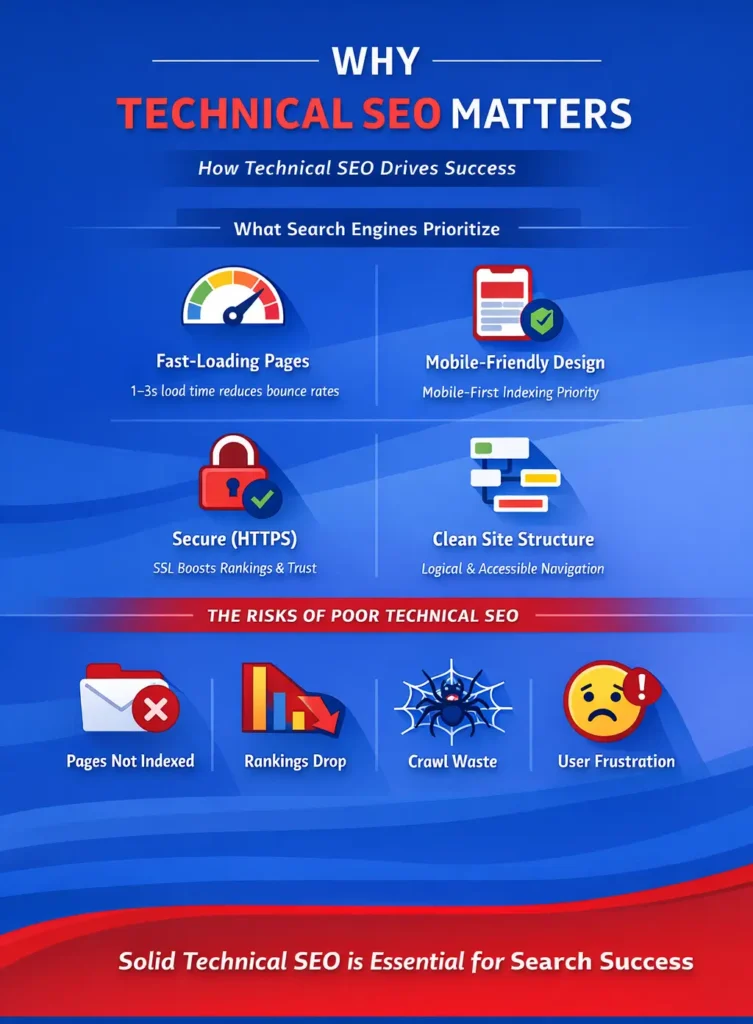
Modern search engines consistently prioritize websites that offer:
- Fast-loading pages
Google data shows that as page load time increases from 1 to 3 seconds, bounce rates can rise by more than 30%. Technical SEO improves speed through optimized images, efficient code, caching, and better server performance. - Mobile-friendly experiences
With mobile-first indexing, Google primarily uses the mobile version of a site for ranking and indexing. Technical SEO ensures responsive design, proper viewport settings, and consistent content across devices. - Secure browsing (HTTPS)
HTTPS is a confirmed ranking signal and a trust factor for users. Browsers now flag non-secure sites, which can reduce engagement and conversions. Technical SEO ensures correct SSL implementation and prevents security-related errors. - Clean site structure and accessibility
Clear website architecture helps search engines crawl pages efficiently and understand content relationships. Strong internal linking and logical hierarchies improve both crawl efficiency and user navigation.
When technical SEO is weak, websites often face serious performance issues, such as:
- Pages failing to get indexed
- Rankings stagnating or gradually declining
- Crawl budget being wasted on low-value or duplicate URLs
- Poor user experience leading to higher bounce rates
Even with advances in AI-driven search, systems still rely on clean HTML, structured data, and accessible content to interpret and surface information correctly. Technical SEO removes friction for both search engines and users.
In simple terms, technical SEO is the infrastructure behind visibility. Without it, content and links cannot perform at their full potential, making long-term organic growth difficult to achieve
Technical SEO Fundamentals
Let’s break down the technical SEO fundamentals every website should focus on.
1. Crawlability
Crawlability determines whether search engine bots can access your pages. If bots can’t crawl your site, they can’t index it.
Key elements affecting crawlability include:
- Robots.txt configuration
- Internal linking
- Server response codes
- Crawl depth
A well-structured site makes it easy for bots to move from one page to another without unnecessary barriers.
2. Indexability
Just because a page is crawlable doesn’t mean it will be indexed. Indexability refers to whether a page is eligible to appear in search results.
Common factors that affect indexability:
- Noindex tags
- Canonical tags
- Duplicate content
- Thin or low-value pages
Technical SEO ensures that your most important pages are indexed correctly while preventing low-value pages from wasting crawl budget.
3. Website Architecture
Website structure plays a major role in how search engines understand your site. A clean architecture:
- Improves crawl efficiency
- Distributes link equity properly
- Helps users find information easily
Best practices include:
- Logical hierarchy
- Clear category structure
- Minimal clicks to reach important pages
Good architecture benefits both search engines and users.
4. Page Speed and Performance
Speed is a confirmed ranking factor and a critical user experience signal. Slow websites lead to higher bounce rates and lower engagement.
Technical SEO focuses on:
- Optimizing images
- Reducing server response time
- Leveraging browser caching
- Minimizing render-blocking resources
Fast-loading pages improve crawl efficiency and user satisfaction.
5. Mobile Optimization
Search engines primarily use mobile versions of websites for indexing and ranking. This makes mobile optimization a core technical SEO requirement.
Key mobile considerations include:
- Responsive design
- Consistent content across devices
- Mobile usability
- Fast mobile load times
A strong mobile experience is no longer optional.
6. HTTPS and Website Security
Security builds trust for users and search engines. HTTPS is a lightweight ranking signal and a baseline requirement for modern websites.
Technical SEO ensures:
- SSL certificates are properly installed
- No mixed-content issues exist
- Secure URLs are consistently used
7. Structured Data and Schema Markup
Structured data helps search engines understand your content contextually. Schema markup can enhance visibility through rich results.
Common schema types include:
- Organization
- Product
- FAQ
- Article
- Local business
While schema doesn’t guarantee rankings, it improves clarity and eligibility for enhanced search features.
8. Duplicate Content and Canonicalization
Duplicate content can confuse search engines and dilute ranking signals. Canonical tags tell search engines which version of a page is the primary one.
Technical SEO ensures:
- Proper canonical usage
- Clean URL parameters
- Controlled pagination
This helps consolidate authority and avoid index bloat.
9. Error Handling and Redirects
Broken pages and incorrect redirects harm both user experience and SEO performance.
Best practices include:
- Fixing 404 errors
- Using 301 redirects correctly
- Avoiding redirect chains
Clean error handling keeps crawl paths efficient.
What Is Included in Technical SEO?
Many businesses ask, what is included in technical SEO? Based on industry standards and our experience at DigiTrend Marketing Solutions, technical SEO typically includes:
- Crawl and index analysis
- XML sitemap optimization
- Robots.txt review
- Website architecture improvements
- Page speed optimization
- Mobile usability checks
- HTTPS and security audits
- Structured data implementation
- Duplicate content management
- JavaScript rendering analysis
Technical SEO is not a one-time task. It requires ongoing monitoring and refinement as websites grow and algorithms evolve.
Technical SEO vs. Other SEO Types
| Aspect | Technical SEO | On-Page SEO | Off-Page SEO |
| Focus | Site structure, crawl, performance | Content quality, keywords | Backlinks, external signals |
| Goal | Enable indexing & ranking > foundation | Improve relevance | Build authority |
| Example | XML sitemap, site speed | Title tags, content depth | Link outreach |
Technical SEO Guide for Modern Websites
A modern technical SEO guide must account for dynamic websites, JavaScript frameworks, and large-scale content systems.
Search engines can render JavaScript, but rendering takes time and resources. Poorly implemented JavaScript can delay indexing or hide content from bots.
Technical SEO best practices for modern sites include:
- Server-side or hybrid rendering
- Clean HTML output
- Avoiding unnecessary scripts
- Ensuring critical content loads early
At DigiTrend Marketing Solutions, we often see major improvements simply by aligning technical setup with how search engines actually process pages.
Enterprise Technical SEO
Enterprise technical SEO focuses on large, complex websites with thousands or millions of URLs. These sites face unique challenges, including:
- Crawl budget limitations
- Large-scale duplicate content
- Complex site architectures
- Frequent content updates
- Multiple stakeholders and systems
Enterprise technical SEO requires:
- Scalable solutions
- Automation
- Strong governance
- Regular technical audits
Small technical issues at the enterprise level can impact thousands of pages, making precision and planning critical.
How Technical SEO Supports Long-Term Growth
Technical SEO is not about quick wins. It’s about building a stable platform for:
- Content marketing
- Link building
- Conversion optimization
- AI-driven search visibility
When technical SEO is done right, every other SEO effort becomes more effective. When it’s ignored, growth becomes unpredictable.
Final Thoughts from DigiTrend Marketing Solutions
Technical SEO is the backbone of search visibility. Understanding what is technical SEO, mastering the technical SEO fundamentals, and implementing a structured technical SEO guide can dramatically improve your organic performance.
Whether you’re managing a small business website or an enterprise-level platform, technical SEO creates the clarity search engines need to reward your content.
At DigiTrend Marketing Solutions, we believe that sustainable SEO success starts with a technically sound foundation. Get that right, and everything else scales faster and stronger.