
What Is Off-Page SEO? Link Building, Brand Mentions, and Authority Explained

So, your technical seo is top-notch, keyword research is on-point and content too is high in quality. But still not seeing traction in organic growth? Well let me break the news for you, you are missing a key element of the puzzle, Backlinks.
Search engines don’t rank websites based on content alone. They rank brands, reputation, and authority. You can publish the best-written page on the internet, but without external validation, Google has little reason to trust it.
That external validation is off-page SEO.
In this guide, we’ll break down what off-page SEO is, how link building works in search engine optimization, why brand mentions matter, and how authority is built beyond your website. This guide is written for business owners, marketers, and SEO professionals who want clarity, not jargon-heavy theory.
What Is Off-Page SEO?
Off-page SEO refers to all optimization activities that happen outside your website to improve its visibility, trust, and rankings in search engines.
Unlike on-page SEO (content, keywords, internal links) or technical SEO (site speed, indexing, schema), off-page SEO focuses on how the rest of the internet perceives your brand.
Off-page SEO signals include:
- Backlinks from other websites
- Brand mentions (linked or unlinked)
- Digital PR coverage
- Reviews and citations
- Social amplification
- Influencer references
Search engines treat these signals as votes of confidence.
According to industry research, backlinks remain among the top three Google ranking factors, alongside content quality and search intent alignment.
Why Off-Page SEO Matters
Google’s algorithms are designed to answer one question:
“Which result should users trust the most?”
Off-page SEO helps answer that question.
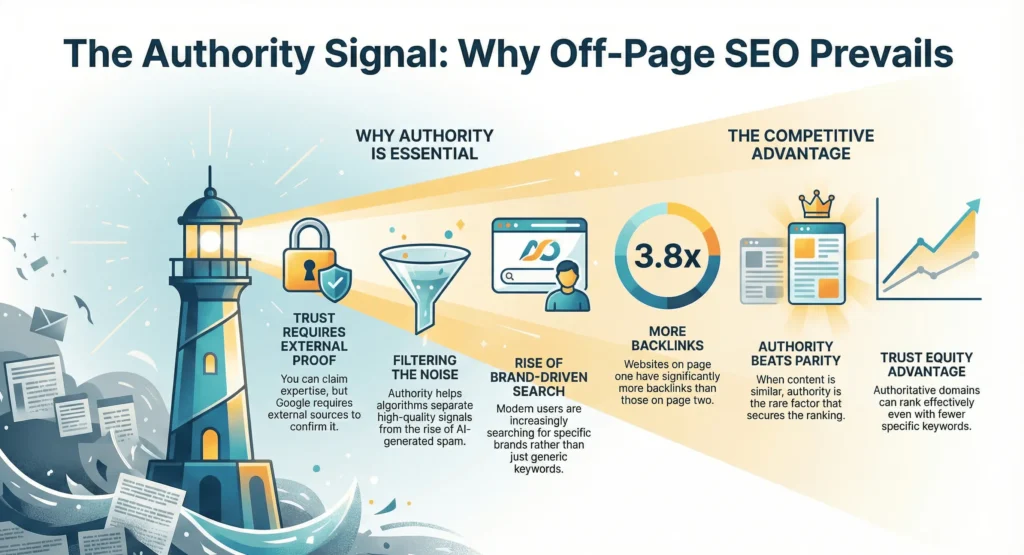
Key reasons off-page SEO is critical:
- Trust signals are external – You can claim expertise, but others must confirm it.
- Competitive SERPs demand authority – Content parity is common; authority is rare.
- AI-generated content increases noise – Authority helps Google separate signal from spam.
- Brand-driven search is rising – Users search brands, not just keywords.
Data insight:
- Websites ranking on page one have 3.8x more backlinks on average than those ranking on page two.
- Authoritative domains can rank with fewer keywords due to trust equity.
What Is Link Building in Search Engine Optimization?
Link building is the process of acquiring hyperlinks from external websites that point back to your website.
These links act as authority endorsements. Each quality link signals to search engines that your content is credible and valuable.
In simple terms:
- A link = a vote
- A relevant link = a strong vote
- A trusted link = a decisive vote
When people ask what is SEO link building, the most accurate answer is:
It’s the process of earning trust through third-party validation.
Why Backlinks Are Still So Powerful (With Data)
The search engines have evolved, but how they decide whether to trust someone or not has not changed so much. Backlinks remain one of the clearest indicators that a website is credible, relevant, and worth ranking, because they represent real-world validation from other websites.
While content quality, user experience, and intent matching are of the essence, data will always point to the same fact: pages without strong signals from backlinks can’t get visibility. Numbers below emphasize why backlinks continue to be a decisive factor in modern SEO.
Here’s what current data shows:
- Websites with strong backlink profiles rank up to 58% faster
- 91% of all pages on the internet receive zero organic traffic, primarily due to lack of backlinks
- High-authority backlinks can increase rankings even with average content
- One contextual link from a trusted site can outperform 50 low-quality links
How Search Engines Evaluate Links
Not all backlinks pass the same value. Search engines analyze where a link comes from, how it’s placed, and why it exists to determine how much trust and authority it should pass.
Google evaluates links using multiple factors:
1. Relevance
Links from websites that operate within the same industry or topical niche carry significantly more SEO value. When a construction website links to another construction-related page, the connection reinforces topical authority.
Search engines look at content themes, surrounding text, and overall site focus to understand relevance. A relevant link signals that your content is a trusted resource within its subject area, not just a random mention.
2. Authority
Authority refers to the overall credibility and trustworthiness of the linking domain. A backlink from a well-established, high-authority publication can influence rankings more than dozens of links from low-quality sites.
Search engines evaluate authority using signals like link history, brand trust, editorial standards, and domain reputation. This is why a single authoritative link can dramatically improve visibility, even for competitive keywords.
3. Anchor Context
Anchor text helps search engines understand what the linked page is about, but it must appear natural. Contextual anchors that flow naturally within a sentence are far more effective than keyword-stuffed or repetitive anchors.
Over-optimized anchor text patterns can trigger spam signals, while descriptive, varied anchors reinforce relevance safely. Search engines now prioritize context around the link, not just the anchor text itself.
Off-Page SEO vs On-Page SEO (Quick Comparison)
| Factor | On-Page SEO | Off-Page SEO |
| Control | Full | Partial |
| Location | On your website | External websites |
| Examples | Content, headings, keywords | Backlinks, brand mentions |
| Speed | Faster impact | Long-term impact |
| Trust Signal | Moderate | High |
You need both, but off-page SEO is the trust layer.
Types of Backlinks in Off-Page SEO
Understanding link types helps avoid common mistakes.
1. Natural Editorial Links
- Earned organically
- No outreach required
- Highest trust value
Example: A blog referencing your guide as a source.
2. Manual Outreach Links
- Acquired through relationship-building
- Guest posts
- Digital PR
- Resource link placements
This is the most scalable and safest approach.
3. Self-Created Links (Use Caution)
- Profiles
- Forums
- Directories
These offer minimal SEO value and can be risky if overused.
Core Off-Page SEO Link Building Techniques
Let’s explore proven off-page link building techniques that work today.
1. Editorial Guest Contributions
Publishing value-driven content on authoritative websites in your niche.
Best practices:
- Focus on insights, not promotion
- Target relevance over traffic
- Avoid mass guest posting networks
2. Digital PR Campaigns
Digital PR blends SEO with traditional public relations.
It focuses on:
- Pitching stories to journalists
- Contributing expert insights
- Newsworthy campaigns
- HARO-style journalist queries
Benefits:
- High-authority editorial links
- Brand mentions
- Referral traffic
- Trust signals beyond SEO
3. HARO & Journalist Outreach
Responding to journalist queries to earn:
- Editorial links
- Brand citations
- Authority mentions
Success rates improve when responses are:
- Concise
- Data-backed
- Non-promotional
4. Link Reclamation
One of the easiest wins in off-page SEO.
This involves:
- Finding broken backlinks pointing to your site
- Reclaiming lost mentions without links
- Fixing outdated URLs
Brands often lose 10–20% of links annually due to site changes. Reclaiming them restores authority fast.
5. Resource Link Building
Creating:
- Ultimate guides
- Tools
- Research assets
Then pitching them as references.
6. Competitor Backlink Analysis
Your competitors already show you what works.
By analyzing:
- Where competitors earn links
- Which pages attract backlinks
- What content formats perform best
You can reverse-engineer winning strategies, without guessing.
Brand Mentions: The Silent Ranking Factor
Links aren’t the only off-page signal.
Brand mentions, even without links, are increasingly important.
Search engines analyze:
- How often your brand is mentioned
- Where it’s mentioned
- Sentiment of mentions
- Context and relevance
Studies show:
- Brands with strong mention signals rank more consistently
- Unlinked mentions still contribute to entity authority
- Google recognizes brand authority beyond backlinks
This is why PR, social buzz, and reputation management matter.
Common Off-Page SEO Mistakes to Avoid
Many businesses sabotage results unintentionally.
Avoid these mistakes:
- Buying low-quality links
- Using private blog networks (PBNs)
- Over-optimizing anchor text
- Ignoring brand mentions
- Chasing quantity over relevance
- Treating link building as a one-time task
Off-page SEO is a long-term investment, not a quick fix.
How Off-Page SEO Supports E-E-A-T
Google evaluates content using Experience, Expertise, Authoritativeness, and Trustworthiness (E-E-A-T).
Off-page SEO directly impacts:
- Authoritativeness through backlinks
- Trust through brand mentions
- Expertise through thought leadership links
- Experience through recognition by industry peers
If trusted sources vouch for you, search engines listen.
KPIs For Off-page SEO
Key metrics to track:
- Referring domains
- Link quality (not just count)
- Brand mentions
- Organic traffic growth
- Keyword ranking improvements
- Referral traffic
- Link velocity (growth over time)
Remember: off-page SEO compounds. Results grow exponentially when done right.
The Future of Off-Page SEO
Off-page SEO is evolving.
Trends shaping the future:
- Entity-based SEO over keyword-based SEO
- Brand authority outweighing raw backlinks
- AI prioritizing trust signals
- Digital PR replacing manual outreach
- Fewer links, higher impact
The question is no longer how many links you have, but who vouches for you.
Final Thoughts: Off-Page SEO Is About Trust
So, what is off-page SEO really about?
It’s not just link building.
It’s not just mentions.
It’s not just authority metrics.
It’s about earning trust and scale it.
When the internet consistently references your brand, search engines respond with visibility.
At DigiTrend Marketing Solutions, we believe off-page SEO should:
- Be ethical
- Be strategic
- Be user-first
- Be sustainable
Build trust first, rankings will follow.
FAQs
What does “off-page” mean?
“Off-page” simply refers to everything that happens outside your website that affects how search engines view your brand. While you can fully control your content and pages, you don’t control what others say about you—and that’s exactly why off-page SEO matters. It includes backlinks, brand mentions, reviews, and online references that help search engines decide whether your site is trustworthy and authoritative.
What is an example of off-site SEO?
A common example of off-site SEO is earning a backlink from a reputable website in your industry. For instance, if a marketing publication mentions your brand and links to your guide as a trusted resource, that link tells search engines your content is valuable. Other examples include digital PR coverage, unlinked brand mentions, influencer references, and positive reviews on trusted platforms.
What is the difference between on-site and off-site SEO?
On-site SEO focuses on optimizing your own website, such as content quality, keyword usage, internal links, page structure, and user experience. Off-site SEO focuses on how the rest of the internet responds to your website, including backlinks, brand mentions, and authority signals.
Think of it this way: on-site SEO is what you say about yourself, while off-site SEO is what others say about you, and search engines trust the latter more.
What are common off-page SEO mistakes?
One of the biggest mistakes is chasing links purely for quantity instead of relevance and quality. Other common issues include using over-optimized anchor text, relying on low-quality directories, ignoring brand mentions that could be turned into links, and treating link building as a one-time task. Off-page SEO works best when it’s consistent, natural, and focused on building real authority, not shortcuts.

