
What Is Conversion Rate Optimization? How To Get Started
Traffic is important, but traffic alone doesn’t grow revenue. The real question is: what happens after someone lands on your website? That’s where conversion rate optimization becomes critical.
If your site attracts 10,000 visitors per month but converts at the industry average of just 2.9% (according to data cited by HubSpot), most of your potential revenue is slipping away. Yet top-performing landing pages can convert at 20% or higher, proving the opportunity is real.
So, what is conversion rate optimization and why does it matter? CRO is the structured process of improving the percentage of users who take a desired action, whether that’s booking a call, requesting a demo, or making a purchase. More importantly, it’s about aligning intent, improving clarity, and eliminating friction.
Understanding what is CRO means recognizing that growth isn’t just about more traffic, it’s about converting the traffic you already have more effectively.
What Is Conversion Rate Optimization?
If you’ve ever asked, what is conversion rate optimization, here’s the clear definition:
Conversion Rate Optimization (CRO) is the systematic process of increasing the percentage of website visitors who complete a desired action.
That action could be:
- Making a purchase
- Submitting a lead form
- Booking a consultation
- Signing up for a demo
- Downloading a guide
The Conversion Rate Formula
The formula is simple:
ConversionRate = TotalVisitors/Conversions×100
If 1,000 visitors land on your page and 30 complete a purchase, your conversion rate is 3%.
But CRO is not about random design tweaks.
According to Optimizely, conversion rate optimization is a structured experimentation discipline. It relies on hypothesis testing, A/B testing, statistical validation, and continuous iteration.
Meanwhile, HubSpot frames CRO as a growth strategy that improves key pages, landing pages, homepages, pricing pages, blog CTAs, to increase business outcomes.
And from an SEO perspective, Moz emphasizes that traffic without conversion is incomplete performance marketing. Conversion rate optimization SEO ensures that ranking pages are also revenue-driving pages.
What Is CRO Really About?
When marketers first hear the term conversion rate optimization, many assume it’s about minor visual tweaks, changing button colors, adjusting layouts, or testing different headline variations. While those elements can be part of the process, they barely scratch the surface of what CRO truly represents. Conversion rate optimization is not about cosmetic improvements; it’s about understanding human behavior. It’s about analyzing how real people interact with your website, identifying where they hesitate, what causes confusion, and what ultimately influences them to take action.
At its core, CRO is about:
- Understanding user behavior
- Reducing friction
- Increasing clarity
- Building trust
- Aligning intent with experience
At its core, CRO answers one powerful question: why are users not converting, and how do we fix it? That question shifts the mindset from chasing more traffic to maximizing the value of the traffic you already have. Instead of relying on assumptions, CRO uses data, testing, and structured experimentation to create better user experiences and stronger business results.
When done correctly, conversion rate optimization transforms your website from a passive digital presence into an intentional growth engine. It replaces guesswork with measurable improvements. It replaces confusion with clarity. And most importantly, it helps users make confident decisions, which is ultimately what drives sustainable revenue and long-term growth.
Why Conversion Rate Optimization Is Important
Let’s address the strategic question: why conversion rate optimization is important?
Because traffic is expensive, and getting more expensive.
Whether you’re investing in SEO, paid media, or content marketing, the cost of acquiring visitors continues to rise. AI search results and zero-click experiences further compress organic opportunities.
Improving conversions protects profitability.
1. It Multiplies Revenue Without Increasing Traffic
If your site receives 50,000 monthly visitors at a 2% conversion rate, that’s 1,000 conversions.
Improve the rate to 4%, without adding traffic, and you double results to 2,000 conversions.
No additional ad spend.
No additional SEO investment.
Just better performance.
2. It Lowers Customer Acquisition Cost (CAC)
Higher conversion rates reduce cost per acquisition automatically.
For example:
- $10,000 ad spend
- 500 conversions → $20 CPA
- 1,000 conversions → $10 CPA
That’s the power of optimization.
3. It Increases ROI Across Channels
CRO amplifies:
- SEO
- PPC
- Email marketing
- Social campaigns
It turns traffic generation into revenue generation.
4. It Improves User Experience
When you optimize conversions, you:
- Remove unnecessary friction
- Clarify messaging
- Improve navigation
- Simplify decision-making
The result is a better user experience, which benefits SEO and brand trust.
Conversion Rate Optimization Statistics You Need to Know
Let’s ground this discussion in real data.
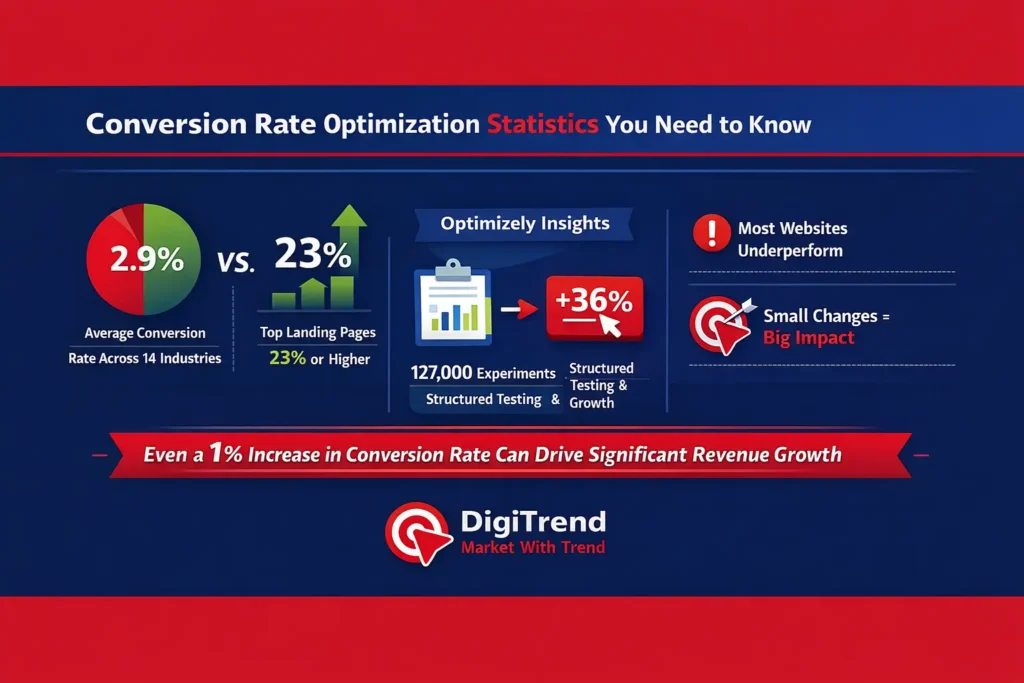
According to HubSpot, citing Ruler Analytics:
- The average conversion rate across 14 industries is 2.9%
- Top-performing landing pages can reach 23% or higher
That gap is enormous.
It shows that most websites are operating far below potential.
Additional insights highlighted in CRO discussions from Optimizely include:
- Structured experimentation across 127,000 experiments revealed measurable performance lifts when companies focused on overlooked optimization opportunities.
- A simple CTA adjustment in one case improved logins by 36%, resulting in measurable revenue impact.
These conversion rate optimization statistics reveal two truths:
- Most websites underperform.
- Small improvements create disproportionate gains.
Even a 1% lift in conversion rate can significantly increase revenue at scale.
The Psychology Behind Conversion Optimization
CRO works because human decision-making is predictable.
Visitors hesitate due to:
- Uncertainty
- Cognitive overload
- Lack of trust
- Poor clarity
- Friction
Effective conversion optimization techniques address those barriers.
For example:
- Reducing form fields reduces cognitive load.
- Adding testimonials increases trust.
- Clear value propositions reduce uncertainty.
- Simplified layouts reduce distraction.
CRO blends data with psychology.
The Conversion Optimization Process (Structured Approach)
Let’s break down the professional conversion optimization process used by high-performing companies.
Step 1: Research & Data Collection
You cannot optimize blindly.
Collect:
- Traffic data
- Funnel drop-off points
- Heatmaps
- Scroll maps
- Session recordings
Identify:
- High-traffic, low-converting pages
- Exit-heavy pages
- Form abandonment areas
Step 2: Qualitative Research
Data tells you what is happening.
User research tells you why.
Use:
- Customer surveys
- Exit-intent feedback
- User interviews
- Usability tests
Ask users directly:
- What almost stopped you from converting?
- What information was missing?
Step 3: Hypothesis Development
Every test needs a structured hypothesis:
“If we simplify the pricing page layout, conversions will increase because clarity reduces friction.”
This moves CRO from guesswork to experimentation.
Step 4: A/B or Multivariate Testing
Test changes against control:
- Headlines
- CTA placement
- CTA copy
- Layout structure
- Social proof positioning
- Page length
Platforms like Optimizely are built around this experimentation discipline.
Step 5: Statistical Analysis
Winning variations must reach statistical significance before implementation.
Without this, you risk acting on noise.
Step 6: Implementation & Iteration
CRO is ongoing.
Optimization is never finished, it evolves with user behavior and market conditions.
Conversion Optimization Techniques That Drive Real Results
Here are practical conversion optimization techniques supported by experimentation data and industry best practices.
1. Clarify Your Value Proposition
Visitors should understand:
- What you offer
- Who it’s for
- Why it’s better
- What happens next
Confusion kills conversions.
2. Optimize CTAs
Instead of generic:
“Submit”
Use action-driven language:
- “Start My Free Trial”
- “Get My Strategy Call”
- “Download the Guide”
3. Reduce Friction in Forms
Shorter forms typically convert better.
Every additional field adds hesitation.
4. Add Social Proof
Testimonials, reviews, case studies, and client logos build trust quickly.
5. Improve Page Speed
Slow-loading pages increase bounce rates and reduce conversion potential.
6. Prioritize Mobile Optimization
Mobile traffic dominates many industries.
Your mobile experience must be frictionless.
Conclusion: Conversion Rate Optimization Is Where Growth Becomes Measurable
Conversion rate optimization isn’t just a tactic, it’s a growth advantage. At DigiTrend Marketing Solutions, we believe traffic without conversion is wasted potential. CRO helps you turn existing visitors into measurable revenue by improving clarity, reducing friction, and aligning user intent with experience.
It replaces guesswork with data and transforms your website into a performance-driven asset. When you optimize strategically, even small lifts compound into meaningful business growth. That’s how we help brands move beyond vanity metrics and build scalable, conversion-focused digital ecosystems.
FAQs
How to optimize conversion rate?
To optimise conversion rate, start by analyzing user behavior through analytics, heatmaps, and funnel reports to identify drop-off points. Next, gather qualitative insights using surveys or user testing to understand friction. Build clear hypotheses, then run A/B tests on high-impact elements such as headlines, CTAs, forms, and pricing pages. Focus on reducing friction, improving clarity, strengthening trust signals, and aligning messaging with user intent. Conversion rate optimization is a continuous process, test, measure, implement, and iterate. Even small improvements compound over time into significant revenue gains.
What is the difference between SEO and CRO?
SEO (Search Engine Optimization) focuses on increasing website visibility and driving traffic from search engines. CRO (Conversion Rate Optimization) focuses on converting that traffic into leads, customers, or sales. SEO answers the question, “How do we get more visitors?” CRO answers, “How do we get more value from the visitors we already have?” While SEO improves rankings and impressions, CRO improves revenue per visitor. Together, they create a complete growth strategy, traffic plus performance.
What are the 6 primary elements of conversion rate optimization?
The six primary elements of conversion rate optimization are:
Value Proposition – Clear communication of benefits and differentiation.
User Experience (UX) – Easy navigation, mobile responsiveness, and fast load speed.
Trust & Credibility – Testimonials, reviews, guarantees, and security signals.
Call-to-Action (CTA) – Clear, compelling, and action-oriented prompts.
Friction Reduction – Simplified forms, streamlined checkout, minimal distractions.
Data & Testing Framework – Continuous A/B testing and performance measurement.
Each element works together to remove hesitation and guide users toward conversion.
What are the 7 stages of conversion?
The 7 stages of conversion typically follow the buyer journey:
Awareness – The user becomes aware of a problem or need.
Interest – They begin researching solutions.
Consideration – They compare options and evaluate alternatives.
Intent – They show signals of purchase readiness (e.g., demo requests, pricing views).
Evaluation – They review details, testimonials, and proof points.
Decision (Conversion) – They complete the desired action.
Retention & Advocacy – Post-conversion engagement leading to repeat business or referrals.

