
Local SEO Plan for Service Businesses in 2026

A Comprehensive Local SEO Plan for Service Businesses By DigiTrend Marketing Solutions.
So, you are running a local service business in 2026, however, you are not visible on google local maps and you are confused what is happening, why google is ignoring you.
Let me break it down for you. So, whether someone needs a plumber, a dentist, a roofing contractor, or a home cleaning service, the journey almost always starts with a search like:
- “best service near me”
- “emergency repair in [city]”
- “local company reviews”
Google is constantly working on local search and thus it has evolved dramatically over the past few years. Algorithm shifts, relevance, proximity, and behavioral ranking signals are reshaping how Google decides which businesses appear at the top. Because of these changes, the old approach to local SEO , setting up a Google Business Profile once and hoping for results, simply does not work anymore.
Service businesses now need a structured, strategic, and data-driven Local SEO Plan for Service Businesses that combines:
- Visibility optimization
- Trust signals
- Conversion performance
- Operational efficiency
- Consistent execution
According to industry observations shared by Search Engine Land, local search continues to be one of the most reliable lead sources for service companies, but success now depends heavily on structured execution rather than isolated tactics. A sprint-based approach with defined priorities is increasingly recommended for sustainable growth. At the same time, broader industry research highlights that mobile devices dominate search behavior, with more than 80% of users relying on smartphones to find businesses and services. This shift reinforces the importance of local optimization for visibility and conversions.
In this comprehensive guide, you will learn:
- A complete local SEO strategy roadmap
- How to perform a local SEO audit
- The role of NAP consistency in rankings
- How to build a local SEO content strategy
- How to conduct a local SEO citation audit
- Key local SEO questions for business owners
- A step-by-step execution framework for 2026
This guide is designed to serve as a pillar resource you can reference throughout the year.
The State of Local SEO in 2026
Local SEO is no longer just about ranking in the map pack. It has evolved into a multi-layer ecosystem where search engines evaluate multiple factors that reflect both online presence and real-world credibility, including:
- Business credibility
- Customer engagement
- Behavioral signals
- Content relevance
- Proximity
- Reputation
- Operational reliability
Shortcuts such as fake addresses, keyword-stuffed business names, and purchased reviews are increasingly risky due to algorithm updates targeting spam and manipulation. Businesses that rely on authentic signals and consistent execution are seeing stronger long-term performance. Another major change is the role of AI-driven search systems, where modern algorithms analyze intent more deeply than before and prioritize businesses that demonstrate expertise, trustworthiness, and user satisfaction. As a result, local SEO is becoming closer to brand building than traditional technical optimization.
Why Local SEO Is Critical for Service Businesses
Service businesses depend heavily on geographic demand. Unlike eCommerce brands that can sell globally, most service providers operate within defined service areas, which makes local search visibility directly connected to revenue.
Several industry patterns confirm this:
- Consumers frequently search online before contacting local businesses.
- Reviews significantly influence decision-making.
- Mobile searches often result in immediate actions such as calls or visits.
- High-intent local searches convert at higher rates than general searches.
Improved local visibility typically leads to:
- Higher website traffic
- More customer inquiries
- Increased trust
- Better conversion rates
When someone searches for a service provider locally, they usually already have purchase intent. Searches like:
- “Emergency plumber near me”
- “Best dentist in Chicago”
- “Roof repair company nearby”
indicate immediate need, and businesses that appear prominently during these moments capture demand more effectively.
The New Reality: Visibility Alone Is Not Enough
One of the most important insights from recent local SEO research is that rankings alone do not guarantee results. Search engines increasingly analyze user behavior after a listing appears, including whether users click your listing, call your business, request directions, stay on your website, or complete actions.
If users engage positively, rankings often improve over time. If users abandon quickly, visibility can decline. This creates a feedback loop where better user experience leads to stronger engagement, which then contributes to improved rankings and more leads. Operational factors , such as answering phone calls promptly or offering easy booking options , can indirectly influence performance because they affect customer satisfaction and engagement signals. This represents a major shift from traditional SEO thinking and highlights the growing connection between marketing performance and operational efficiency.
Core Components of a Modern Local SEO Plan
A successful Local SEO Plan for Service Businesses in 2026 includes five major pillars:
- Technical foundation
- NAP consistency and citations
- Content and relevance signals
- Reputation and reviews
- Behavioral and conversion optimization
Each component supports the others. For example:
- Accurate citations improve trust.
- Reviews improve click-through rates.
- Content improves relevance.
- Good user experience improves engagement.
Together, they create a strong local presence.
Understanding Local SEO Strategy NAP
NAP stands for:
- Name
- Address
- Phone number
NAP consistency remains one of the foundational elements of local SEO. Search engines use business listings across directories to verify legitimacy, and inconsistent information across platforms can create confusion and reduce trust signals. Common issues include:
- Different phone numbers
- Slightly different business names
- Old addresses
- Duplicate listings
A strong local SEO strategy NAP approach ensures that your business information is:
- Accurate
- Consistent
- Updated everywhere
- Structured properly
This applies to platforms such as:
- Google Business Profile
- Yelp
- Facebook
- Bing Places
- Industry directories
- Local directories
Consistency reinforces credibility.
What Is a Local SEO Audit?
Before building a strategy, businesses need to understand their current position. A local SEO audit evaluates performance across multiple factors, including:
- Google Business Profile optimization
- Citation consistency
- Website technical health
- Local keyword rankings
- Review quantity and sentiment
- Competitor analysis
- Content relevance
- Backlink profile
- User experience
An audit identifies:
- Weaknesses
- Opportunities
- Competitive gaps
- Quick wins
Without an audit, businesses often waste resources on ineffective tactics.
Local SEO Questions for Business Owners
Many service business owners are unsure where to start. Important local SEO questions for business owners include:
- Is my business appearing in Google Maps?
- Are my reviews competitive compared to local competitors?
- Is my NAP information consistent everywhere?
- Do I have location-specific service pages?
- How often am I receiving new reviews?
- Are customers calling from search results?
- Is my website mobile-friendly?
- Do I rank for “near me” searches?
- Are competitors outranking me consistently?
These questions help clarify priorities and guide decision-making.
Google Business Profile Optimization Steps That Work in 2026
A smart approach to Google Business Profile optimization is not about quick tricks or stuffing keywords everywhere. Service businesses win locally when the basics are strong and consistent, which means improving:
- Relevance – matching what customers actually search for
- Authority – showing you’re established and credible
- Trust – earning real reviews and keeping information accurate
- User behavior – encouraging clicks and calls
- Conversion performance – turning visibility into real leads
Step 1: Google Business Profile Optimization (Your Primary Asset)
Your Google Business Profile (GBP) is the most influential local ranking factor for service businesses. It affects:
- Map pack rankings
- Calls
- Direction requests
- Website visits
- Customer trust
A fully optimized profile should include:
- Accurate business name
- Correct categories
- Service areas
- Business description
- High-quality photos
- Services list
- Products (if applicable)
- Updated hours
- Attributes
- Messaging enabled
- Regular posts
Research across the industry consistently shows that businesses with complete profiles receive significantly more engagement than incomplete listings. Customer reviews also directly influence click-through rates and credibility, as consumers tend to trust businesses with higher ratings and more recent feedback.
Step 2: Website Optimization and Local Relevance
Your website still plays a critical role in local SEO because search engines analyze it to confirm:
- Services offered
- Location relevance
- Authority
- Expertise
- User experience
Location-Focused Service Pages
Each core service should have its own page targeting:
- Service keyword
- Location keyword
- Customer intent
For example:
- HVAC Repair in Dallas
- Emergency Plumbing in Phoenix
- Dental Implants in Miami
These pages should include:
- Local references
- Testimonials
- Service details
- FAQs
- Structured data
- Calls to action
Location relevance improves rankings.
Step 3: Local SEO Content Strategy
A strong local SEO content strategy builds authority and relevance simultaneously. Content types that work well include:
- Service guides
- Location pages
- FAQs
- Problem-solution articles
- Case studies
- Local event or community content
- Educational resources
Content helps businesses rank beyond just the map pack and supports voice search and AI-driven queries, which are becoming more conversational. This means content should answer real customer questions, such as:
- How much does roof repair cost?
- When should I replace my HVAC system?
- What causes plumbing leaks?
Educational content builds trust before customers contact you.
Step 4: Reviews and Reputation Signals
Reviews are among the strongest local ranking signals and influence:
- Rankings
- Click-through rates
- Conversions
- Customer trust
Key factors include:
- Review quantity
- Review frequency
- Review sentiment
- Review responses
- Keywords within reviews
Businesses that consistently generate new reviews often outperform competitors with stagnant profiles. A practical strategy includes:
- Asking every satisfied customer
- Sending automated follow-ups
- Providing direct review links
- Responding professionally to all feedback
Search engines interpret review activity as a signal of business activity and credibility.
Step 5: Local SEO Citation Audit
A local SEO citation audit ensures your business information is consistent across the web. Citations include listings on:
- Directories
- Maps platforms
- Social media
- Industry sites
- Local business portals
Inconsistent information weakens trust signals. A citation audit should identify:
- Duplicate listings
- Incorrect phone numbers
- Outdated addresses
- Name variations
- Missing listings
Correcting citations strengthens local authority.
Step 6: Behavioral Signals and Conversion Optimization
One of the most important modern ranking factors is user behavior. Search engines evaluate how people interact with your business after seeing your listing, including:
- Click-through rate
- Call activity
- Direction requests
- Website engagement
- Time on site
- Bounce rate
- Booking completion
Operational efficiency, such as answering phone calls promptly, can influence performance because poor experiences reduce engagement signals. This highlights the reality that local SEO is partially influenced by customer experience, and improving conversions often improves rankings indirectly.
The 90-Day Local SEO Execution Plan
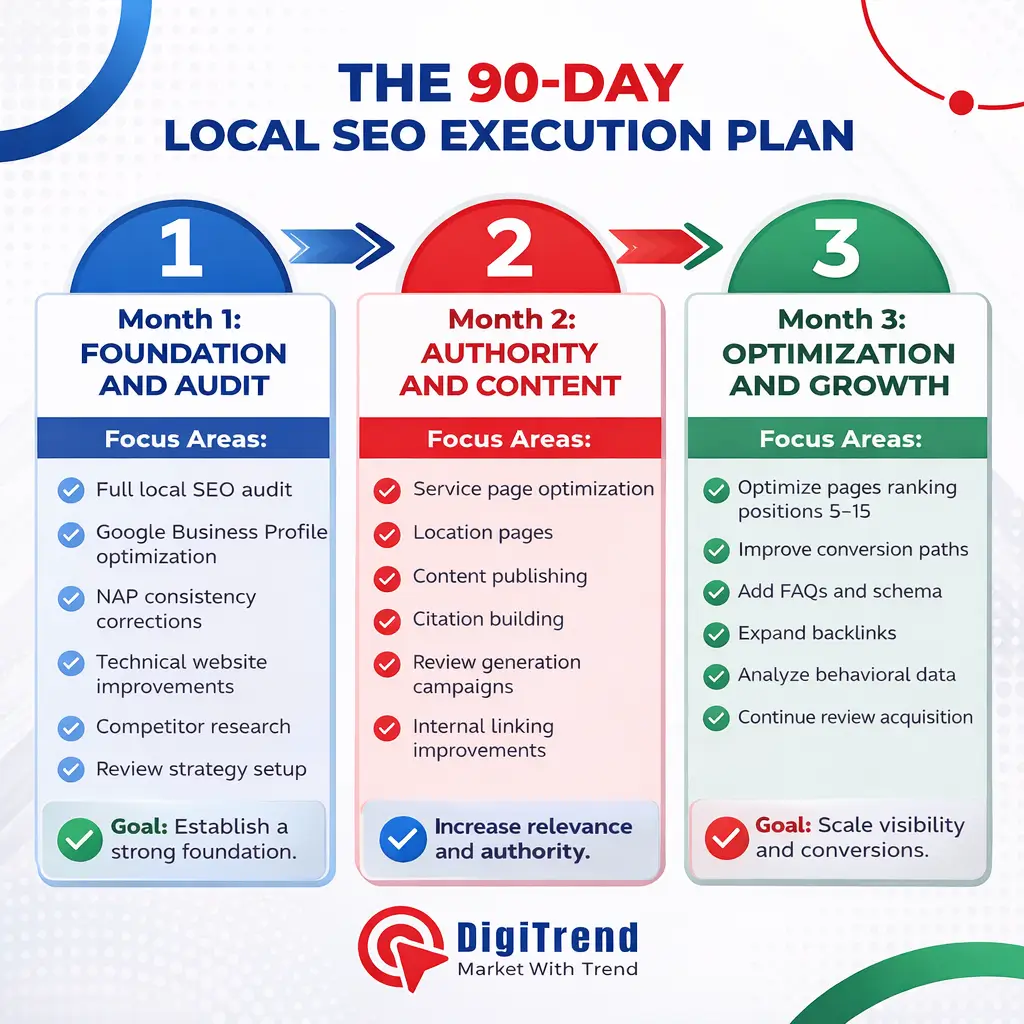
A structured timeline improves results significantly because it allows businesses to focus on the right priorities at the right time instead of trying to fix everything at once. Below is a practical 90-day framework inspired by industry sprint models that service businesses can realistically implement.
Month 1: Foundation and Audit
Focus areas:
- Full local SEO audit
- Google Business Profile optimization
- NAP consistency corrections
- Technical website improvements
- Competitor research
- Review strategy setup
Goal:
Establish a strong foundation.
The first month should focus on understanding the current position of the business and correcting any fundamental issues that may be limiting visibility. Many companies discover that inaccurate listings, incomplete profiles, or technical website problems are holding them back more than they realized. Fixing these issues early creates momentum for the rest of the strategy.
Month 2: Authority and Content
Focus areas:
- Service page optimization
- Location pages
- Content publishing
- Citation building
- Review generation campaigns
- Internal linking improvements
Goal:
Increase relevance and authority.
Once the foundation is stable, the next phase focuses on strengthening signals that demonstrate expertise and local relevance. Publishing useful content, optimizing service pages, and generating reviews help search engines understand both what the business offers and why customers trust it. Authority is not built overnight, but consistent activity during this stage begins to produce measurable improvements.
Month 3: Optimization and Growth
Focus areas:
- Optimize pages ranking positions 5–15
- Improve conversion paths
- Add FAQs and schema
- Expand backlinks
- Analyze behavioral data
- Continue review acquisition
Goal:
Scale visibility and conversions.
By the third month, businesses often start seeing ranking movement and engagement data that can be used to refine strategy. Optimizing pages that are already close to top positions typically produces faster results than creating entirely new content. Conversion improvements also become critical at this stage, because increased traffic only matters if it turns into leads.
Statistics That Show the Power of Local SEO
Local search behavior continues to grow rapidly, and multiple industry observations highlight how strongly it influences purchasing decisions. Some key insights include:
- A large percentage of consumers use mobile devices to find local businesses.
- Searches with local intent frequently lead to action within hours.
- Reviews significantly impact purchasing decisions.
- Businesses appearing in the top map results capture the majority of clicks.
Mobile usage dominance reinforces the importance of mobile-friendly websites, accurate listings, and easy contact options. These behavioral patterns confirm that local SEO directly influences revenue for service businesses, especially those operating in competitive markets.
Common Mistakes Service Businesses Make
Many companies struggle with local SEO because of avoidable mistakes that weaken trust signals or reduce engagement. Some of the most common issues include:
Inconsistent NAP Information
Conflicting business details confuse search engines and reduce credibility.
Ignoring Reviews
Lack of review activity reduces trust and ranking potential.
Thin Location Pages
Generic content without local relevance performs poorly in search results.
Poor Mobile Experience
Mobile usability directly affects conversions and engagement.
Slow Website Speed
Performance issues reduce user satisfaction and increase abandonment.
No Strategy or Tracking
Without measurement, improvement becomes difficult and inconsistent.
Avoiding these mistakes alone can create immediate advantages because many competitors continue to overlook them.
Advanced Local SEO Opportunities in 2026
Businesses that want competitive advantages should consider expanding beyond basic optimization into more advanced opportunities, including:
- Structured data markup
- AI-optimized content
- Voice search targeting
- Local backlinks from community organizations
- Reputation management systems
- Conversion rate optimization
- Customer experience improvements
Local SEO is becoming increasingly holistic, meaning success depends on how well marketing, technology, and customer experience work together.
How to Measure Success
Tracking performance is essential for long-term improvement. Key metrics include:
- Map pack rankings
- Website traffic
- Calls and leads
- Direction requests
- Conversion rate
- Review growth
- Keyword rankings
- Engagement metrics
Monitoring these indicators allows businesses to understand what is working, identify areas for improvement, and adjust strategies accordingly. Consistent measurement also helps demonstrate return on investment from local SEO efforts.
Final Thoughts: The Future of Local SEO
Local SEO in 2026 is no longer optional for service businesses. It has become one of the most powerful growth channels available because it connects businesses directly with customers who already have intent to purchase. Companies that invest in visibility, reputation, and customer experience position themselves for sustainable success over time.
The businesses that succeed are those that:
- Execute consistently
- Build trust signals
- Optimize customer experience
- Focus on real value
- Follow structured plans
A well-designed Local SEO Plan for Service Businesses creates compounding growth. As visibility improves and trust strengthens, lead generation becomes more predictable and scalable. Businesses that treat local SEO as a long-term investment rather than a short-term tactic are far more likely to dominate their markets.