
What Is Knowledge Graph Optimization? A Complete Beginner’s Guide
Knowledge Graph Optimization is the process of helping search engines understand your business, brand, products, and content as real-world entities instead of just keywords. This is achieved by using structured data, ensuring that business information is consistent, incorporating authoritative content, and relying on reliable online mentions in order to establish a clear digital identity that search engines can identify.
Search engines have moved on from simply matching keywords with a query; they now also attempt to determine who made the content, what the business or subject is about, and how it relates to other reliable entities on the web. This ability affects the way content appears in search results, in Google AI Overviews, and in other AI-driven search features.
In this guide, you will find out what Knowledge Graph Optimization is, how it functions, why it is becoming an important element of modern SEO, and the practical steps you can take to strengthen your online presence.
Table of Contents
What Is Knowledge Graph Optimization?
Knowledge Graph Optimization involves making it easier for search engines to understand who you are, what your business is about, and how it is related to other people, places, organizations, and topics on the internet. Rather than focusing on keywords alone, you focus on entities, real-world items that Google can recognize and link together.
An entity may be a person, a business, a product, a location, an event, or even a concept; for instance, ‘Nike’ is an entity, ‘New York City’ is an entity, and ‘Taylor Swift’ is an entity. Each of these has its own set of facts and relationships which enables Google to tell it apart from other names or topics that are similar.
Google uses entities because keywords alone can be unclear. A search for “Apple” may refer to the technology company or the fruit. By grasping entities and their context, Google can provide more precise and relevant search results.
This change has also led to the rise of Entity SEO, which focuses on creating a clear, trustworthy digital identity. When search engines understand your entity, they can more effectively link your content to relevant searches and establish your authority on the topic.
What Is Google’s Knowledge Graph?
Google’s Knowledge Graph is a massive database of real-world entities and the connections between them. Instead of storing only web pages, it organizes information about people, businesses, products, places, events, and concepts, helping Google understand what each entity is and how it relates to others.
Every entity has attributes (its characteristics) and relationships (how it connects to other entities). For example, Google understands that:
- Apple is a technology company.
- CEO: Tim Cook
- Product: iPhone
- Industry: Technology
Because these relationships are already established, Google can confidently answer questions like “Who is Apple’s CEO?” or “Who makes the iPhone?” without relying on exact keyword matches.
The Knowledge Graph helps Google understand the meaning behind a search, not just the words someone types. For example, if a user searches for “Apple stock,” Google knows they’re referring to the company, not the fruit. This ability to understand context allows Google to deliver more accurate search results, AI-generated answers, and rich search features. The better Google understands your business as an entity, the easier it is to connect your content with relevant searches.
Knowledge Graph Optimization vs. Traditional SEO
Traditional SEO and Knowledge Graph Optimization share the same goal, helping people find your content, but they do it in different ways. Traditional SEO focuses on optimizing individual pages and keywords, while Knowledge Graph Optimization helps search engines understand your business or brand as a recognized entity with clear connections across the web.
| Traditional SEO | Knowledge Graph Optimization |
| Focuses on keywords | Focuses on entities |
| Optimizes individual pages | Builds connected information across the web |
| Matches search intent | Understands entities and their relationships |
| Aims to improve rankings | Builds recognition, trust, and authority |
Today, successful SEO combines both approaches. Keywords still help search engines understand what a page is about, but entities provide the context needed to understand who created the content and how it relates to other trusted information. By optimizing for both keywords and entities, you improve your chances of ranking in traditional search results while strengthening your visibility in AI-powered search experiences.
How Does Knowledge Graph Optimization Work?
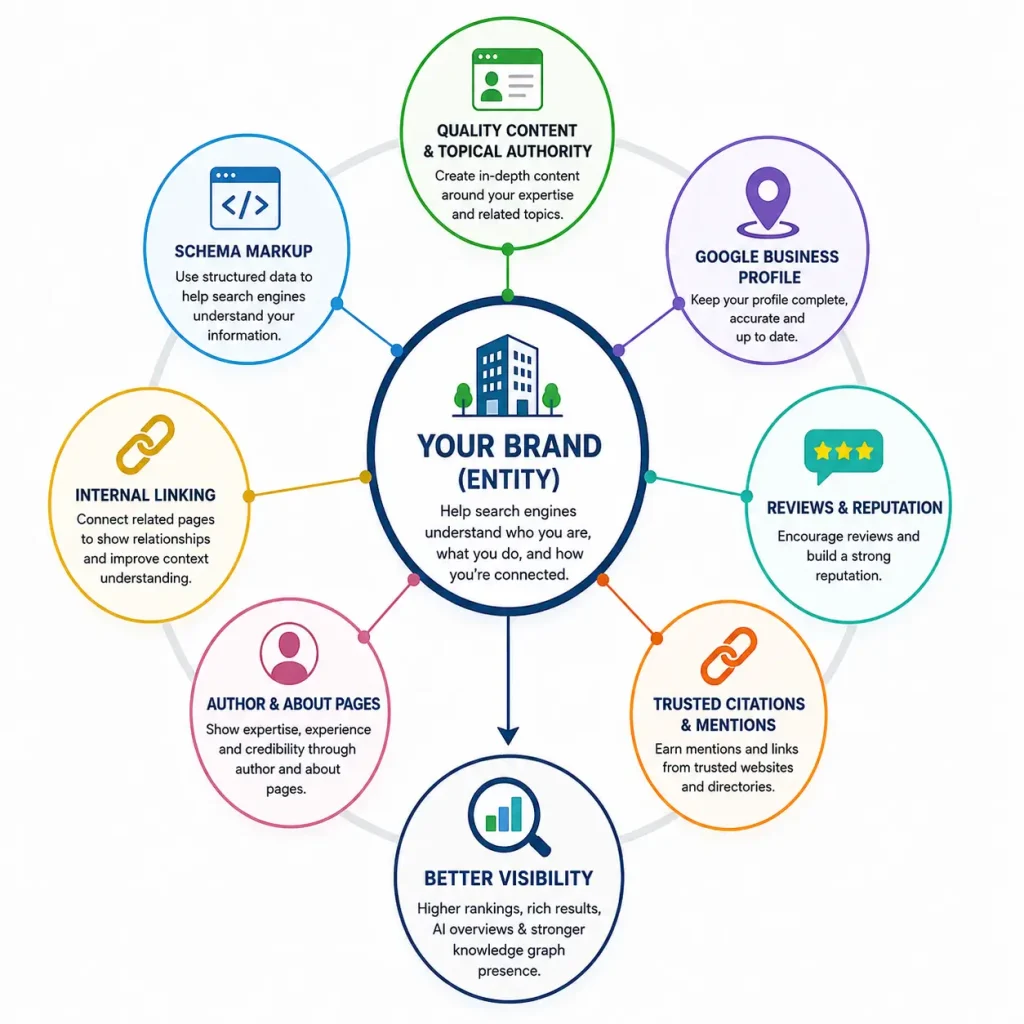
Knowledge Graph Optimization helps search engines understand your business or brand. Instead of relying on just one ranking signal, Google gathers information from your website and trusted third-party sources to confirm who you are, what you do, and how you’re connected to other entities.
Build a Clear Brand Identity
Keep your business name, logo, About page, contact details, and website information consistent across all platforms. A clear and consistent identity makes it easier for Google to recognize your entity.
Create Topical Authority
Publish high-quality content focused on your area of expertise. Covering unrelated topics weakens your authority. A collection of well-connected articles helps Google understand what your website is known for and builds your credibility.
Add Schema Markup
Use structured data like Organization, Person, LocalBusiness, or Product schema to describe important entities on your website. Schema helps search engines better understand your content. However, schema markup does not automatically create a Google Knowledge Panel; it simply provides structured information that aids Google’s understanding of your entity.
Keep Business Information Consistent
Your business name, address, phone number, website, and other details should match across your website, Google Business Profile, social media, and online directories. Consistency builds trust and reduces confusion.
Build Trusted Mentions
Earn backlinks, citations, and mentions from reputable websites, industry publications, and local directories. These signals help Google confirm your business and enhance its credibility.
Improve Internal Linking
Link related pages together to show how your content connects. A strong internal linking structure helps search engines understand your topics, discover important pages, and build stronger entity relationships across your website.
Knowledge Graph Optimization Best Practices
There isn’t a single action that improves Knowledge Graph Optimization. Instead, it’s the result of consistently sending clear and trustworthy signals about your business across your website and the web. The following best practices help search engines understand and verify your entity.
Build a Strong Entity Foundation
- Add Organization Schema to identify your business.
- Use Person Schema for founders, authors, or key team members.
- Add LocalBusiness Schema if you serve a specific location.
- Include SameAs links to your official social media profiles and trusted business listings.
- Create a detailed About page that explains who you are, what you do, and your expertise.
- Publish author pages with credentials, experience, and links to articles they have written.
Strengthen Your Website
- Create topical clusters by publishing multiple pages around related subjects.
- Use internal linking to connect related articles, service pages, and category pages.
- Keep your business name, address, phone number, and contact information consistent throughout your website.
Build Trust Beyond Your Website
- Optimize and regularly update your Google Business Profile with accurate information.
- Encourage customers to leave genuine reviews, and respond to them consistently.
- Earn trusted citations in reputable business directories and industry websites.
- Invest in digital PR to gain mentions and backlinks from news publications, trade websites, and authoritative blogs.
Keep Your Information Consistent
To identify an entity, search engines look at information from a number of different sources. The more consistent the details are across your website, your Google Business Profile, your social media accounts, and the various online directories, the more confident Google will be in verifying your business. When combined with high-quality content and structured data, these actions help to strengthen your entity, boost your topical authority, and lead to better visibility in both regular search results and in search experiences that are powered by AI.
Common Mistakes to Avoid
Even with the right strategy, a few common mistakes can limit the effectiveness of your Knowledge Graph Optimization efforts. Avoid these issues to help search engines better understand your business.
Relying Only on Schema Markup
Schema markup is important, but it isn’t enough on its own. Google also looks at your content, trusted mentions, backlinks, and consistency across the web before recognizing an entity.
Keyword Stuffing
Repeating the same keywords unnaturally doesn’t improve entity recognition. Focus on creating helpful content that clearly explains your expertise and covers related topics.
Inconsistent Business Information
Using different business names, phone numbers, addresses, or website URLs across platforms can confuse search engines and weaken trust.
Weak About Page
A vague or incomplete About page makes it harder for Google to understand who you are and what your business does. Include your background, services, experience, and mission.
Publishing Thin Content
Short, low-value pages don’t establish topical authority. Create comprehensive content that answers users’ questions and demonstrates expertise.
Missing Entity Relationships
Don’t treat each page as a standalone asset. Connect related pages with internal links and cover related topics to help search engines understand how your content fits together.
Ignoring Author Expertise
Author pages with credentials, experience, and published content strengthen credibility and support Google’s understanding of who created your content.
Frequently Asked Questions
What is Knowledge Graph Optimization?
Knowledge Graph Optimization is the process of helping search engines recognize your business as a valid entity. This is done through structured data, consistent information, quality content, and reliable online mentions.
Does schema markup create a Google Knowledge Panel?
No. Schema markup helps Google understand your content, but it does not automatically create a Knowledge Panel. Google decides whether to show one based on various trust and authority signals.
Is Knowledge Graph Optimization important for small businesses?
Yes. Small businesses can enhance local visibility and build trust by keeping their business information consistent, optimizing their Google Business Profile, and publishing reliable content.
How long does Knowledge Graph Optimization take?
Results vary depending on your website’s authority and online presence. Most businesses notice improved entity recognition after several months as Google collects and verifies information from different sources.
Can Knowledge Graph Optimization improve AI search visibility?
Yes. A clearly defined entity helps AI-powered search engines better understand your business. This increases the chances of being referenced in AI Overviews and other AI-driven search results.
To Conclude
Knowledge Graph Optimization is about helping search engines understand who you are, what you do, and how you’re connected to other trusted entities. Rather than focusing only on keywords, it builds a clear digital identity using high-quality content, structured data, consistent business information, and trusted mentions across the web. These signals work together to strengthen your authority and improve how search engines interpret your brand.
As search continues to evolve, entity recognition is becoming just as important as traditional SEO. By combining Knowledge Graph Optimization with strong content and technical SEO, you can improve visibility in both traditional search results and AI-powered experiences.

