Google’s May 2026 Core Update is Now Rolling Out: What SEOs Need to Know
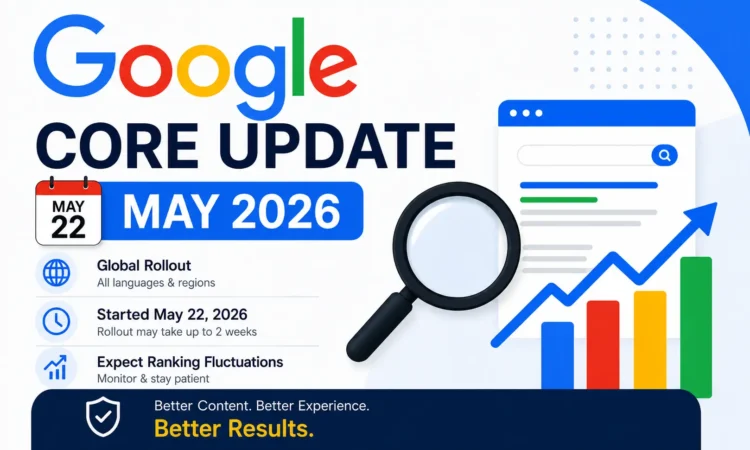
Google has officially started rolling out the Google Core Update May 2026, and the SEO industry is already seeing major ranking shifts across search results.
The rollout began on May 22, 2026, and according to Google, the update may take up to two weeks to fully complete. During this period, websites may experience major increases or drops in visibility, traffic, and keyword rankings.
Google announced the update through its Search Status Dashboard and official social media channels. This is the second confirmed broad core update of 2026 and comes shortly after several major AI search announcements from Google I/O 2026.
Official Confirmation From Google
Google confirmed the rollout publicly through:
- Google Search Status Dashboard
- Google Search Central Social Media pages
- Google Search Liaison communication channels
According to Google, the purpose of the update is to continue improving the quality and relevance of search results.
Official Google resources:
- Google Search Central LinkedIn Announcement: https://www.linkedin.com/posts/googlesearchcentral_google-search-status-dashboard-activity-7463253451183951873-SdbR
What Is a Core Update?
A core update is a broad adjustment to Google’s ranking systems. Unlike manual penalties or spam actions, a core update does not target one specific issue.
Instead, Google reevaluates how content should rank overall.
This means some websites gain visibility because Google now sees their content as more useful, while others lose rankings because competing pages better satisfy user intent.
Google has repeatedly explained that a ranking drop after a core update does not necessarily mean a website violated guidelines.
Early Data and Ranking Volatility
SEO tracking platforms reported heavy fluctuations even before Google officially confirmed the rollout.
Several tools showed unusually high volatility scores across industries, including:
- Home services
- Finance
- Health
- SaaS
- Affiliate marketing
- Local SEO
- News publishing
Some SEO monitoring platforms reported ranking turbulence levels above normal baseline averages within the first 24 hours of rollout.
Barry Schwartz from Search Engine Roundtable stated that the rollout officially began around 11:43 AM ET on May 22.
Industry tracking resources:
- Search Engine Roundtable: https://www.seroundtable.com/google-may-2026-core-update-41367.html
- SEMrush Sensor: https://www.semrush.com/sensor/
- MozCast Weather Report: https://moz.com/mozcast
- Algoroo Google Algorithm Tracker: https://algoroo.com/
What Google May Be Prioritizing
Although Google never reveals exact ranking signals behind core updates, early analysis suggests several common patterns.
1. Original Information
Google continues rewarding pages that provide unique value instead of recycled summaries.
Websites publishing:
- original research
- first-hand experience
- expert commentary
- case studies
- custom insights
appear to be performing better during the early stages of the rollout.
This follows Google’s long-standing push toward “helpful content.”
2. Topical Authority
Sites with strong topical depth are seeing more stability.
Instead of isolated blog posts targeting individual keywords, Google increasingly evaluates how well a website covers an entire subject.
For example, an HVAC company with detailed resources on:
- AC repair
- furnace maintenance
- indoor air quality
- duct cleaning
- energy efficiency
- thermostat troubleshooting
may outperform websites publishing generic content with little depth.
3. Trust and Brand Signals
Trust continues to become more important in Google Search.
Websites with:
- clear author profiles
- strong business information
- customer reviews
- real contact details
- consistent branding
- trustworthy backlinks
may have an advantage after the update.
Google’s Search Quality Evaluator Guidelines continue emphasizing E-E-A-T:
- Experience
- Expertise
- Authoritativeness
- Trustworthiness
Google Quality Rater Guidelines:
https://static.googleusercontent.com/media/guidelines.raterhub.com/en//searchqualityevaluatorguidelines.pdf
4. AI-Generated Content Quality
Google has clarified multiple times that AI-generated content is not automatically against guidelines.
However, mass-produced content with little originality or human editing appears more vulnerable during core updates.
Many SEOs are reporting losses among websites heavily dependent on scaled AI publishing without adding unique value.
Industries Seeing Major Impact
Early discussions across SEO communities suggest stronger volatility in:
- affiliate websites
- local businesses
- publisher sites
- lead generation websites
- comparison blogs
- niche authority sites
Local SEO professionals are also noticing movement inside Google Business Profile rankings and map pack visibility.
Some websites are reporting traffic swings of 20% to 40% within the first few days of rollout, although these numbers may continue changing until the update fully completes.
What Website Owners Should Do
If your rankings changed after the Google Core Update May 2026 started rolling out, avoid reacting too quickly.
Google rankings often fluctuate heavily during rollout periods.
Instead, focus on collecting data and identifying broader patterns.
Monitor Key Metrics
Track:
- organic traffic
- impressions
- keyword movement
- click-through rate
- indexed pages
- top landing pages
Use tools such as:
- Google Search Console
- Google Analytics 4
- Ahrefs
- SEMrush
- Screaming Frog
Improve Content Quality
Review older content carefully.
Ask questions like:
- Does this page fully answer the user’s search intent?
- Is the information current?
- Does the content provide anything unique?
- Would users trust this information?
Thin pages and repetitive AI-assisted articles may require updates or consolidation.
Strengthen Internal Linking
Strong internal linking helps Google understand website structure and topical relationships.
Connecting related service pages and blog posts can improve crawlability and user engagement.
Avoid Panic Changes
One of the most common mistakes during a core update is making large SEO changes too early. Because the rollout may take up to two weeks, rankings can continue shifting daily. Waiting until the update finishes allows you to analyze stable data instead of temporary fluctuations.
Final Thoughts on Google Core Update May 2026
The Google Core Update May 2026 continues Google’s long-term focus on useful, trustworthy, and original content. Websites built around real expertise and strong user experience are more likely to perform well over time.
For businesses and SEO professionals, this update is another reminder that long-term quality matters far more than shortcuts or scaled low-value content.
Over the next few weeks, monitoring performance carefully and improving overall content quality will remain the safest approach while the rollout completes.