Google Search Console New AI Report: What Does This Mean for Monthly SEO Reporting
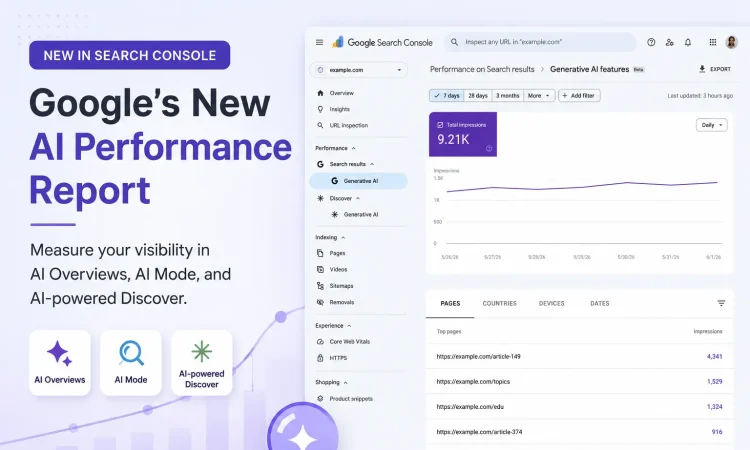
Google’s new Generative AI Performance Reports in Search Console give website owners a way to measure visibility within AI-powered search experiences, including AI Overviews, AI Mode, and AI-powered Discover.
Until now, SEO reporting focused on rankings, clicks, traffic, and conversions. While those metrics still matter, they don’t show how often Google’s AI systems surface your content in generated answers. The new reports fill that gap by introducing AI visibility as a measurable performance metric.
For SEO teams and agencies, this means monthly reporting can go beyond traditional rankings and traffic to include how frequently pages appear in AI experiences, which pages are being surfaced, and how AI visibility changes over time. As AI becomes a larger part of Google Search, understanding your presence in AI-generated results will be just as important as tracking organic performance.
Google Search Central Blog – https://developers.google.com/search/blog/2026/06/gen-ai-performance-reports?uule=w%2BCAIQICIJkRlbnZlciwgQ29sb3JhZG8sIDgwMjY0LCBVbml0ZWQgU3RhdGVz&gl=us&hl=en
Understanding What Google Actually Announced
According to Google’s announcement, the new Generative AI Performance Reports will allow website owners to view:
- AI-related impressions
- Pages appearing within AI experiences
- Country-level visibility
- Device-level visibility (for Search)
- Performance trends over time
Importantly, Google stated that this data has already been included within the overall Search Console reporting. The new reports simply provide a dedicated view that isolates visibility from AI-powered search experiences.
This distinction matters because many site owners have struggled to determine whether changes in traffic patterns were related to traditional rankings or AI-generated search features. The new reporting layer begins to provide that clarity.
The rollout is currently limited to a subset of websites, allowing Google to gather feedback before broader deployment. While the initial release appears relatively simple, the strategic implications are significant.
Google rarely invests engineering resources into standalone reporting environments unless it expects long-term adoption. The creation of dedicated AI reporting strongly suggests that AI-generated search experiences are becoming a permanent component of the search ecosystem rather than a temporary experiment.
The Rise of AI Search Is No Longer Theoretical
Google’s investment in AI search continues to accelerate.
According to Google’s public statements, AI Overviews reached more than 2 billion monthly users across over 200 countries and territories. That makes AI-generated search experiences one of the largest deployments of generative AI in the world.
Independent studies also indicate that AI-generated search results are becoming increasingly common.
Research published in 2026 found AI Overviews appeared for 51.5% of representative user queries. Another large-scale study found AI Overview activation rates reached 64.7% for question-based searches.
For SEO teams, this means visibility is no longer determined solely by rankings.
In many cases, the AI-generated answer becomes the first thing users see.
Why Traditional SEO Reporting Is Becoming Incomplete
For more than two decades, SEO success was measured through a relatively straightforward process. Higher rankings produced more impressions. More impressions generated more clicks. More clicks led to more conversions and revenue.
That relationship is becoming increasingly complex.
AI-generated search experiences often provide answers directly within the search results. Users may receive detailed information without ever clicking through to a website. In many cases, brands can gain visibility without receiving traffic.
This creates a reporting challenge that many agencies are already encountering.
Imagine a scenario where a client’s organic traffic declines by 8% over a three-month period. Under traditional reporting frameworks, that decline would immediately raise concerns. However, what if the same client’s content was appearing thousands of times inside AI Overviews during that period?
The website may be receiving fewer clicks while simultaneously becoming more visible across Google’s search ecosystem.
Without AI reporting, that visibility remains invisible.
This is one reason many SEO professionals have struggled to explain performance changes since the rollout of AI Overviews. Search Console has historically provided excellent reporting for traditional search interactions, but it offered limited insight into how AI systems were using website content.
The new reports begin to bridge that gap.
The Rise of AI Search Cannot Be Ignored
The significance of this reporting update becomes clearer when viewed against the broader adoption of AI search.
Google has publicly stated that AI Overviews now reach more than 2 billion monthly users across over 200 countries and territories. That level of adoption makes AI Overviews one of the largest generative AI products in the world.
Independent research also suggests that AI-generated search experiences are appearing with increasing frequency. Studies examining search result pages have found AI Overviews appearing for a substantial percentage of informational and question-based queries. In some verticals, AI-generated answers now occupy the most prominent area of the search results page.
Research from the Pew Research Center found that users are less likely to click traditional search listings when AI-generated summaries appear. This finding aligns with observations from SEO platforms and publishers that have reported changes in click-through rates for queries that trigger AI-generated responses.
For businesses that rely on organic search, this introduces a new reality. Visibility and traffic are no longer interchangeable metrics.
A page may generate significant AI exposure while producing fewer direct visits than it would have generated under traditional search conditions.
That does not necessarily mean SEO performance has declined. It simply means measurement frameworks must evolve.
The End of Click-Only Reporting
One of the most important outcomes of Google’s announcement is the formalization of AI visibility as a measurable performance indicator.
Historically, SEO reports have focused on metrics such as:
- Organic clicks
- Organic impressions
- Average position
- Click-through rate
- Conversions
Those metrics remain useful, but they primarily describe interactions with traditional search results.
AI search introduces a new question:
How often is Google’s AI choosing your content as part of its answer generation process?
The answer to that question may become increasingly important over the next several years.
When Google’s AI systems repeatedly reference a website across thousands of searches, that represents a form of visibility that rankings alone cannot capture.
As a result, agencies should begin considering new performance indicators, including:
- AI impressions
- AI visibility growth
- AI-surfaced pages
- AI visibility by topic
- AI visibility by country
- AI-assisted conversions
These metrics should not replace traditional SEO KPIs. Rather, they should complement them by providing a broader view of search performance.
Query Fan-Out Changes How SEO Performance Should Be Measured
Perhaps the most important concept influencing future SEO reporting is query fan-out.
In traditional search, users submit a query, and Google returns a set of ranked results. The relationship between query and result is relatively direct.
AI-powered search works differently.
When a user submits a query through AI Mode or triggers an AI Overview, Google’s systems often expand that query into multiple related searches. Rather than evaluating a single keyword, the system may investigate dozens of related questions, concepts, entities, and subtopics before generating a response.
Consider a user searching for:
“Best supplements for senior dogs with joint problems.”
A traditional search engine would largely evaluate pages optimized for that keyword and closely related variants.
An AI system may instead explore:
- Glucosamine benefits for dogs
- Green-lipped mussel supplements
- Senior dog mobility issues
- Veterinary recommendations
- Joint pain treatment options
- Supplement safety concerns
- Comparative product information
This fan-out process means content can earn visibility through a much broader set of topical relationships.
As a result, keyword-level reporting becomes less useful as a standalone measurement system.
If a page receives AI visibility because it effectively addresses dozens of related concepts, ranking reports alone may fail to explain why that visibility exists.
Future reporting should increasingly focus on topical authority rather than individual keywords.
Instead of asking:
“How did this keyword perform?”
SEO teams should ask:
“How visible are we across this topic ecosystem?”
That shift represents one of the most significant changes in SEO measurement since the introduction of Search Console itself.
How Monthly SEO Reports Should Change
Most agencies will need to modify their reporting frameworks to accommodate AI search data.
A modern SEO report may eventually include four distinct performance sections.
1. Traditional Organic Search Performance
This section should continue tracking:
- Clicks
- Impressions
- Rankings
- CTR
- Organic conversions
These metrics remain foundational.
2. AI Visibility Performance
This section should focus on:
- AI impressions
- AI visibility growth
- AI-surfaced URLs
- Country-level AI visibility
- Device-level AI visibility
The objective is to measure how frequently Google’s AI systems reference website content.
3. Content Authority Analysis
This section should examine:
- Topic clusters generating AI visibility
- Pages gaining AI exposure
- Pages are losing AI exposure
- Content gaps preventing AI inclusion
Because AI systems evaluate topical breadth, this analysis becomes increasingly valuable.
4. Business Impact Metrics
Ultimately, visibility must connect to business outcomes.
Reports should continue tracking:
- Leads
- Sales
- Assisted conversions
- Revenue
- Customer acquisition costs
AI visibility alone is not a business objective. It is a performance signal that should support broader growth goals.
What Agencies Need to Explain to Clients
One challenge many agencies will face is client education.
Business owners have spent years associating SEO success with rankings and traffic. The concept of AI visibility may initially seem abstract.
Agencies should prepare to answer questions such as:
- Why did AI impressions increase while traffic remained flat?
- Why is our content appearing in AI Overviews but not generating clicks?
- How does AI visibility contribute to business growth?
- Are competitors receiving more AI exposure?
- What content earns AI inclusion?
These conversations will become increasingly common as AI reporting expands.
The agencies that can clearly explain the relationship between AI visibility, brand exposure, and business outcomes will have a significant advantage.
What Google’s New Report Reveals About the Future of SEO
Beyond the reporting capabilities themselves, Google’s announcement provides insight into the direction of search.
The company is creating infrastructure to measure AI visibility because AI visibility matters.
This should not be interpreted as the end of traditional SEO. Rankings, traffic, and conversions will continue to play essential roles in search marketing.
However, the pathways through which users discover information are evolving.
Google’s AI systems increasingly act as intermediaries between content creators and searchers. As that trend continues, measuring how often content appears within AI-generated experiences becomes just as important as measuring where content ranks.
The introduction of Generative AI Performance Reports marks the beginning of a new reporting era.
SEO professionals who continue relying solely on rankings and clicks will miss an increasingly important part of the search landscape. Those who adapt their reporting frameworks to include AI visibility, topical authority, and query fan-out performance will be better positioned to understand search behavior and communicate value to clients.
The future of SEO reporting is no longer just about measuring traffic. It is about measuring presence wherever searchers encounter information, including the AI-generated experiences that are rapidly becoming a core part of Google Search.
FAQ
What is the new AI Performance Report in Google Search Console?
The AI Performance Report shows how often your website appears in AI-powered search experiences, including AI Overviews, AI Mode, and AI-powered Discover.
How are AI impressions different from regular impressions?
Regular impressions come from traditional search results, while AI impressions measure visibility within Google’s AI-generated answers and experiences.
Can my content appear in AI Overviews without ranking #1?
Yes. Google’s AI systems may use content from authoritative sources even if they are not the top-ranking organic result.
What is query fan-out in AI Search?
Query fan-out is Google’s process of expanding a user’s search into multiple related questions and topics before generating an AI response.
Which AI metrics should be included in monthly SEO reports?
Key metrics include AI impressions, AI visibility trends, top AI-surfaced pages, and topic-level performance alongside traditional SEO metrics.