What’s Missing From Google Search Console’s New AI Report?
Google’s new Generative AI Performance Report is a major step toward measuring visibility in AI Overviews and AI Mode. For the first time, website owners can see how often their content appears in Google’s AI-powered search experiences.
But after reviewing both Google’s announcement and the first screenshots of the report, it’s clear that some of the most valuable SEO insights are still unavailable.
While the report shows AI impressions, pages, countries, devices, and trends over time, several critical metrics remain missing.
Let’s break down what the current report includes and what SEO professionals will likely want in future updates.
Google Search Central Blog – https://developers.google.com/search/blog/2026/06/gen-ai-performance-reports?uule=w%2BCAIQICIJkRlbnZlciwgQ29sb3JhZG8sIDgwMjY0LCBVbml0ZWQgU3RhdGVz&gl=us&hl=en
Table of Contents
What the Current AI Report Shows
AI Impressions
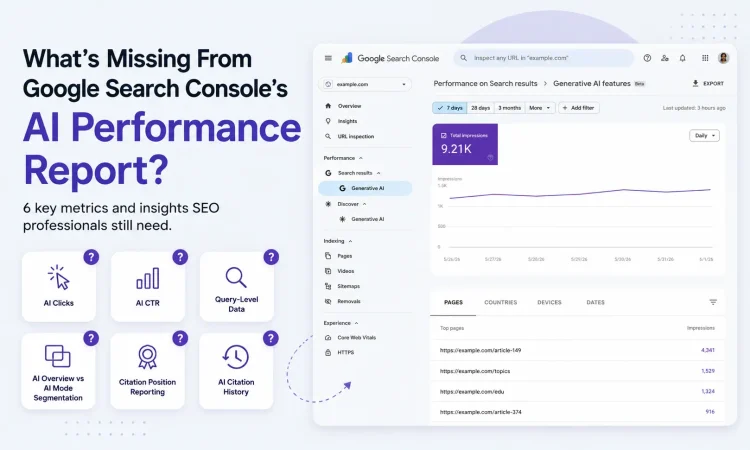
The most prominent metric in the new report is AI Impressions, which measures how often your content appears within Google’s AI-powered search experiences. In the screenshot, the selected property generated 9.21K AI impressions over a seven-day period. This gives website owners a new way to measure visibility beyond traditional search rankings and organic impressions. However, impressions alone don’t reveal whether users engaged with the content or visited the website. While the metric helps quantify AI exposure, it doesn’t yet provide enough context to determine the business impact of that visibility.
Top Pages
The Pages report shows which URLs are appearing most frequently within AI-generated experiences. This is particularly useful for content audits because it helps identify the pages Google considers reliable sources when generating answers. By reviewing these URLs, SEO teams can better understand which topics, content formats, and page structures are earning AI visibility. For many websites, this may become one of the most actionable sections of the report, as it offers direct insight into the content that Google’s AI systems are choosing to surface.
Country Reporting
The Countries tab allows website owners to analyze AI visibility across different geographic markets. For businesses operating internationally, this can reveal whether AI exposure is concentrated in specific regions or whether visibility is distributed across multiple countries. This data can help teams identify emerging markets, evaluate international content strategies, and understand where Google’s AI systems are most likely to reference their content. Over time, these insights could influence localization and international SEO decisions.
Device Reporting
The Devices report breaks down AI visibility by desktop and mobile users. While the initial data may appear simple, it has the potential to become increasingly important as AI search experiences evolve. If AI Overviews, AI Mode, or future AI features behave differently across devices, this report could help identify patterns in user exposure. SEO teams may eventually use this data to understand where AI visibility is strongest and how user behavior differs between device types.
Historical Trends
The performance graph provides a timeline of AI impressions, allowing users to track changes in visibility over days, weeks, and months. This trend data can help connect AI visibility shifts with content updates, technical SEO changes, algorithm updates, or broader search trends. Rather than looking at AI impressions as a standalone metric, marketers can use the historical view to identify patterns and understand whether visibility is improving, declining, or remaining stable over time. As the report matures, trend analysis will likely become one of its most valuable capabilities.
What’s Missing From The Report?
This is where things become interesting.
1. AI Clicks
The biggest limitation of the current report is the absence of click data. While Google now shows how often your content appears in AI-generated experiences, it doesn’t reveal whether those appearances result in website visits.
For example, if a page receives 50,000 AI impressions, website owners still have no way of knowing how many users clicked through after seeing that content in an AI Overview or AI Mode response. Visibility is useful, but businesses ultimately need to understand whether that visibility contributes to traffic, leads, or revenue. Until click data becomes available, the report remains focused on exposure rather than performance.
2. AI CTR
Since click data isn’t included, click-through rate (CTR) is also missing from the report. This creates a significant reporting gap because CTR helps SEO teams evaluate the effectiveness of search visibility.
Without AI CTR data, marketers cannot determine:
- Which AI appearances generate the most engagement
- Which pages convert visibility into traffic
- Whether certain content formats attract more clicks than others
A future CTR metric would help separate pages that simply appear in AI results from those that successfully encourage users to visit the website.
3. Query-Level Data
One of the first things SEOs look for in Search Console is query data. Surprisingly, that information is absent from the new AI report.
The current interface includes Pages, Countries, Devices, and Dates, but there is no dedicated Queries tab. As a result, website owners cannot see:
- Which searches triggered AI visibility
- Which questions generated AI impressions
- Which keywords contributed to AI inclusion
For many SEO professionals, query-level reporting would be one of the most useful additions because it would connect AI visibility directly to user intent.
4. AI Overview vs AI Mode Segmentation
At the moment, Google’s reporting appears to combine multiple AI experiences into a single view. While this provides a high-level overview, it limits deeper analysis.
Ideally, future reports would separate performance across different AI surfaces, including:
- AI Overviews
- AI Mode
- AI-powered Discover
- Future AI search experiences
Each of these environments serves users differently and may generate different levels of engagement. Breaking them out individually would provide much clearer performance insights.
5. Citation Position Reporting
Not every AI citation receives the same level of visibility. Being referenced prominently within an AI-generated answer is very different from being listed as a secondary source near the bottom.
Future reporting could provide details such as:
- Primary source citations
- Supporting citations
- Citation frequency
- Citation prominence
This would help website owners understand not only whether they are cited, but also how visible their brand is within the generated response.
6. AI Citation History
The report currently provides visibility data for selected date ranges, but it doesn’t show the historical lifecycle of AI citations.
For example, if a page suddenly disappears from AI Overviews, there is no easy way to determine when that change occurred or how visibility evolved over time.
Future reporting could include:
- First AI appearance
- Last AI appearance
- Visibility growth trends
- Visibility losses
This type of historical tracking would make diagnosing performance changes much easier and help teams identify successful content strategies.
Final Thoughts
Google’s new AI Performance Report is an important first step, but it is still a visibility report rather than a complete performance report.
Today, it tells us where content appears inside AI experiences. What it doesn’t tell us is why it appears, which queries triggered it, how much traffic it generated, or how it compares to competitors.
As AI search continues to evolve, these missing data points are likely to become some of the most requested features in Search Console. Until then, SEO professionals should view the current report as the beginning of AI measurement—not the finished product.
Related Blogs –
Google Search Console New AI Report & Monthly SEO Reporting