How to Get Cited in Google AI Overviews: Biggest Factors
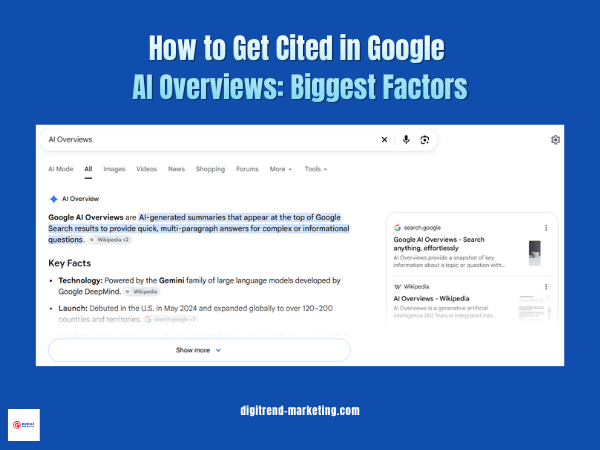
Google AI Overviews are changing the way people search for information, evaluate options, and make purchasing decisions. Instead of browsing multiple websites to find answers, users can now access AI-generated summaries directly in Google Search, along with links to selected sources.
For businesses and publishers, this shift creates a new opportunity to reach audiences beyond traditional organic search rankings. Being cited in an AI Overview can put a website in front of users while they are researching a topic, comparing solutions, or evaluating products and services.
However, earning these citations requires more than publishing keyword-focused articles or ranking on Google’s first page. Content quality, first-hand experience, topical authority, technical SEO, source credibility, and the relevance of information all play a role in building a website that search systems can recognize and reference.
Although Google does not disclose a definitive formula for selecting AI Overview sources, its official documentation and independent research offer useful insights into the factors that influence AI search visibility.
This guide examines the biggest factors behind Google AI Overview citations, supported by research, practical SEO recommendations, and actionable steps to help your website become a more credible source of information.
Quick Overview –
- Google AI Overviews select sources based on relevance, content quality, credibility, and how well a page answers the search query.
- Original research, first-hand experience, expert insights, and specific examples give content a stronger reason to be cited.
- Topical authority matters. Consistently publishing useful content around a subject helps establish your website as a reliable source.
- Direct, well-structured answers make information easier for search systems to identify and use.
- Strong E-E-A-T signals—including author expertise, accurate information, and trustworthy sourcing—support content credibility.
- Technical SEO still matters. Pages must be crawlable, indexable, mobile-friendly, and accessible to Google.
- Semantic relevance is more important than keyword repetition. Cover the topic, related concepts, and the intent behind the search.
- Quality backlinks, brand mentions, and a recognizable online presence can strengthen your website’s credibility.
- Keep statistics, examples, product details, and other factual information accurate and up to date.
- Track AI search visibility alongside traditional SEO metrics, and use performance data to improve content over time.
Table of Contents
Understand How Google AI Overviews Select Sources
Google AI Overviews use generative AI to answer search queries by gathering and summarizing relevant information from multiple sources.
A simplified explanation of the process involves three stages:
- Information retrieval: Google’s systems find relevant pages from its Search index.
- Answer generation: AI systems process information from relevant sources.
- Source selection: Supporting links are presented so users can explore the information further.
Google also uses a process called query fan-out, where a search can trigger multiple related searches to gather additional information.
For example, a search for “How to improve website SEO” may involve related topics such as technical SEO, keyword research, content quality, and internal linking.
This means your content should address the main search intent and relevant supporting questions.
Does ranking in the top 10 guarantee an AI Overview citation?
No. Traditional rankings and AI Overview citations are related but different outcomes.
An Ahrefs study published on March 2, 2026, analyzed 863,000 keyword SERPs and 4 million AI Overview URLs. It found that approximately 37.1% of cited URLs also appeared in the top 10 organic results for the same query.
This suggests that strong organic rankings alone do not guarantee AI Overview visibility.
Biggest Factors That Influence AI Overview Citations
Google has not confirmed an official weighting system for AI Overview citation factors. However, the following practices are supported by its search guidance and independent research.
1. Original Content and First-Hand Experience
Google recommends publishing original, useful content that provides information beyond what readers can find elsewhere.
Generic articles that repeat existing information offer little additional value.
To make your content more useful, include:
- Original research and surveys.
- Real-world case studies.
- First-hand product testing.
- Expert interviews.
- Original statistics and observations.
- Practical examples and implementation insights.
For example, instead of simply explaining how conversion tracking works, publish a case study explaining how you implemented it, identified tracking errors, and measured the results.
Original information gives readers a reason to reference your website.
2. Topical Authority and Subject Expertise
Websites that consistently publish relevant, high-quality content about a subject can establish stronger topical coverage.
For example, a website targeting AI SEO should cover related topics such as:
- Google AI Overviews.
- Generative Engine Optimization (GEO).
- Technical SEO.
- Entity SEO.
- Search intent.
- AI search visibility.
- Content optimization.
- Organic search measurement.
Build a content cluster around your main subject and connect relevant articles through internal links.
However, publishing more articles does not automatically establish authority. Content quality, relevance, accuracy, and subject coverage matter more than page count.
3. Clear and Direct Answers
AI systems need to interpret information in context. Make important answers easy to identify.
Follow these practices:
- Use descriptive H2 and H3 headings.
- Answer questions directly.
- Keep paragraphs focused.
- Define technical terms.
- Use numbered steps for processes.
- Include relevant examples and comparisons.
- Explain exceptions and limitations.
For example, if the heading is “What Is a Canonical Tag?”, begin with a clear definition before discussing implementation.
Avoid lengthy introductions that delay the actual answer.
4. Strong E-E-A-T Signals
E-E-A-T stands for Experience, Expertise, Authoritativeness, and Trustworthiness.
Google uses multiple signals to identify helpful and trustworthy content. E-E-A-T itself is not a single ranking factor, but its principles are important for content quality.
Improve E-E-A-T by:
- Adding relevant author biographies.
- Demonstrating professional experience.
- Including original case studies.
- Citing authoritative sources.
- Supporting factual claims with evidence.
- Providing accurate company information.
- Updating outdated content.
- Disclosing commercial relationships where applicable.
Make sure author credentials and experience are genuine and verifiable.
5. Technical SEO and Indexability
Your content must meet Google’s technical eligibility requirements to appear as a supporting link in AI Overviews.
Check that:
- Googlebot can crawl the page.
- The page is indexed.
- Important content is not blocked.
- The page is eligible to appear with a search snippet.
- Canonical tags are configured correctly.
- Internal links help Google discover important pages.
- Main content is accessible.
- Mobile usability is satisfactory.
Google confirms that pages must be indexed and eligible to appear with a snippet to qualify for AI Overview supporting links. However, meeting these requirements does not guarantee inclusion.
6. Semantic Relevance and Search Intent
Do not optimize content only for one primary keyword.
Understand the questions, related concepts, comparisons, and problems behind the search.
For example, an article targeting “best CRM software” may need to address:
- CRM features.
- Pricing.
- Free versus paid options.
- Small business requirements.
- Integrations.
- Advantages and disadvantages.
Cover related questions naturally when they support the main topic.
The objective is to provide a complete answer to the user’s information needs, not to increase keyword density.
7. Relevant Backlinks and Brand Mentions
External recognition can help establish your website’s credibility and subject relevance.
Focus on earning references through:
- Relevant industry publications.
- Expert contributions.
- Original research.
- Editorial backlinks.
- Professional interviews.
- Industry events and webinars.
- Genuine customer reviews.
Avoid buying backlinks, creating artificial mentions, or publishing low-quality guest posts simply to increase link counts.
Google has not confirmed a specific backlink or brand-mention threshold for AI Overview citations. Focus on genuine recognition rather than manufactured signals.
8. Accurate Statistics and Verifiable Information
AI-generated answers often include factual claims, comparisons, and statistics.
Make your content easier to verify by providing:
- Original research sources.
- Publication dates.
- Relevant data periods.
- Sample sizes where available.
- Research methodology.
- Supporting documentation.
Prefer government data, academic studies, original research, and official documentation.
Never publish unverified statistics simply to make an article appear authoritative.
9. Content Freshness and Accuracy
Freshness is particularly relevant for topics involving technology, pricing, software, regulations, and industry developments.
Regularly review your content to:
- Replace outdated statistics.
- Update technical instructions.
- Verify product information.
- Remove obsolete recommendations.
- Fix broken links.
- Add relevant developments.
Changing the publication date without improving the content does not make an article genuinely fresh.
10. Clear Entity Relationships
Entities include identifiable people, companies, products, technologies, organizations, and concepts.
Use accurate names and explain how related concepts connect.
For example, an article about Google Ads should clearly distinguish between Google Ads, Google Analytics 4, Google Tag Manager, and conversion tracking.
Use relevant structured data when appropriate, but do not treat it as an AI citation shortcut.
11. Strong Internal Linking
Internal links help search engines discover related pages and understand website structure.
Connect relevant supporting articles to your main topic using descriptive anchor text.
For example, an AI SEO article could link to on-page SEO, technical SEO, content marketing, keyword research, and off-page SEO resources.
Avoid irrelevant links and excessive exact-match anchor text.
12. Relevant Images and Videos
Original images, diagrams, screenshots, and videos can help explain complex information.
Use multimedia when it adds genuine value.
Follow these practices:
- Write descriptive image alt text.
- Use relevant filenames.
- Add captions where useful.
- Include video transcripts.
- Use original screenshots and demonstrations.
- Keep important explanations available in text.
Multimedia can support content quality and provide additional discovery opportunities, but it does not guarantee AI Overview citations.
What Research Reveals About AI Overview Citations
Independent research provides useful insights into how AI Overviews affect search visibility.
Finding 1: Top rankings do not guarantee citations.
Ahrefs’ March 2026 study found that approximately 37.1% of cited URLs also appeared in the top 10 organic results for the same query. This demonstrates that AI Overview citations are not limited to the highest-ranking pages.
Finding 2: AI Overviews can use multiple sources.
Google’s query fan-out process allows its systems to explore related searches and retrieve information from different sources. This creates opportunities for pages that answer specific supporting questions.
Finding 3: AI Overviews affect organic click behavior.
A July 2025 Pew Research Center study found that users were less likely to click traditional search results when an AI summary appeared. Only 1% of visits to Google pages containing AI summaries resulted in clicks on links within those summaries.
What this means for businesses: AI search visibility should be measured through citations, brand exposure, referral traffic, and conversions rather than traditional keyword rankings alone.
How to Optimize Content for AI Overview Citations
Follow this process when creating or updating content.
Step 1: Find Relevant Keywords
Prioritize informational, comparison, and problem-solving queries that may trigger AI Overviews.
Examples:
- What is technical SEO?
- How to improve website rankings?
- SEO vs. GEO.
- Best CRM software for small businesses.
- How does Google AI Mode work?
Check actual search results to identify queries that generate AI Overviews.
Step 2: Analyze Existing Citations
Review the websites and pages Google currently cites.
Identify:
- Commonly cited domains.
- Content formats.
- Questions answered.
- Supporting statistics.
- Original research.
- Information gaps.
Use this research to identify opportunities to provide more useful information.
Step 3: Create a Comprehensive Content Outline
Cover the main topic and its important supporting questions.
Avoid creating separate articles for every minor keyword variation. Group related questions when they share the same search intent.
Step 4: Provide Direct Answers
Start major sections with clear explanations. Follow them with examples, evidence, implementation steps, and limitations.
Make the article easy to understand without sacrificing technical accuracy.
Step 5: Include Original Information
Add case studies, expert insights, original research, and practical examples wherever possible.
Never invent statistics, customer experiences, or performance results.
Step 6: Add Authoritative References
Support important claims with links to official documentation, original research, government sources, and academic publications.
Distinguish between verified facts and professional opinions.
Step 7: Improve Technical SEO
Check indexing, crawlability, canonical tags, internal links, mobile usability, and content accessibility.
Use Google Search Console to identify technical problems.
Step 8: Strengthen Content Distribution
Promote original research through relevant industry publications, professional communities, newsletters, webinars, and other appropriate channels.
Focus on genuine audience engagement rather than artificial mentions.
Step 9: Monitor Citation Performance
Track target queries, cited URLs, competitors, and changes in search visibility.
Update content when new information or better evidence becomes available.
Does Schema Markup Help Get Cited in AI Overviews?
Schema markup is not a direct requirement for Google AI Overview citations.
Google explicitly states that no special schema.org markup is required for inclusion in AI Overviews or AI Mode.
However, relevant structured data remains useful for helping search engines understand supported page information.
Common schema types include:
- Article
- BlogPosting
- Organization
- Person
- Product
- LocalBusiness
- BreadcrumbList
- VideoObject
Use only appropriate markup that accurately reflects visible page content.
Do not add structured data simply to manipulate AI citations.
How to Measure AI Overview Visibility
Use a combination of Google Search Console, SEO platforms, and manual tracking.
Google Search Console: Monitor search performance, indexing, and available generative AI reporting. Google’s July 2026 guidance directs website owners to its Generative AI performance report for measuring discovery through generative AI features.
Third-party SEO tools:
- Ahrefs – Citation research, keyword analysis, and competitor monitoring. Website
- Semrush – SEO and AI visibility research. Website
- Profound – AI search visibility and citation analytics. Website
- SE Ranking – SEO tracking and AI visibility capabilities. Website
Manual tracking: Maintain a spreadsheet containing:
| Metric | What to track |
| Target query | Search keyword |
| AI Overview | Present or absent |
| Cited URL | Your website’s cited page |
| Competitors | Other cited websites |
| Search date | Date of observation |
| Referral traffic | Visits from AI search experiences |
| Conversions | Leads and sales |
Also monitor branded searches, organic traffic, and assisted conversions.
Remember that a citation does not guarantee a website visit or conversion.
Common AI Overview Optimization Mistakes
Avoid these practices:
- Publishing generic AI-generated content: Content that simply repeats existing information provides little additional value.
- Overusing keywords: Keyword repetition does not demonstrate expertise.
- Adding unnecessary FAQs: FAQ sections do not guarantee citations.
- Treating schema as a shortcut: No special schema markup is required for AI Overviews.
- Buying backlinks: Artificial link-building practices can create search spam risks.
- Ignoring technical SEO: Important pages must be accessible and eligible for Google Search.
- Publishing unsupported statistics: Unverified claims reduce content reliability.
- Updating dates without improving content: Genuine updates matter more than cosmetic changes.
- Measuring only rankings: Citation visibility and business outcomes also matter.
Google’s guidance prioritizes helpful, original, people-first content rather than artificial optimization techniques.
Frequently Asked Questions
1. How can I get my website cited in Google AI Overviews?
Publish original, accurate, and helpful content. Build topical authority, demonstrate expertise, improve technical SEO, answer relevant questions, and earn genuine industry recognition. No method guarantees a citation.
2. Does ranking in Google’s top 10 guarantee an AI Overview citation?
No. AI Overviews can cite relevant pages outside the top 10 organic results. Traditional rankings remain useful but do not guarantee citation visibility.
3. Can new websites appear in AI Overviews?
Yes. Newer websites can receive citations if their pages are eligible and relevant to a query. Google does not publish a minimum domain age requirement.
4. Does E-E-A-T affect AI Overview citations?
Google uses multiple signals associated with content quality and trustworthiness. E-E-A-T provides a useful framework for demonstrating experience, expertise, authority, and trust, but it is not a standalone citation formula.
5. Does AI-generated content rank in AI Overviews?
Yes. Google does not automatically exclude AI-generated content. However, content created primarily to manipulate rankings without providing genuine value can violate its spam policies.
6. How long does it take to get cited in AI Overviews?
There is no fixed timeline. Citation selection depends on relevance, indexing, available sources, and Google’s systems.
7. Does long-form content perform better in AI Overviews?
Not necessarily. Google does not specify a minimum word count. Content should be as comprehensive as the topic requires without unnecessary information.
8. Are backlinks important for AI Overview visibility?
Relevant editorial backlinks can support overall search visibility and authority. However, Google has not confirmed a specific backlink requirement for AI Overview citations.
9. Should I create separate pages for every related search query?
No. Combine closely related questions when they share the same search intent. Create separate pages when the topics require different information or serve different audiences.
10. Can AI Overview citations generate website traffic?
Yes, citations can generate referral visits and brand exposure. However, users may receive their answers without clicking through to the cited websites.
Conclusion
Getting cited in Google AI Overviews requires more than traditional keyword optimization. Businesses need to publish original information, demonstrate subject expertise, answer relevant questions, maintain technical SEO, and build genuine industry recognition.
Traditional SEO remains the foundation, but AI search creates additional opportunities to earn visibility beyond standard organic rankings.
The strongest strategy is to create content that provides information competitors cannot easily reproduce. Original research, practical experience, expert insights, and verifiable facts give readers a reason to trust and reference your website.
Focus on becoming a reliable source of information rather than trying to manipulate AI search systems.
Sources and Further Reading
- Google Search Central – Optimizing Your Website for Generative AI Features.
- Google Search Central – AI Features and Your Website.
- Google Search Central – Creating Helpful, Reliable, People-First Content.
- Ahrefs – AI Overview Citation Research (March 2026).
- Pew Research Center – Google Users Are Less Likely to Click on Links When an AI Summary Appears (July 2025).
- Google Search Central – Google’s Guidance on Generative AI Content.
Editorial note from DigiTrend: This article distinguishes Google’s documented guidance from independent research and practical SEO recommendations. Citation percentages are study-specific observations, not confirmed Google ranking weights. The research and recommendations reflect the sources available as of November 6, 2026.
Similar Articles