Google Now Calls Fake Author Bios “Deceptive”: How to Fix Your Bylines
Google has updated its guidance on helpful, reliable, people-first content to warn website owners against using fake author information. The warning specifically addresses fabricated author profiles, AI-generated headshots, made-up names, and false credentials used to make content appear as if it came from human experts.
The change matters for publishers, business websites, affiliate blogs, and companies that publish content to build trust with potential customers. A polished author bio may look professional, but if it misrepresents who created the content or what that person knows, it can undermine the credibility of the entire page.
For website owners, the solution is not to add longer biographies or more credentials. It is to make authorship accurate, verifiable, and consistent with the people who actually create, review, and take responsibility for the content.
In this guide, DigiTrend Marketing Solutions explains what Google’s updated guidance means, which author practices deserve an audit, and how to fix bylines, author pages, and Article structured data without creating unnecessary work.
What Did Google Change About Fake Author Bios?
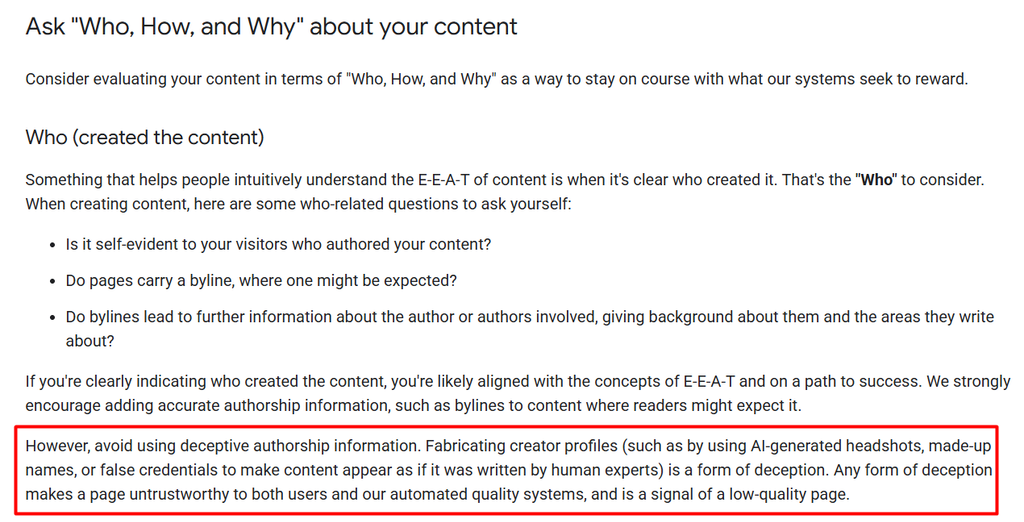
On October 1, 2026, Google updated its Creating Helpful, Reliable, People-First Content guidance with a more explicit warning against deceptive authorship information. Search Engine Journal reported the change on October 2, 2026.
Google’s guidance identifies fabricated creator profiles, AI-generated headshots, made-up names, and false credentials as examples of deception when they are used to make content appear as if it was written by human experts.
The guidance also states that deception makes a page untrustworthy to users and Google’s automated quality systems, and that it is a signal of a low-quality page.
This is more than a recommendation to improve author biographies. It is a direct warning against misrepresenting the people responsible for website content.
Google had already addressed similar issues in its Search Quality Rater Guidelines. The October update brings this concern into the guidance written specifically for website owners and content creators.
What website owners should understand: Google is not asking every blogger to have a famous author, a formal degree, or years of industry experience. It is asking publishers not to manufacture evidence of expertise or mislead readers about who created their content.
Sources: Google Search Central and Search Engine Journal’s coverage of the update.
What Counts as Deceptive Author Information?
An author bio becomes deceptive when it creates a false impression about a person’s identity, experience, qualifications, or involvement in producing the content.
The problem is not limited to entirely fictional people. A real employee can also have a misleading biography if the website assigns them qualifications they do not possess or claims they personally wrote work they did not contribute to.
Here are the main situations website owners should review.
1. Publishing AI-generated headshots as real author photographs
AI image tools can create realistic portraits of people who do not exist. Using one as an illustration is different from presenting it as a genuine photograph of a real author.
For example, a company might generate a professional-looking portrait and place it beside the name “Michael Turner, Senior HVAC Engineer.” If Michael is fictional and the image is intended to convince readers that a qualified engineer wrote the article, the profile misrepresents the source of the advice.
A safer approach is to use an authentic photograph when one is available, publish a biography that accurately describes the author’s role, or omit the portrait altogether.
An author does not need a headshot to have a credible byline.
2. Creating fictional authors to make a website appear authoritative
Some publishers assign different fictional names to articles across multiple subject areas. One profile might supposedly specialize in healthcare, another in finance, and another in technical SEO.
The names may make a site look like it has a team of subject-matter experts, even when those people do not exist.
This is especially concerning when the profiles are used to create an appearance of professional review or first-hand experience that the publisher cannot substantiate.
How to fix it: Replace fictional identities with the real people responsible for writing, editing, reviewing, or publishing the content. If several employees contribute to an article, describe their roles accurately rather than inventing a separate author for each topic.
3. Claiming qualifications that an author does not have
Credentials can influence whether readers trust a recommendation. That is why false claims about degrees, licenses, certifications, job titles, and professional experience are serious problems.
Examples include:
- Describing a general content writer as a licensed medical professional.
- Claiming an author has 15 years of industry experience when that experience cannot be substantiated.
- Listing certifications the author has never earned.
- Calling someone a subject-matter expert solely because they have published several articles about a topic.
The correction is not to remove all qualifications from author bios. It is to verify each claim and describe experience in terms that accurately reflect the person’s background.
4. Using a real person’s name without their meaningful involvement
A real author can also be misrepresented when their name is attached to an article they did not write, review, or approve.
For example, a company might place its technical director’s name on every engineering article to make the content appear professionally reviewed. If that director has never seen the articles, the byline gives readers a false impression.
There are legitimate ways to credit collaborative work. A writer can draft an article, an engineer can review its technical accuracy, and an editor can prepare it for publication. The website should identify those roles correctly instead of treating them as interchangeable.
5. Creating author biographies that exaggerate real experience
A biography does not have to be completely fabricated to be misleading.
Suppose a marketing professional has three years of SEO experience and has worked on local business websites. Describing that person as an internationally recognized search strategist with extensive experience advising major enterprises would misrepresent their background if those claims are untrue.
A more credible biography would describe their actual responsibilities, the kinds of projects they have handled, and the subjects they are qualified to discuss.
Readers do not need inflated titles. They need enough accurate information to understand why the author is a suitable source for the article.
Does Google’s Update Mean Every Article Needs a Named Author?
No. Google encourages accurate authorship information, including bylines where readers would reasonably expect them. However, the guidance does not establish a universal requirement that every webpage must display an individual author’s name.
The appropriate approach depends on the type of content and how it is produced.
| Content type | Recommended authorship approach |
| Expert-led technical article | Name the actual writer and identify any qualified technical reviewer. |
| Company blog post | Credit the employee, contributor, or editorial team genuinely responsible for the work. |
| News article | Provide a clear byline and relevant author information. |
| Product review | Identify the people or team responsible for the review and accurately explain how the evaluation was conducted. |
| Company service page | Use a company or editorial attribution when that reflects how the content was created. |
| Short announcement | Use an organizational byline when individual authorship is not meaningful or customary. |
| AI-assisted article | Credit the responsible human contributor or organization accurately; do not invent an AI-generated human identity. |
An organizational byline is preferable to a fictional individual when the organization genuinely takes responsibility for the content.
The goal is to represent authorship honestly, not to force every page into the same publishing format.
Why Author Bylines Matter for SEO and E-E-A-T
An author byline tells readers who is responsible for an article. A well-maintained author page can provide additional context about that person’s experience, qualifications, and subject knowledge.
These details contribute to the broader question of trustworthiness, which Google discusses through its E-E-A-T framework: Experience, Expertise, Authoritativeness, and Trustworthiness.
However, E-E-A-T is not a checklist where adding an author photo, biography, and credentials automatically improves rankings. Google explains that E-E-A-T itself is not a specific ranking factor. Its automated systems use a range of signals to identify helpful, reliable content, and trust is the most important element of the framework.
A genuine author profile can help readers assess a source, but it cannot compensate for inaccurate information, weak research, or content that lacks first-hand knowledge.
The connection between authorship and trust
Consider two articles about the same technical subject.
The first displays a detailed biography claiming that its author has extensive professional experience, but the website provides no reliable evidence of that background. The second identifies its actual writer, links to relevant work, cites reliable sources, and explains when a qualified professional reviewed the material.
The second article gives readers more reasons to assess its credibility. That does not guarantee better rankings, but it makes the authorship information more useful and less misleading.
For businesses publishing content on healthcare, finance, legal matters, home restoration, or other subjects that can affect people’s well-being, accurate credentials and appropriate expert review deserve particular attention.
Does adding an author bio improve rankings?
Not automatically.
Google’s guidance encourages accurate authorship information, but it does not promise a ranking increase from adding bylines or author pages. Nor does it establish a required number of articles, qualifications, or years of experience for every author.
A useful author bio supports a greater content-quality effort. It should help readers understand the source of the information while the article itself demonstrates accuracy, relevance, originality, and appropriate expertise.
Sources: Google’s people-first content guidance and Google’s E-E-A-T explanation.
How to Audit and Fix Your Website’s Author Bylines
If your website publishes dozens or hundreds of articles, start with an authorship audit rather than changing every author profile at once.
The objective is to identify where the displayed author information differs from the actual content-production process, then correct those discrepancies.
Step 1: Create a complete list of published content
Export your website’s published URLs from your CMS, sitemap, or content inventory. Include blog posts, guides, service pages, landing pages, product reviews, and other substantial editorial content.
For each URL, record the following:
- Page title and URL.
- Visible author name or organizational byline.
- Link to the author profile, if available.
- Author photo or avatar.
- Credentials and professional claims in the biography.
- Writer, editor, and subject-matter reviewer, where applicable.
- Author information declared in structured data.
This inventory gives you a practical way to compare what readers see with what your publishing team can verify.
Do not assume that every page needs an individual byline. First determine whether individual authorship is appropriate for the content.
Step 2: Verify every author identity
Check whether each named author is a real person and whether the website accurately represents their role.
Confirm details through appropriate internal records, direct confirmation from the author, professional biographies, or other reliable sources. Public information may help verify credentials, but the absence of an extensive online profile does not mean that a person is fictional.
Ask these questions:
- Does this person actually exist?
- Did they write, substantially contribute to, or review the content as claimed?
- Are their job title, qualifications, and experience accurate?
- Does the author photo genuinely represent the person if presented as their photograph?
- Is the person comfortable being credited for this work?
If a profile cannot be verified, do not automatically conclude that the author is fake. Investigate the publishing history and ask the responsible editor or content manager to confirm the facts.
If the profile was invented, remove the false identity and correct the associated bylines.
Step 3: Rewrite author bios using verifiable information
An author bio should explain the person’s relevant background without trying to make them appear more qualified than they are.
A useful structure includes:
- The author’s real name and current professional role.
- Relevant work experience or subject knowledge.
- Specific responsibilities or experience that relate to the article’s topic.
- Selected published work, professional qualifications, or other verifiable evidence, where applicable.
Avoid vague claims such as “one of the world’s leading experts” unless there is credible evidence to support them.
Example: Before
“David Miller is an award-winning HVAC engineering expert with more than 20 years of experience helping homeowners and businesses solve complex heating and cooling problems.”
This bio should not be published unless the identity, award, professional background, and experience claims are all accurate.
Example: After
“David Miller is a content specialist who writes about residential heating, cooling, and indoor comfort. His work covers HVAC maintenance, system selection, and common homeowner questions. Technical claims are reviewed by the company’s qualified HVAC professional when appropriate.”
This is an illustrative example, not a verified biography of a real person. It demonstrates how to describe a content contributor’s actual role without attributing engineering qualifications they may not possess.
For a real author, replace the generic description with verified information about their responsibilities and experience.
Step 4: Replace misleading author photos
Review every headshot and avatar used on author pages and bylines.
If an image is presented as a real person’s photograph, confirm that it genuinely represents that person. Remove AI-generated portraits that were created to impersonate fictional or invented experts.
If a contributor does not want to provide a photograph, use a neutral design or omit the image. Do not create a synthetic portrait to fill the space.
AI-generated illustrations are not inherently deceptive. The issue is the false impression created when an image is presented as evidence of a real person’s identity.
Step 5: Correct bylines on existing articles
Once the identities and biographies are verified, update the affected pages.
Use the following rules:
- The real writer created the article: Credit that person.
- Several people contributed substantially: Credit the contributors according to your editorial policy.
- A qualified professional reviewed the article: Identify the reviewer separately if the review actually occurred.
- An editor prepared the article: Credit the editor only when that reflects their contribution and your publishing conventions.
- A fictional author was used: Remove the fabricated identity and replace it with accurate attribution.
- The organization created the content collectively: Use an organizational byline if that is the most accurate representation.
Do not replace one fictional name with another. Do not assign an executive’s name to an article merely because their title looks more impressive.
For older articles, preserve the original publication date when appropriate. Update the modified date only when the page has undergone a substantive revision, and ensure the displayed date and structured data remain accurate.
Step 6: Build useful author profile pages
A dedicated author page gives readers a place to verify the information associated with a byline.
A useful profile may include:
- The author’s real name.
- A current role or professional affiliation.
- A concise, factual biography.
- Relevant qualifications or experience.
- Links to articles the person actually wrote or contributed to.
- A genuine photograph, if available and appropriate.
- Relevant professional profiles or publications, where they exist.
An author page does not need to be long. Its purpose is to help readers understand who the person is and why their background is relevant to the subjects they cover.
Avoid filling author pages with generic biographies, unrelated credentials, or hundreds of automatically generated profile descriptions. A smaller number of accurate profiles is better than a large directory of invented identities.
Step 7: Review your editorial workflow
Correcting author pages is only part of the work. Your publishing process should prevent the same issue from returning.
Establish a policy that requires:
- Real, verified author identities.
- Accurate professional and credential claims.
- Clear distinctions between writers, editors, and technical reviewers.
- Evidence of expert review when a page claims that review occurred.
- Human fact-checking of AI-assisted content.
- Approval of author profiles before publication.
- Periodic reviews of existing bylines and biographies.
Assign responsibility to an editor or content manager. Without a named owner, authorship checks can easily become an unfinished task that is overlooked during routine publishing.
How to Fix Author Schema Markup Without Misrepresenting People
Visible bylines are only one part of the picture. Websites may also use Article, BlogPosting, or NewsArticle structured data to describe authors to search engines.
Structured data should accurately reflect the content users can see and the people responsible for producing it.
Google’s Article structured data documentation recommends several author-related properties that can help it understand article authorship.
| Property | What it does | What to check |
| author | Identifies the article’s author as a person or organization. | The entity should reflect genuine authorship. |
| author.name | Provides the author’s name. | It should match the correct person or organization. |
| author.url | Links to a page identifying the author. | Use a relevant author profile or another page that genuinely identifies the author. |
| datePublished | Identifies when the article was first published. | Preserve the correct original publication date. |
| dateModified | Identifies when the article was last substantially modified. | Update it when appropriate and keep it consistent with the visible page. |
These are recommended Article properties, not a guarantee of enhanced search results.
Example of accurate Article schema
The following example illustrates how a website can identify a real author and link the article to that person’s profile. Replace the example domain, names, and dates with verified information before using it.
<script type="application/ld+json">
{
  "@context": "https://schema.org",
  "@type": "BlogPosting",
  "headline": "How to Maintain a Home HVAC System",
  "author": {
    "@type": "Person",
    "name": "Jane Smith",
    "url": "https://example.com/authors/jane-smith/"
  },
  "datePublished": "2026-09-15",
  "dateModified": "2026-10-10"
}
</script>
This is a structural example only. The name, URL, headline, and dates are illustrative and must not be copied as factual details for a real website.
The author.url property should point to a page that identifies the actual author. Do not create a profile URL simply to give a fictional name the appearance of legitimacy.
Should you use Person or Organization in Article schema?
Use Person when the article is genuinely attributed to an individual. Use Organization when the organization is the actual author or appropriate publisher of the content.
For example, a company may publish a service announcement under its corporate name rather than assigning it to an individual employee. That can be appropriate when it reflects the real publishing arrangement.
Do not use an organizational byline to conceal a misleading editorial process, and do not mark up an organization as the author of every article merely because it owns the website. Choose the entity that accurately represents authorship.
Should you add ProfilePage structured data?
Google supports ProfilePage structured data for pages whose primary focus is an individual or organization associated with the website.
An author profile page may qualify. The markup can help Google understand the relationship between the profile and the person it describes.
However, structured data does not verify someone’s qualifications or make a fabricated identity legitimate. It must describe a genuine profile and comply with Google’s structured data guidelines.
After making changes, validate the markup with Google’s Rich Results Test and inspect representative URLs in Google Search Console. A successful technical test confirms that the tested markup can be parsed; it does not certify the truth of an author’s biography or guarantee a rich result.
Does Using AI to Write Content Violate Google’s Authorship Guidance?
No. Using AI to assist with content creation is not, by itself, a violation of Google’s authorship guidance.
Google’s guidance on generative AI content explains that AI can help with research and content structure. The concern is producing content at scale without adding value, failing to fact-check outputs, or using automation primarily to manipulate search rankings.
The distinction is between using a tool to help create content and inventing a human identity to make that content appear more authoritative.
Consider three common publishing situations.
Situation 1: A writer uses AI for research and drafting
A real writer uses AI to organize research, develop an outline, or produce a first draft. The writer checks the facts, adds original analysis, edits the material, and takes responsibility for the final article.
The author byline can identify that writer if it accurately reflects their contribution. The use of AI does not automatically make the byline deceptive.
Situation 2: A company publishes AI-assisted content under its editorial team
A business uses AI tools as part of its content workflow, with an editor checking the final output and ensuring that it meets the company’s standards.
An organizational or editorial-team byline may be appropriate if it reflects the actual process. Where readers would reasonably want to know how the content was produced, a clear explanation of the workflow can provide useful context.
Situation 3: A website invents an expert to give AI content credibility
A publisher generates dozens of articles, creates a fictional author name and AI headshot, and claims that the person has professional qualifications.
This is the type of authorship misrepresentation Google’s updated guidance explicitly warns against.
The corrective action is to remove the fabricated identity, establish accurate attribution, review the content for factual accuracy, and correct any unsupported claims of expert involvement.
The practical rule: Credit the people or organization genuinely responsible for the content. Explain the use of automation when that context is useful to readers, and never invent a human expert to disguise how an article was produced.
Will Google Penalize a Website for Fake Author Bios?
Google’s updated guidance states that deceptive authorship makes a page untrustworthy to users and its automated quality systems and signals low page quality.
That statement should be taken seriously, but it does not establish a separate, automatic penalty for every inaccurate author bio.
There is no published statistic in the guidance showing how many websites will lose rankings because of fake authorship. Google has not announced a specific ranking update tied solely to this change, nor does the guidance specify a fixed ranking loss for an individual violation.
It is therefore inaccurate to claim that every website with an outdated biography will be penalized or that removing a questionable byline will automatically restore rankings.
The appropriate response depends on the actual problem.
If a website has a minor factual error in a biography, correct it. If a website has invented experts and false credentials across hundreds of pages, the issue is broader and requires an editorial audit, not just a quick metadata change.
What should you do if organic traffic has declined?
Do not assume that a traffic decline is caused by author information alone.
Review the affected pages, compare performance before and after the decline, and investigate other potential causes, including content quality, search intent, technical issues, indexing, competition, and relevant search updates.
Google’s Search Console manual actions report can help determine whether Google has issued a manual action. A site can also experience ranking changes without receiving a manual action.
If a manual action is present, follow the specific instructions in Search Console, correct the underlying violations, and request a review when the site is compliant. If there is no manual action, do not submit a reconsideration request simply because traffic has fallen.
The priority is to correct misleading information and improve the quality of the affected pages, while investigating ranking changes on their own evidence.
A Practical Author Audit Checklist for SEO Teams
Use this checklist to review your website’s bylines, author pages, and structured data. Start with pages that make strong claims about professional expertise or provide information that could affect a reader’s health, finances, safety, or major purchasing decisions.
- Every named author is a real, identifiable person.
- Every author has genuinely contributed to the content as described.
- Author photos are not presented as real portraits of fictional people.
- Job titles, degrees, certifications, and experience claims are accurate.
- Technical reviewers are credited only when they actually reviewed the content.
- Organizational bylines reflect genuine editorial responsibility.
- Author pages contain useful, verifiable background information.
- Article schema matches the visible byline and identifies the correct author.
- Author profile URLs lead to relevant, accessible pages.
- Publication and modification dates are accurate.
- AI-assisted content has been checked for factual errors and unsupported claims.
- The editorial team has a process for reviewing new and existing author profiles.
Record the URLs that need correction, assign an owner, and track completion. Recheck the affected pages after implementation to confirm that the visible content and structured data tell the same story.
For a large website, prioritize fictional identities, false credentials, and claims of expert review that cannot be substantiated. Those problems should be addressed before minor formatting inconsistencies.
Frequently Asked Questions
Can I use a pen name for my blog?
A pen name is not automatically deceptive. Writers may use pseudonyms for legitimate privacy, editorial, or professional reasons. The concern arises when a pen name is used to fabricate qualifications, impersonate a real person, or falsely suggest that a fictional expert has created the content.
If you use a pen name, avoid inventing credentials or a professional history to support it. Ensure that your publishing practices do not mislead readers about the source of the information.
Can I use an AI-generated author photo if the author is real?
You should not present a synthetic portrait as a genuine photograph of that person. If an AI-generated image is used for an illustrative purpose, make its nature clear when readers could otherwise mistake it for an authentic portrait. The safer option for an author profile is a genuine photo or no photo.
Do I need to add author schema to every blog post?
Google’s Article documentation recommends author-related structured data properties, but not every page needs to qualify for a specific search feature. Use structured data where it accurately describes the page and supports your technical implementation. A correct visible byline and accurate editorial information remain important even when structured data is absent.
Will adding author bios improve E-E-A-T?
Author bios can help readers understand the source of an article and assess the relevance of the author’s experience. However, there is no guarantee that adding biographies will improve rankings. The information must be accurate, and the content itself must be useful, reliable, and appropriate to its subject.
Should I remove every old article that has no author name?
No. Google’s guidance does not require a named individual on every page. Review whether a byline is appropriate for the content and whether the existing attribution is misleading. You can add accurate attribution where it helps readers, use an organizational byline where appropriate, or retain a page without an individual author when that accurately reflects the publishing context.
Does Google require every author to have a public LinkedIn profile?
No. Google does not require every author to maintain a LinkedIn profile. An author page can provide useful information about a person’s background and published work, but the profile should contain accurate details and should not be treated as a substitute for genuine qualifications or relevant experience.
Should I disclose that AI helped write an article?
Google recommends considering how content was created and whether readers would reasonably want that context. AI disclosure is not universally required for every use of AI, but an explanation may be appropriate when automation substantially contributed to the content or when the production process is relevant to the reader’s trust in the material.
How long does it take to recover from fixing fake author information?
Google does not provide a standard recovery timeline for correcting deceptive author profiles. Search systems need to recrawl and reassess updated pages, and any ranking changes depend on the circumstances. Correct the information because it is misleading, then monitor indexing and performance without assuming that the fix will produce an immediate ranking increase.
Final Thoughts: Make Your Bylines Accountable
Google’s updated guidance gives website owners a clear reason to review how they identify the people behind their content. Fictional authors, misleading AI-generated portraits, and unsupported professional credentials create a false impression of expertise that readers cannot reliably evaluate.
For DigiTrend Marketing Solutions, the practical lesson is simple: build author profiles around real people, describe their experience accurately, credit contributors according to their actual roles, and make sure structured data matches what visitors see.
You do not need a large team of authors with impressive titles to publish credible content. You need an honest publishing process, accurate information, responsible editorial review, and articles that give readers a genuine reason to trust what they read.
Start with your existing bylines. Verify the identities, correct misleading claims, and establish a process that keeps future content accurate from the moment it is published.
Editorial note: The article distinguishes Google’s published guidance from practical SEO recommendations. Google has not published a specific penalty amount or recovery timeline for fake author bios. The example names, credentials, URLs, and dates in the schema examples are illustrative, not claims about real individuals or businesses.