Google Just Dropped Another Spam Update. Here We Go Again. September 2026 Spam Update
Just when you thought you could enjoy a quiet week of checking rankings, fixing broken links, and pretending that a 0.2% CTR change is not bothering you, Google has rolled out another spam update.
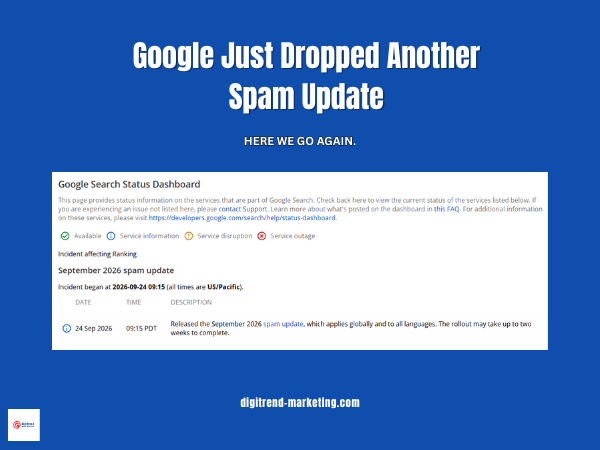
The Google September 2026 Spam Update started rolling out on September 24, 2026, and this time Google says the rollout could take up to two weeks.
Yes, two weeks.
So if your rankings move around a little over the next several days, resist the urge to open 47 browser tabs and start rewriting your entire website.
Google has confirmed that the update is rolling out globally and across all languages. However, it has not said that the update is targeting one particular spam tactic or spam policy.
So, what do we actually know?
Quite a bit.
And also, somehow, not very much.
Official Links
Official Google Doc for September 2026 spam update
Google Search Status Dashboard
Google Search Spam Updates and Your Site
TL;DR
- Google started rolling out the September 2026 Spam Update on September 24.
- The update is global and affects all languages.
- Google says the rollout could take up to two weeks to complete.
- Google has not confirmed a specific spam tactic that this update targets.
- There is currently no official confirmation that the update specifically targets AI-generated content.
- If your rankings or traffic drop, don’t immediately assume you’ve been hit by a spam update. Check Google Search Console, affected pages, indexing, technical SEO, content quality, and spam-policy compliance first.
- Avoid making major site-wide changes while the update is still rolling out unless you’ve identified a genuine problem.
- If Google does identify spam-related issues with a site, fixing them may not lead to an immediate recovery. Google says its systems can take time to recognize improvements.
- In short: watch the data, don’t panic, and maybe stop refreshing Search Console every five minutes.
What Is the Google September 2026 Spam Update?
The September 2026 Spam Update is a change to Google’s automated systems for detecting search spam.
Google regularly improves these systems so they can identify websites that violate its Search spam policies. These systems operate continuously, while Google occasionally announces larger improvements as confirmed spam updates.
Google’s documentation explains that spam updates can result in sites that violate its policies ranking lower or disappearing from search results. Google also says that fixing problems does not necessarily mean rankings will return immediately; its systems may need months to recognize that a site is now complying with its policies.
The September update is therefore not the same thing as a core update.
A core update broadly changes how Google evaluates and ranks content.
A spam update is focused on detecting and dealing with behavior that violates Google’s spam policies.
That distinction matters when you’re trying to figure out why your traffic suddenly decided to take a vacation.
When Did the September Spam Update Start?
Google started the September 2026 Spam Update on:
September 24, 2026, at 9:15 a.m. PDT.
The update applies:
- Globally
- To all languages
- Across Google’s search results
- To Google’s automated spam-detection systems
Google says the rollout may take up to two weeks to complete.
That does not mean your website will be judged for exactly 14 days.
It simply means Google has given itself a fairly large window to complete the rollout.
And honestly, that is probably good news for SEOs who enjoy watching ranking graphs behave like heart-rate monitors.
This Is the Fourth Spam Update of 2026
September isn’t Google’s first spam-related cleanup of the year.
It is the fourth confirmed spam update of 2026.
The previous confirmed spam updates were:
- March 2026 Spam Update
- June 2026 Spam Update
- August 2026 Spam Update
- September 2026 Spam Update
The March update was completed in less than a day, while the June and August updates took a few days. Google has now given the September update a rollout window of up to two weeks.
That longer rollout window doesn’t automatically mean this update is more severe.
So don’t look at the calendar and conclude:
“Two weeks? Google must be coming for everyone’s rankings.”
We don’t know that.
Google hasn’t said it.
And SEO Twitter has enough theories already.
What Is Google Targeting?
Here’s where things get interesting.
Google has not said.
At least not specifically.
Google has confirmed that the update improves its automated spam-detection systems, but it hasn’t announced a new spam policy or identified one particular spam technique as the target of the September update.
That means we shouldn’t automatically say:
- “This is an AI content update.”
- “This is a link spam update.”
- “Google is targeting programmatic SEO.”
- “Expired domains are being wiped out.”
- “Local SEO is dead.”
- “My competitor lost rankings, so Google finally caught them.”
That last one may be emotionally satisfying, but it isn’t an SEO analysis.
Without evidence, it’s speculation.
Is Google Targeting AI-Generated Content?
This is probably going to be one of the first questions SEOs ask.
The answer is: Google has not said that the September 2026 Spam Update specifically targets AI-generated content.
That doesn’t mean content created with AI cannot cause problems.
If a website publishes large amounts of low-value, repetitive or search-engine-first content, it can run into quality and spam-related problems regardless of whether a human, AI system, or a sleep-deprived intern wrote it.
The tool used to create the content isn’t the entire story.
What matters is what the content actually does for the user and whether the publishing process violates Google’s policies.
Google’s current spam documentation focuses on prohibited practices rather than simply banning content because AI was involved in producing it.
So don’t respond to this update by deleting every article that was ever touched by ChatGPT.
Please.
Your content team has suffered enough.
Instead, review the pages that are actually showing signs of trouble.
What About Link Spam?
Same answer.
Google has not confirmed that the September update is specifically a link spam update.
If your rankings decline, that doesn’t mean you should immediately start deleting backlinks or launch a disavow campaign because you found a handful of suspicious domains linking to you.
Look for evidence first.
Ask:
- Did important keywords decline?
- Which pages lost visibility?
- Did the decline happen during the update?
- Did competitors change?
- Are there indexing problems?
- Did organic impressions fall?
- Did branded searches change?
- Did only one content category decline?
- Are there obvious spam-policy issues on the affected pages?
An SEO audit is much more useful when it starts with data instead of panic.
Should You Be Worried About a Ranking Drop?
Not every ranking drop during an update means your website has been hit by the update.
Search results change for plenty of reasons.
For example:
- Search demand can change.
- Competitors can publish better content.
- SERP features can change.
- Seasonality can affect traffic.
- Google can recalculate rankings.
- Tracking can break.
- A technical issue can prevent pages from being indexed.
- Your rankings can simply fluctuate.
And yes, sometimes an algorithmic system really can be responsible.
The point is to determine which one you’re dealing with.
Google itself recommends reviewing Search Console data and its spam policies if your site changes after a spam update.
How to Check If Your Website Was Affected
If you manage SEO for a business, now is a good time to keep an eye on your data.
But don’t stare at it every five minutes.
Google Search Console is not going to change its mind because you refreshed the Performance report 18 times.
1. Check Google Search Console
Start by comparing your performance before and after September 24.
Look at:
- Clicks
- Impressions
- Average position
- CTR
- Queries
- Pages
Don’t only look at total clicks.
A website can lose traffic because one high-performing page dropped, while the rest of the site remains perfectly healthy.
2. Find the Pages That Lost Visibility
Page-level analysis is much more useful than simply saying:
“Traffic is down 20%.”
Find out where the decline happened.
For example:
Scenario A:
One blog post lost traffic.
That doesn’t necessarily indicate a site-wide spam problem.
Scenario B:
Hundreds of similar pages lost visibility at roughly the same time.
Now you’ve got something worth investigating.
Look for patterns across:
- Blog content
- Location pages
- Service pages
- Product pages
- Programmatic pages
- AI-assisted content
- Pages targeting very similar keywords
Patterns usually tell you more than the headline traffic number.
3. Check Indexing
Before blaming Google, make sure Google can actually access your pages.
Check:
- Indexing status
- Robots.txt
- Canonical tags
- Noindex directives
- XML sitemaps
- HTTP status codes
- Internal links
- Server issues
It would be slightly embarrassing to spend three weeks investigating an algorithm update only to discover that someone accidentally added noindex to 600 pages.
It happens.
4. Review Your Content
If specific content groups lost visibility, review those pages manually.
Look for content that is:
- Repetitive
- Thin
- Created primarily to capture search traffic
- Overloaded with keywords
- Mass-produced without meaningful editorial review
- Very similar across multiple URLs
- Providing little information beyond what already exists elsewhere
This does not mean:
“Low traffic = spam.”
A page can have low traffic and still be useful.
Likewise, a page can have thousands of visits and still have problems.
The question is whether the content and publishing practices comply with Google’s policies.
Don’t Rewrite Your Entire Website on Day Two
This deserves its own section because it happens after almost every Google update.
A ranking drops.
Someone checks Search Console.
Someone else checks Ahrefs.
Then somebody says:
“We need to rewrite the whole blog.”
And suddenly 300 URLs are being edited before anyone has figured out what actually happened.
Don’t do that.
The September update can take up to two weeks to complete, according to Google.
That means rankings can continue changing during the rollout.
If you make major changes immediately, you may also make it harder to understand what caused the original decline.
A better approach is:
Monitor → Find patterns → Investigate → Fix confirmed problems → Monitor again
Not:
Traffic down → Panic → Delete blog → Cry → Blame AI
The second workflow is considerably less useful.
What Should SEOs Do During the Rollout?
For now, keep your monitoring process active.
A practical checklist:
Monitor organic performance
Track your important keywords and landing pages throughout the rollout.
Compare Search Console data
Compare performance with the period immediately before the update, while accounting for normal seasonality and demand changes.
Check commercial pages
Don’t focus only on blog traffic.
Look at your service, product, category, and location pages too.
Those pages often matter more to the business.
Review unusual traffic patterns
Look for sudden changes concentrated around specific page types, topics or templates.
Check technical SEO
Make sure there hasn’t been a crawling, indexing, canonical, robots.txt or server issue.
Review spam policies
If a site has experienced a significant decline, compare its publishing and SEO practices against Google’s current spam policies.
Don’t make changes without evidence
If you cannot explain why you’re changing something, you probably need more data first.
What Happens After the Update?
This is another area where SEOs sometimes expect instant results.
You fix something on Monday.
You expect Google to notice on Tuesday.
Google says, “Cute.”
Google’s documentation states that improvements may take months to be reflected if its automated systems need time to learn that a site is complying with its spam policies.
So if a website has genuine spam-policy problems, fixing them is only the first step.
Recovery isn’t necessarily immediate.
This is one reason why avoiding risky SEO practices in the first place is much easier than trying to recover after a major visibility loss.
What We Don’t Know Yet
There are several things Google hasn’t told us about the September update.
We don’t currently have an official answer on:
- Which specific spam tactics are being affected most
- Whether one type of website is being affected more than another
- Whether AI-assisted content is disproportionately affected
- Whether link spam is a major focus
- Whether programmatic sites are being affected more heavily
- How significant the impact will be once the rollout is complete
Those questions may become clearer as SEO professionals analyze the data over the next couple of weeks.
For now, any claim that Google has specifically targeted one of these areas should be treated as an observation or theory unless Google confirms it.
Final Thoughts
Google’s September 2026 Spam Update has officially started rolling out, and this time Google has given SEOs a longer window than usual to wait, watch, and wonder what is happening.
The update began on September 24, 2026, applies globally and across all languages, and may take up to two weeks to finish. Google has not announced a specific spam tactic as its target.
So, if your rankings move over the next few days, don’t immediately assume you’ve been penalized.
Check the data.
Find the pages affected.
Look for patterns.
Review the technical setup.
Review the content.
Check Google’s spam policies.
Then make changes based on what you actually find.
Because SEO already has enough mystery.
We don’t need to invent more of it.
And if your rankings haven’t moved yet, enjoy the peace while it lasts.
Google probably has another notification somewhere.