Google Just Changed How It Reads Your Schema Markup: Should You Be Concerned?
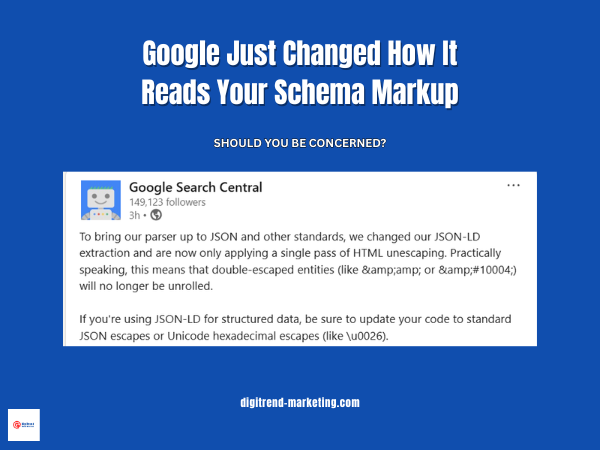
There’s a minor change from Google that’s worth looking at if you’re using Schema markup on your website.
The good news is that this isn’t another ranking update; Google is altering the way its parser deals with certain incorrectly escaped characters found within JSON-LD structured data. For the majority of websites that have properly formatted Schema, nothing should change.
A Small Google Change Could Break Some JSON-LD Schema Markup
Google has made a quiet change to the way it reads JSON-LD structured data.
For most website owners, this will not be a problem. But if your Schema markup contains double-escaped characters, Google may no longer interpret them the way it did before.
Here is what happened, why it matters, and what you should check.
First, What Is Changing?
Google has updated its JSON-LD extraction process so that it now applies only one pass of HTML unescaping.
In simple terms, Google is becoming stricter about how it reads certain characters inside JSON-LD.
Previously, if a character had been escaped more than once, Google could sometimes keep decoding it until it reached the intended character.
For example:
&
could eventually become:
&
With the new behavior, Google only processes the escaping once. That means:
&
may no longer be interpreted as:
&
Instead, part of the HTML encoding may remain in the final data Google reads.
Why Would This Happen?
In many cases, the issue comes from how a website generates Schema markup.
A CMS, plugin, template, JavaScript tool, or another system may encode the same character multiple times.
For example, imagine a business name:
Smith & Sons
Some systems may convert it to:
Smith & Sons
And if another process encodes it again, it could become:
Smith & Sons
Previously, Google might have been more forgiving. Now, it expects the JSON-LD to follow standard JSON formatting more closely. The recommended approach is to use standard JSON escapes, or Unicode escapes where needed, such as \u0026.
Is This a Google Ranking Update?
No.
This is not a core update, spam update, or ranking algorithm change.
Google is simply changing how its systems parse certain JSON-LD content.
However, structured data can help Google understand information on a page and may make a page eligible for certain rich result features. Google recommends JSON-LD as a structured data format and advises website owners to test their markup for technical issues.
So, if incorrectly escaped characters cause your Schema to be read incorrectly, that specific markup could potentially stop working as intended.
Who Should Check Their Website?
You may want to take a closer look if:
- Your website uses automatically generated Schema markup.
- You use multiple plugins or tools that modify Schema.
- Your JSON-LD is injected through JavaScript or Google Tag Manager.
- Your Schema contains special characters such as &, quotes, symbols, or Unicode characters.
- You have previously copied Schema code from different sources and modified it manually.
Google can process JSON-LD generated or injected through JavaScript, but the final markup still needs to be valid and correctly formatted.
What Should You Do?
You do not need to panic or rewrite all your Schema markup.
Start by checking your important pages:
- Review the JSON-LD in the rendered page.
- Look for double-escaped characters such as &.
- Make sure the Schema contains valid JSON.
- Test the page using Google’s Rich Results Test.
- Watch Google Search Console for structured data errors.
Google notes that correctly implemented structured data does not guarantee a rich result, but technical errors can prevent markup from being processed as expected.
The Bottom Line
Google is basically saying:
Do not rely on Google to keep fixing incorrectly escaped JSON-LD.
If your Schema is properly formatted, this change is unlikely to affect you.
But if your website has been relying on Google repeatedly decoding characters such as &, it is time to clean that up.
This is a relatively technical change, but it is also a good reminder for SEOs and developers: Schema markup should be checked as part of regular technical SEO maintenance, not simply added once and forgotten.
If you manage multiple websites, a quick audit of your existing JSON-LD may save you from unexpected structured data issues later.
Also Read: