Google Opens Conversion Lift to Search and Performance Max: What It Is and Who Qualifies
For a long time, Google Ads advertisers have needed a dependable method of working out whether or not their campaigns lead to additional conversions or merely pick up conversions that would have occurred anyway. Conversion Lift studies are able to answer this question by measuring the incremental effect of advertising.
Advertisers now have another method of assessing the effectiveness of their campaigns beyond the conversions shown in Google Ads, since Conversion Lift has been extended to Search and Performance Max campaigns.
For marketers, the main questions are practical: What does Conversion Lift measure? How does it work? Which advertisers are eligible? And when should a business use it rather than depending on standard conversion tracking?
The guide describes how Google Ads Conversion Lift functions, what the expansion implies for Search and Performance Max, the eligibility issues that advertisers should be aware of, and how to understand the results without confusing correlation with causation.
What Is Google Ads Conversion Lift?
Google Ads Conversion Lift is a measurement tool that estimates how many conversions an advertising campaign generates that would not have occurred without the ads.
It measures incremental conversions, rather than simply counting conversions attributed to advertising.
Google explains the methodology in its official Conversion Lift measurement guide.
Consider this example:
A home services company runs Google Search ads to generate water damage restoration leads. Google Ads reports 100 leads during the campaign period. However, some customers might have contacted the company through other channels or searched for its brand regardless of whether they saw an ad.
Conversion Lift helps estimate how many additional leads the campaign generated by comparing a group eligible to see the ads with a control group held back from the measured campaigns.
A simple example of incremental conversions
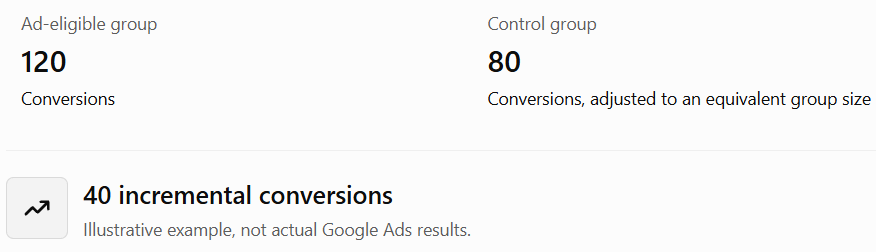
In this example, the estimated incremental impact is 40 additional conversions. The campaign generated 120 conversions in the ad-eligible group, but the control group indicates that some conversions would likely have occurred without exposure to the measured campaigns.
The example assumes comparable groups and equivalent measurement periods. Actual Conversion Lift studies use their configured experimental design and statistical methodology.
Conversion Lift vs. regular conversion tracking
Standard conversion tracking tells advertisers which conversions Google Ads attributes to campaigns under the selected attribution and measurement settings. Conversion Lift addresses a different question: whether the advertising caused additional conversions.
| Measurement | What it tells you |
| Standard conversion tracking | How many conversions are reported or attributed to ads |
| Conversion attribution | How credit for a conversion is assigned across eligible ad interactions |
| Conversion Lift | How many additional conversions are estimated to result from the measured advertising |
These methods serve different purposes. Conversion Lift does not replace conversion tracking, and attribution reports remain useful for campaign management. Instead, lift studies provide experimental evidence about incremental impact.
Source: Google Ads Help.
What Has Google Changed in October 2026?
On October 7, 2026, Search Engine Land reported that Google was expanding self-service, user-based Conversion Lift studies to Search and Performance Max campaigns. Previously, advertisers using these campaign types needed assistance from a Google representative to access this measurement.
Source: Search Engine Land, October 7, 2026.
The expansion brings Search and Performance Max into the supported campaign types for user-based Conversion Lift studies, alongside Display, Video, Demand Gen, and eligible app campaigns.
The change matters because Search and Performance Max serve different advertising roles:
- Search campaigns can capture demand from people actively searching for products, services, or solutions.
- Performance Max campaigns can reach potential customers across Google’s advertising inventory through a single campaign.
- Conversion Lift studies can help determine whether the measured campaigns generated additional conversions rather than simply receiving credit for existing demand.
For advertisers who meet Google’s requirements, the change offers a more direct route to testing the incremental impact of these campaigns.
It does not mean that every Google Ads account automatically qualifies or that every campaign will produce a statistically conclusive result.
Who Qualifies for Conversion Lift on Search and Performance Max?
Google’s official setup documentation lists account thresholds, compatible conversion actions, and campaign eligibility requirements.
The following are the main requirements advertisers should check before planning a study.
1. At least 1,000 observed conversions
Your account must have at least 1,000 observed conversions. Conversions reported through supplementary conversion data do not count toward this minimum.
2. A minimum campaign budget of $5,000
The study requires a minimum campaign budget of $5,000 USD. Advertisers should confirm the applicable budget requirements during study setup rather than assume that any account spending this amount automatically qualifies.
3. At least one compatible conversion action
The account must track at least one conversion action supported by Conversion Lift. Having conversions in Google Ads alone does not guarantee that the selected actions are eligible.
4. An eligible campaign type
Search and Performance Max are supported, along with other listed campaign types. Certain campaign categories, including iOS app campaigns and Travel Ads, are excluded from the documented eligibility.
5. Availability in the Google Ads account
Google states that Conversion Lift is not available for all accounts. New campaign types in alpha or beta may still require assistance from a Google account representative.
Source for all requirements: Google Ads Help — Set up Conversion Lift based on users.
Does spending $5,000 guarantee access?
No. The minimum budget is one eligibility condition, not a guarantee of access or a conclusive study.
Advertisers must also meet the conversion threshold, use compatible conversion actions, and have an eligible account and campaign configuration. The study’s statistical power depends on additional factors, including conversion volume, study duration, and the size of the control group.
Practical takeaway: Check all eligibility conditions in Google Ads before allocating budget specifically for a Conversion Lift study.
How Does Conversion Lift Work?
Google’s user-based Conversion Lift study uses an experimental design to compare two groups.
Step 1: Create two groups
Google divides eligible users into a treatment group that can see the measured ads and a control group held back from those campaigns.
Step 2: Measure conversion activity
The study records eligible conversion activity for both groups during the measurement period.
Step 3: Estimate incremental impact
Google compares the results to estimate the conversions and conversion value generated by the measured advertising.
Step 4: Review the study results
Advertisers can evaluate incremental conversions, incremental cost per action, relative lift, and incremental return on ad spend, depending on the study configuration.
Source: Google Ads Help — Understanding Conversion Lift results.
The control group is central to the method. Without a comparison group, advertisers cannot reliably distinguish conversions caused by the advertising from conversions that would have occurred without it.
One qualification matters: a user-based study holds users back from the campaigns included in the experiment. It does not necessarily prevent them from seeing other ads or encountering the business through organic search, direct visits, or other marketing channels.
Consequently, the results estimate the incremental contribution of the campaigns being measured within the broader marketing environment.
Why Does This Expansion Matter for Search Campaigns?
Search advertising often reaches people who already have a specific need. Someone searching for a company’s name, for example, may already intend to purchase from that business.
This creates a measurement challenge.
A campaign might report a high number of conversions because it captures existing demand. That does not automatically mean every reported conversion was caused by the ad.
Conversion Lift can help advertisers investigate this distinction.
Example: Branded Search vs. nonbrand Search
Suppose an online retailer runs campaigns targeting branded and nonbrand search terms.
- Branded searches reach people who already know the retailer.
- Nonbrand searches reach people searching for a product category or solution.
The retailer may find that branded campaigns generate many attributed conversions. However, some of those customers might have visited the website through organic search or direct navigation without an ad.
A lift study can help estimate the additional conversions produced by the measured campaigns, provided the study has sufficient data and is configured appropriately.
This does not mean branded Search is ineffective. Branded ads may protect visibility, influence the path to purchase, or produce additional conversions. The point is to measure their contribution rather than assume that every attributed conversion is incremental.
Questions Search advertisers can investigate
- Do branded Search campaigns generate additional sales or mostly capture existing demand?
- Do nonbrand Search campaigns produce incremental leads at an acceptable cost?
- Does a campaign generate enough additional revenue to justify its budget?
- Should more budget go to campaigns that create new demand rather than campaigns that mainly capture it?
These are measurement questions, not conclusions that can be drawn from conversion counts alone.
Why Is Conversion Lift Relevant to Performance Max?
Performance Max is a goal-based Google Ads campaign type that can serve ads across eligible Google advertising channels. Because a single campaign can reach users in different contexts, understanding its total incremental contribution can be difficult.
For example, a retailer might use Performance Max to generate online purchases. Standard reporting may attribute purchases to the campaign, but those numbers alone do not establish how many sales the campaign caused.
Conversion Lift offers a way to test that question.
Three situations where it can help
1. Evaluating whether additional spend produces additional sales
An advertiser may be considering a budget increase. A lift study can provide evidence about whether the campaign generates incremental conversion value, rather than relying exclusively on reported ROAS.
2. Assessing the contribution of Performance Max alongside other campaigns
A business might run Search, Performance Max, and other advertising campaigns at the same time. A study can help estimate the contribution of the selected Performance Max campaigns while the rest of the marketing activity continues.
3. Supporting budget allocation decisions
If incremental returns differ across measured campaigns, advertisers can use the findings alongside profitability, customer acquisition costs, and other business metrics when reviewing budget allocation.
The third point requires care: a Conversion Lift study measures the campaigns included in that study. It does not automatically produce a complete comparison of every channel or campaign in the account.
Google recommends considering campaigns with similar types, audiences, and targeting strategies when deciding which campaigns to include. Measuring only a subset may also reduce the chance of detecting lift when the control group remains exposed to other campaigns.
Source: Google Ads Conversion Lift setup guidance.
Which Conversion Lift Metrics Should Advertisers Track?
The value of a lift study depends on selecting the right business outcome and interpreting the metrics correctly.
Google’s reporting documentation describes several measures that help advertisers understand incremental performance.
| Metric | What it measures | Why it matters |
| Incremental conversions | Estimated additional conversions generated by the campaigns | Shows the campaign’s estimated contribution to conversion volume |
| Relative lift | Incremental conversions divided by control-group conversions | Shows the percentage increase relative to the control baseline |
| Incremental CPA (iCPA) | Ad spend divided by incremental conversions | Estimates the cost of generating an additional conversion |
| Incremental conversion value | Difference between treatment and control conversion value | Estimates additional sales or other assigned conversion value |
| Incremental ROAS (iROAS) | Incremental conversion value divided by ad spend | Estimates the additional conversion value generated per advertising dollar |
Source: Google Ads Help — Conversion Lift metrics.
Example: Incremental CPA
Assume a campaign spends $10,000 and the study estimates 400 incremental leads.
iCPA = $10, 000 / 400 = $25
The incremental cost per lead is $25.
This differs from standard CPA because the calculation uses the estimated additional leads generated by the advertising, not simply the conversions attributed to the campaign.
Example: Incremental ROAS
Suppose an advertiser spends $5,000 and the study estimates $12,000 in incremental conversion value.
iROAS = $12, 000 / $5,000 = 2.4
The incremental ROAS is 2.4, or 240%. That means the measured campaign generated an estimated $2.40 in additional conversion value per advertising dollar.
These examples are illustrative. Actual results depend on the study design, conversion values, and measured outcomes.
Why standard ROAS and incremental ROAS can differ
Standard ROAS divides attributed conversion value by advertising spend. Incremental ROAS uses the difference between the treatment and control groups’ conversion values.
A campaign can have high attributed ROAS but lower incremental ROAS if many reported conversions would have happened anyway. Conversely, a campaign with lower attributed ROAS may still produce meaningful additional business value.
Advertisers should evaluate both metrics rather than treating one as a replacement for the other.
How to Set Up a Conversion Lift Study in Google Ads
Eligible advertisers can create a user-based Conversion Lift study through the Google Ads interface. Google’s current help documentation provides the following setup process.
- Open the Lift studies area under Campaigns and select the option to create a new study.
- Select Conversion Lift as the measurement type.
- Choose Based on users for the test-group method.
- Give the study a name and select eligible campaigns.
- Choose the conversion goals to measure, or retain the applicable campaign defaults.
- Select whether the study should focus on conversion volume or conversion value.
- Set the study’s start and end dates, then review the recommended control-group size and estimated study power.
- Review the configuration and create the study.
The exact interface may vary as Google updates its products. Campaign eligibility is checked during setup, and a campaign already included in another Brand Lift, Search Lift, or Conversion Lift study may not be available for selection.
See Google’s official setup instructions before launching a study.
How long should a study run?
Google allows studies as short as seven days but generally recommends running them for more than 14 days, especially when conversions take longer to occur. Its documentation reports that studies with long conversion delays that run for less than 14 days have shown up to a 17% drop in absolute lift.
The appropriate duration depends on the campaign’s conversion lag, expected conversion volume, and the study’s statistical power. A longer study may collect more evidence, but duration alone does not guarantee a conclusive result.
Should you change campaigns during the study?
Avoid major changes that could make the results difficult to interpret.
Google advises caution when modifying campaigns included in an active study. Routine business changes, such as bid or budget adjustments, may be possible, but changes to creatives or audiences can affect the study’s findings.
Where possible, define the hypothesis and measurement plan before the study begins, and keep campaign conditions reasonably consistent throughout the test.
How to Improve the Reliability of Conversion Lift Results
Meeting Google’s eligibility thresholds is only the starting point. The study also needs enough data to detect a meaningful difference between the groups.
1. Check conversion tracking before launch
Verify that the selected conversion actions record the intended business outcomes. For a lead-generation business, that could mean form submissions or qualified leads, depending on what is supported and selected for the study.
Enhanced conversions for web or leads may help improve measurement by providing securely hashed first-party data. Google also recommends appropriate Consent Mode implementation and provides diagnostics to identify tracking readiness issues.
These features should be implemented in accordance with Google’s technical guidance and applicable privacy requirements. They do not guarantee perfect measurement.
2. Select conversion actions with enough volume
A study focused only on a rare, high-value conversion may not collect enough data to establish a clear result.
For example, an ecommerce advertiser might have enough purchases to measure lift but too few repeat purchases during the study period. A lead-generation advertiser might have more form submissions than closed sales.
Measuring a more frequent conversion action can increase the chance of detecting lift. However, the selected action must still reflect a meaningful business objective. A rise in low-quality leads is not equivalent to an increase in profitable customers.
3. Review study power before committing
Google’s study setup process estimates the likelihood of obtaining conclusive results based on the planned configuration.
Google recommends aiming for 90% or higher certainty. Results between 50% and 90% may offer directional evidence, but they provide less certainty that the measured effect reflects a real campaign impact.
Study power is affected by factors such as conversion volume, campaign budget, duration, selected conversion actions, and control-group size. A study with a low estimated power may need a longer duration or a different configuration.
4. Choose campaigns that answer one clear question
Avoid including unrelated campaigns merely because they are available.
If the goal is to understand the incremental contribution of Performance Max, decide whether to measure a specific campaign or a broader group of similar campaigns. If the goal is to evaluate Search, define which Search campaigns and conversion goals are relevant.
The study should match the business decision you need to make.
5. Allow for the sales cycle
A conversion does not always happen immediately after an ad interaction. This is especially relevant for expensive products, B2B services, and purchases that require several decision-makers.
Set the measurement period with the normal conversion delay in mind. Also distinguish between observed results and modeled results where the reporting interface includes both.
Google’s documentation currently describes delayed incremental conversion projections for eligible Demand Gen-only studies. Advertisers should not assume this feature automatically applies to Search or Performance Max studies.
Source: Google Ads Conversion Lift guidance.
Who Should Consider Conversion Lift?
The expansion is most relevant to advertisers who have enough conversion volume and budget to run a meaningful experiment and a clear business question to answer.
High-volume Search advertisers
Businesses that want to understand whether branded or nonbrand campaigns generate additional conversions beyond existing demand.
Performance Max advertisers
Retailers and other advertisers looking to estimate the incremental value of their campaigns while other marketing activity continues.
Marketing teams reviewing budget allocation
Teams that need stronger evidence before shifting substantial spend between campaign types or validating a media investment.
Advertisers with reliable conversion measurement
Accounts with compatible conversion actions, sufficient observed conversions, and tracking that is ready for an experiment.
Who may not benefit yet?
Advertisers with low conversion volume, limited budgets, inconsistent tracking, or no clear measurement question may struggle to obtain a conclusive result.
A smaller advertiser can still use standard conversion tracking, attribution reports, and other campaign analysis methods to make informed decisions. Conversion Lift is not a requirement for running effective Google Ads campaigns.
The decision to run a study should depend on the potential value of the answer relative to the cost and operational effort of conducting the experiment.
What Are the Limitations of Conversion Lift?
Conversion Lift provides evidence about incremental impact, but it is not a complete measure of business profitability.
Keep these limitations in mind:
- Eligibility is restricted. The feature is not available to every Google Ads account, and minimum thresholds apply.
- Results have uncertainty. A study can return inconclusive or low-certainty results even when a campaign has a real effect.
- The selected campaigns define the question. A study measuring only some campaigns does not establish the incremental impact of every campaign in the account.
- Other marketing can affect the results. Users in the control group may still encounter the brand through organic search, other ads, referrals, or direct visits.
- Conversion value is not necessarily profit. Incremental revenue or assigned conversion value does not account for product costs, fulfillment, refunds, or operating expenses unless those factors are reflected in the business analysis.
- Results depend on tracking quality. Missing or inconsistent conversion data can affect the strength and interpretation of the findings.
A lift study should therefore inform budget and campaign decisions alongside conversion quality, revenue, margins, customer lifetime value, and other business outcomes.
Frequently Asked Questions
1. Is Conversion Lift now available for Google Search and Performance Max?
Yes. Google’s current documentation lists Search and Performance Max among the supported campaign types for user-based Conversion Lift studies. Access is subject to account, campaign, conversion, and budget eligibility requirements.
2. What is the minimum budget for Google Ads Conversion Lift?
Google’s current setup documentation specifies a minimum campaign budget of $5,000 USD for the study. This is one eligibility requirement, not a guarantee that an account will qualify or produce conclusive results.
3. How many conversions are required for Conversion Lift?
The account must have at least 1,000 observed conversions. Conversions using supplementary data do not count toward this minimum. Advertisers must also use at least one compatible conversion action.
4. Does Conversion Lift replace Google Ads conversion tracking?
No. Standard conversion tracking reports and attributes conversions according to the configured measurement settings. Conversion Lift uses a treatment-and-control comparison to estimate additional conversions caused by the measured campaigns.
5. Can Conversion Lift measure incremental ROAS?
Yes. When the study is configured to measure conversion value, the results can include incremental conversion value and incremental ROAS (iROAS). This estimates the additional conversion value generated per advertising dollar.
6. How long does a Conversion Lift study take?
Google allows studies as short as seven days but generally recommends more than 14 days, especially when conversions take longer to occur. The best duration depends on conversion lag, campaign activity, and the study’s estimated power.
7. Can small businesses use Conversion Lift?
Some small businesses may qualify, but eligibility depends on meeting the conversion, budget, conversion-action, and account requirements. Businesses that do not qualify can still use standard conversion tracking and other methods to evaluate campaign performance.
8. Does a high Conversion Lift result guarantee profitability?
No. Conversion Lift estimates the incremental effect of advertising on selected conversion outcomes. Profitability also depends on margins, fulfillment costs, lead quality, customer retention, and other business expenses.
Final Thoughts
Google’s expansion of Conversion Lift to Search and Performance Max gives eligible advertisers another way to evaluate the actual contribution of their campaigns.
For digital marketers, the key change is the ability to investigate whether reported conversions represent additional business outcomes or demand that might have existed without the ads.
At DigiTrend, we recommend treating incrementality as one part of campaign evaluation, alongside conversion tracking, lead quality, revenue, and profitability. Before launching a study, verify eligibility, check measurement quality, and define the business decision the results should support.
The goal is not simply to report more conversions. It is to understand which advertising activity generates additional business value.
Also Read: