Google Core Update November 2026: What You Need to Know
Google has just released another broad core update, and it’s come in at the absolute start of one of the busiest shopping periods of the year.
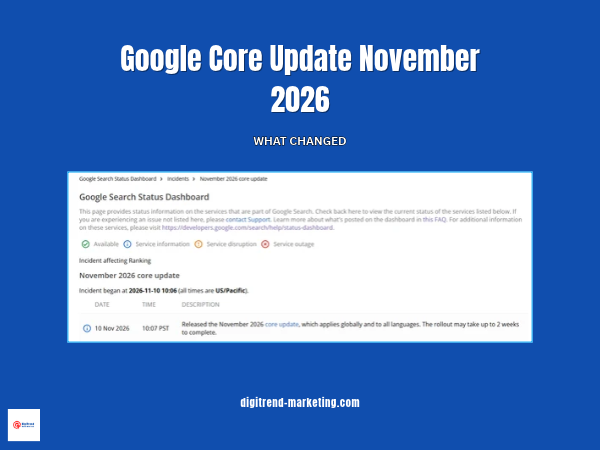
On 10th November 2026, Google launched its November 2026 Core Update. It’s a global update, applies to all languages, and could take up to two weeks to complete.
In other words, Google’s ranking algorithms are now looking at websites all over the world. Some will be moving up, some will be moving down, and a lot of site owners are going to be spending the next few days checking their Google Search Console as if it were a live cricket score.
But what’s actually changing? Is this another quality update? Does it have any impact on AI-generated content? Should businesses be updating their existing blogs? Should they be reviewing their SEO strategy? Or is it just another case of ‘wait and see’?
There are loads of questions, but not all the answers are in yet.
At DigiTrend Marketing Solutions, we think the right response to a Google algorithm update is to first and foremost understand what Google has actually said. You need to separate the actual announcement from the industry rumor mill and then make your decisions based on your site’s performance rather than on a knee-jerk reaction to an update.
Table of Contents
November 2026 Google Core Update: Key Takeaways
Here are the most important developments at a glance:
- Official release: Google announced the November 2026 Core Update on November 10, 2026.
- Global rollout: The update applies to all regions and languages.
- Expected duration: Google says the rollout may take up to two weeks, potentially completing around November 24.
- Primary objective: Google describes it as a regular update designed to surface more relevant and satisfying content from websites of all types.
- Ranking fluctuations: Websites may experience changes in organic rankings, impressions, and traffic during the rollout.
- No confirmed targeting: Google has not announced any specific industry, content format, SEO tactic, or ranking factor being targeted.
- Not a penalty: A decline in rankings does not automatically mean a website has violated Google’s guidelines.
- AI search reporting issue: Google confirmed a separate reporting error affecting impressions in its Generative AI performance report between November 9 and November 11.
- Recommended approach: Wait for the rollout to finish and allow another full week before conducting a meaningful post-update comparison.
- Long-term priority: Original, useful, reliable, and people-first content remains central to Google’s published guidance.
What Is the Google November 2026 Core Update?
The November 2026 Core Update is a broad change to Google’s search ranking systems.
Unlike a narrowly focused spam update, which addresses specific forms of policy violations, a core update involves broader changes to the systems Google uses to evaluate and rank content.
Google’s stated objective is to improve the overall quality of search results by presenting information that better satisfies users’ needs.
The company’s announcement describes this release as:
“This is a regular update designed to better surface relevant, satisfying content for searchers from all types of sites. The rollout may take up to 2 weeks to complete.”
This wording matters.
Google has not announced that it is specifically targeting AI-generated articles, affiliate websites, product reviews, link building, or any particular content category.
Instead, the update is intended to improve how Google’s ranking systems assess content across the web.
For website owners, this means that previously well-performing pages may lose positions while competing pages gain visibility. A page that was ranked fifth could move to second, while another page could disappear from the first page.
That does not necessarily mean the declining page has become worse. It may simply mean Google’s systems now consider other pages better suited to the search.
Think of it as a restaurant changing its menu recommendations. Your favorite restaurant has not suddenly become terrible. There may simply be another place serving what you want more effectively.
Official Google announcement
Google confirmed the update through its Search Status Dashboard and Search Central’s LinkedIn announcement.
You can follow both announcements here:
- Google Search Status Dashboard – November 2026 Core Update
- Google Search Central’s official LinkedIn announcement
These are the primary sources to monitor for rollout updates and confirmation that the update has finished.
When Did the November 2026 Core Update Start?
Google officially started rolling out the update on November 10, 2026, at 10:06 a.m. Pacific Time.
Search Engine Land reported the announcement at approximately 1:07 p.m. Eastern Time.
According to Google’s Search Status Dashboard, the update affects the Ranking category and applies globally.
Google estimates that the rollout may take up to 14 days.
November 2026 Core Update timeline
| Event | Date and details |
| Official announcement | November 10, 2026 |
| Rollout started | November 10, 2026, 10:06 a.m. PT |
| Geographic coverage | Worldwide |
| Language coverage | All languages |
| Expected duration | Up to two weeks |
| Estimated completion | Around November 24, 2026 |
| Current status (November 13) | Rolling out |
The November 24 date is an estimate based on Google’s stated maximum rollout period, not a confirmed completion date.
You should use Google’s official dashboard rather than relying on estimated dates from third-party SEO tracking platforms.
Why does the timing matter?
The update is arriving just before the US holiday shopping season.
If the rollout takes the full two weeks, it could finish around November 24, immediately before Thanksgiving, Black Friday, and Cyber Monday.
For ecommerce businesses, this creates an uncomfortable timing issue.
Imagine preparing your biggest annual sales campaign, only to discover that your organic product category pages have moved down several positions.
Not exactly the holiday surprise anyone ordered.
Businesses should therefore monitor organic search performance carefully while avoiding unnecessary website changes during the rollout.
What Has Google Actually Confirmed About This Update?
Before discussing potential ranking factors, it is worth separating confirmed information from industry assumptions.
Google has provided a relatively short announcement. It has not published a detailed technical breakdown of the November update.
Here is what we know.
Confirmed information
1. The update is global.
The November 2026 Core Update applies across all regions and languages. It is not restricted to US websites or English-language search results.
2. It is a broad core update.
Google describes it as a regular update intended to improve the relevance and satisfaction of search results.
3. It affects Google’s ranking systems.
The Search Status Dashboard lists the update under Ranking.
4. The rollout may take up to two weeks.
Google has provided an estimated rollout window, but the actual completion date will depend on the rollout.
5. No specific website category has been identified as a target.
Google has not announced a dedicated focus on ecommerce, publishers, affiliate sites, local businesses, or any other particular category.
What Google has not confirmed
There is no official confirmation that the November update:
- Specifically penalizes AI-generated content.
- Introduces a new E-E-A-T ranking factor.
- Targets websites with excessive affiliate links.
- Penalizes websites for publishing frequently.
- Introduces a new backlink evaluation system.
- Targets websites with low word counts.
- Prioritizes websites using a particular content management system.
- Changes the ranking weight of Core Web Vitals.
- Introduces a new standalone AI search ranking algorithm.
These topics may appear in SEO discussions, but they should not be presented as confirmed objectives of this update.
There is a difference between an informed SEO hypothesis and an official Google announcement. The two should not be mixed just to make an article sound more exciting.
How Is the November Update Different From Previous Google Core Updates?
The November update is Google’s third core update of 2026.
To understand its timing, let’s look at the recent update history.
Google core update timeline
| Update | Start date | Completion date | Duration |
| November 2026 Core Update | November 10, 2026 | In progress | Up to 2 weeks |
| May 2026 Core Update | May 21, 2026 | June 2, 2026 | 11 days, 21 hours |
| March 2026 Core Update | March 27, 2026 | April 8, 2026 | 12 days, 4 hours |
| December 2025 Core Update | December 11, 2025 | December 29, 2025 | 18 days, 2 hours |
| June 2025 Core Update | June 30, 2025 | July 17, 2025 | 17 days |
| March 2025 Core Update | March 13, 2025 | March 27, 2025 | 14 days |
The gap between the May and November 2026 core updates is particularly noticeable.
Google’s May 2026 update finished on June 2, while the next announced core update did not begin until November 10.
That is more than five months without another announced core update.
However, this does not mean Google stopped changing its search systems during that period. Google continuously makes smaller, unannounced ranking adjustments.
A major core update is simply a more substantial and publicly announced change.
What happened between the core updates?
The period also included several other confirmed search updates:
- September 2026 Spam Update: September 24 to October 8.
- August 2026 Spam Update: August 18 to August 21.
- June 2026 Spam Update: June 24 to June 26.
- March 2026 Spam Update: March 24, lasting 19 hours and 30 minutes.
This distinction matters because a website experiencing ranking fluctuations should not automatically attribute every change to a core update.
Google’s search ecosystem includes several ranking systems and update types. Identifying the likely cause requires looking at the timing, affected pages, search queries, and available evidence.
What Could the November 2026 Core Update Mean for SEO?
Google has not disclosed the precise technical changes behind this release.
Therefore, the following sections discuss areas website owners should evaluate based on Google’s established core update guidance and broader SEO principles. They are not confirmed descriptions of the November update’s internal changes.
A. Content quality and search intent
Content quality remains one of the most important areas to review.
A page can contain the correct keywords, an attractive title, structured headings, and several internal links but still fail to answer the user’s question.
Consider someone searching for:
“Best CRM software for small businesses.”
They probably want more than a list of ten CRM products with affiliate links.
They may need:
- A comparison of pricing plans.
- Features relevant to small teams.
- Information about ease of use.
- Integration options.
- Limitations and drawbacks.
- Recommendations for different business requirements.
A page that genuinely helps someone make a decision offers more than a page that simply repeats product descriptions.
Businesses should examine whether their content satisfies the reason behind a search rather than merely including the search phrase.
What to review:
- Does the page answer the primary search query?
- Does it address related questions?
- Does it provide useful examples?
- Does it include original information?
- Does it explain limitations and practical considerations?
- Can a reader make a better decision after reading it?
B. Originality and information gain
The internet already has enough articles explaining what SEO stands for.
Publishing another generic definition is unlikely to give readers a compelling reason to choose your page.
Originality means contributing something beyond information that is already widely available.
This could include:
- Firsthand experience.
- Original research.
- Expert commentary.
- Practical case studies.
- Proprietary data.
- Real examples.
- Detailed comparisons.
- Lessons from actual business projects.
For example, an article about website conversion rates becomes more useful when it explains what was changed on a landing page, why the change was made, and what happened afterward.
A collection of generic conversion tips is not equivalent to documented experience.
This is also where information gain becomes useful as a content strategy concept. Ask what a reader will learn from your page that they would not easily find in the other results.
C. E-E-A-T: Experience, Expertise, Authoritativeness, and Trust
E-E-A-T remains an important framework in Google’s Search Quality Rater Guidelines and content guidance.
It stands for:
- Experience: Does the content demonstrate firsthand knowledge or practical experience?
- Expertise: Does the author have relevant knowledge of the subject?
- Authoritativeness: Is the website or author recognized as a reliable source?
- Trustworthiness: Is the information accurate, honest, and dependable?
E-E-A-T is not a single ranking factor or a score that website owners can calculate.
Instead, it provides a useful way to assess whether content demonstrates the qualities that users and Google’s evaluation systems should be able to recognize.
For businesses, this means paying attention to the people and evidence behind their content.
A medical article should have appropriate medical expertise and reliable references. A financial guide should provide accurate information and clearly explain its limitations. A technical article should be supported by actual technical knowledge.
Adding an author biography that says someone is an industry expert is not enough if the person has no relevant background.
Google also recommends making authorship clear where readers would reasonably expect it.
D. AI-generated content and editorial quality
AI-generated content is likely to remain a major discussion point following this update.
However, there is no official evidence that the November 2026 Core Update specifically targets AI-written articles.
Google’s published position has focused on the quality and purpose of content rather than the mere use of an AI writing tool.
AI can assist with:
- Research organization.
- Topic discovery.
- Content outlines.
- Draft preparation.
- Data analysis.
- Editing and proofreading.
- Content gap identification.
Problems arise when websites use automation to produce large quantities of pages without providing meaningful value.
Consider two examples.
Website A: Publishes 100 AI-generated articles covering similar topics. Most contain generic explanations, repeated information, and little original research.
Website B: Uses AI to assist its editorial team. Every article undergoes fact-checking, expert review, original analysis, and editorial refinement.
Both websites use AI. Their content quality and publishing processes are very different.
The lesson is simple: AI should assist the editorial process, not replace responsibility for accuracy and usefulness.
For additional guidance, see Google’s Creating Helpful, Reliable, People-First Content.
E. Topical relevance and content depth
Publishing dozens of unrelated articles does not automatically establish topical authority.
A website about digital marketing, for example, should provide meaningful coverage of its primary subject areas.
If it publishes an article about technical SEO, it should ideally connect that topic with relevant resources covering:
- Website crawling.
- Indexing.
- Site architecture.
- Internal linking.
- Canonical tags.
- Structured data.
- Website performance.
This creates a useful information structure for readers and search engines.
However, content depth should not be confused with article length.
A 1,500-word article that answers a question completely can be more useful than a 4,000-word article that repeats the same three ideas in different paragraphs.
Word count is not a substitute for substance.
F. Website experience and technical SEO
Content quality does not eliminate the need for a technically sound website.
Search engines need to crawl, render, understand, and index pages correctly.
Businesses should review:
- Mobile usability.
- Page loading performance.
- Core Web Vitals.
- Crawlability.
- Indexability.
- Canonical tags.
- Redirects.
- Internal linking.
- HTTPS implementation.
- Structured data.
- Duplicate pages.
- Broken links.
Core Web Vitals measure aspects of loading performance, interactivity, and visual stability.
The current metrics include:
| Metric | What it measures | Good threshold |
| LCP | Largest Contentful Paint | 2.5 seconds or less |
| INP | Interaction to Next Paint | 200 milliseconds or less |
| CLS | Cumulative Layout Shift | 0.1 or less |
These are Google’s published good-performance thresholds, measured at the 75th percentile of page loads.
They are useful technical benchmarks, but there is no evidence that the November update introduces new Core Web Vitals thresholds.
A technically healthy website is a sensible SEO priority regardless of whether a core update is running.
G. Content freshness and outdated information
Updating a publication date does not make an article useful again.
Content freshness should involve meaningful improvements.
For example, an article about Google Ads written in 2023 may contain outdated interface instructions, old campaign settings, and references to discontinued features.
A proper content refresh should:
- Verify the accuracy of existing information.
- Remove outdated recommendations.
- Add relevant developments.
- Replace old examples where necessary.
- Include current sources.
- Improve sections that no longer answer user questions.
- Update screenshots and instructions where appropriate.
Do not update every article simply because its publication date looks old.
Some evergreen resources remain accurate for years. Others become outdated within months.
The reader’s needs should determine whether an update is necessary.
Will the November 2026 Core Update Affect AI Overviews and AI Search?
This is one of the more interesting questions for businesses investing in AI SEO and generative engine optimization (GEO).
Google’s announcement specifically discusses improving Google Search results. It does not provide a detailed explanation of how the November update affects individual AI-powered search features.
Search Engine Roundtable also notes that core updates can have implications for Google Discover and other search features.
However, website owners should not assume that every change in AI Overview visibility is caused by this core update.
There is another development that deserves attention.
Google Search Console reports a Generative AI performance data issue
On November 12, 2026, Search Engine Land reported a Google-confirmed logging error affecting the Generative AI performance report in Search Console.
The issue affected impression reporting between November 9 and November 11, 2026.
Google explained that the error affected data logging only and did not affect actual performance in Google Search’s AI experiences.
This distinction is important.
If your website’s Generative AI performance report shows a sudden decline in impressions during this period, it may be related to the reporting error rather than an actual decline in visibility.
The timing also overlaps with the beginning of the November Core Update.
Consequently, website owners should avoid combining the two developments into one explanation.
Our recommendation:
- Check the Search Console data anomaly annotation.
- Separate traditional Web Search performance from Generative AI reporting.
- Compare actual clicks and traffic with reported impressions.
- Avoid drawing conclusions from November 9–11 AI performance data.
- Continue monitoring AI search visibility after the reporting issue.
The broader lesson is that SEO reporting requires understanding how data is collected, not just reading the numbers displayed in a dashboard.
What Should Websites Avoid During the November Core Update?
An active core update can make even experienced marketers uncomfortable.
But making unnecessary changes during the rollout can create additional problems.
Here are some actions we recommend avoiding.
Avoid rewriting every article.
A ranking decline does not mean every page needs to be rewritten. Identify the pages experiencing meaningful losses first.
Avoid deleting content indiscriminately.
Removing old pages without evaluating their purpose, traffic, backlinks, and internal links can create additional SEO problems.
Google recommends treating content deletion as a last resort.
Avoid keyword stuffing.
Adding more keyword variations does not automatically improve relevance.
Avoid buying backlinks to recover rankings.
There is no evidence that a sudden backlink campaign will restore visibility after a core update. Manipulative link schemes can also violate Google’s spam policies.
Avoid copying competitors.
A competitor’s ranking does not mean its content should be duplicated. Identify what it does better and create a more useful resource.
Avoid making major website migrations without a business reason.
A redesign, domain migration, or large-scale URL restructuring introduces additional variables when you are trying to understand ranking changes.
Do not postpone necessary security or business-critical maintenance, but avoid unnecessary large changes during the monitoring period.
Avoid treating AI-generated content as automatically harmful.
Evaluate the actual quality, accuracy, originality, and purpose of your content.
Avoid judging results too early.
A few days of ranking fluctuations do not provide enough evidence to determine the long-term impact of a broad core update.
DigiTrend’s Recommended SEO Action Plan
At DigiTrend Marketing Solutions, we recommend a measured approach instead of reacting to every movement in search rankings.
Here is the action plan we suggest for the November 2026 Core Update.
| Period | Recommended action | Objective |
| November 10–24 | Monitor rankings, traffic, and indexing | Observe rollout movements |
| November 10–24 | Record baseline and performance data | Preserve comparison data |
| November 10–24 | Avoid unnecessary large-scale changes | Reduce additional variables |
| November 25–December 1 | Continue monitoring | Allow post-rollout stabilization |
| After December 1 | Compare Search Console performance | Identify sustained changes |
| December onward | Audit affected pages | Determine likely causes |
| December onward | Improve content and technical issues | Address documented weaknesses |
| Ongoing | Monitor conversions and organic revenue | Measure business outcomes |
The dates assume the rollout completes around November 24. If Google announces a different completion date, adjust the schedule accordingly.
Our post-update SEO audit checklist
Use this checklist when evaluating your website.
- Confirm the official rollout completion date.
- Compare pre-update and post-update performance.
- Identify pages with significant ranking losses.
- Identify pages that have gained visibility.
- Review affected search queries.
- Check organic traffic in GA4.
- Examine changes in conversion rates.
- Review search intent and competitor pages.
- Assess content originality and usefulness.
- Verify author information and supporting sources.
- Check technical SEO and indexing.
- Review internal linking.
- Evaluate backlink quality where evidence warrants it.
- Prioritize improvements based on business impact.
- Document changes and monitor subsequent performance.
Frequently Asked Questions About the Google Core Updates
When did Google release the November 2026 Core Update?
Google began rolling out the November 2026 Core Update on November 10, 2026, at 10:06 a.m. Pacific Time.
How long will the November 2026 Core Update take?
Google says the rollout may take up to two weeks. If it uses the full period, it could finish around November 24, 2026.
Is the November 2026 Core Update global?
Yes. Google confirmed that the update applies worldwide and covers all languages.
Is the November 2026 update a penalty?
No. A core update is not a manual penalty. It involves broad changes to Google’s ranking systems, which may cause websites to gain or lose visibility.
A ranking decline does not automatically indicate a policy violation.
Does the November 2026 Core Update target AI-generated content?
Google has not announced any specific targeting of AI-generated content in this update.
The company’s established guidance focuses on helpfulness, originality, reliability, and the purpose of content rather than the tool used to create it.
Should I update my website during the November 2026 Core Update?
You can continue normal website maintenance and publish genuinely useful content.
However, avoid making unnecessary large-scale changes based on temporary ranking fluctuations. Investigate the evidence before changing pages that are already performing well.
How can I check whether my website has been affected?
Use Google Search Console to compare clicks, impressions, CTR, average position, queries, and landing pages.
Also review GA4 organic traffic and business conversions.
Wait until the rollout has finished and allow at least one additional full week before conducting the main post-update assessment, following Google’s guidance.
Can a website recover after losing rankings?
Yes, websites can regain visibility through meaningful improvements, although recovery is not guaranteed or immediate.
Google explains that improvements can take several months to be reflected in its systems.
Does the update affect Google Discover?
Google core updates can affect Discover and other Google search features. However, Google has not published specific November 2026 findings about the impact on Discover.
Will publishing more content help recover rankings?
Not necessarily.
Publishing additional articles without improving their usefulness, originality, or relevance may not address the underlying problem.
Prioritize improving the quality and purpose of existing content where evidence indicates a weakness.
Should I disavow backlinks after a ranking decline?
Not automatically.
A core update-related decline does not prove that backlinks are responsible. Review your backlink profile and take action only when there is a clear reason to do so.
When should I start analyzing the impact of the update?
Wait until Google confirms that the rollout has finished. Then allow at least one full week before conducting the main Search Console comparison.
If the rollout finishes around November 24, the first suitable assessment period would begin after December 1.
Final Thoughts
The November 2026 Google Core Update is another reminder that organic search is not a fixed competition.
Rankings change. Search behavior evolves. Competitors improve their content. Google adjusts its ranking systems.
A website that ranks well today cannot assume that the same pages will maintain their positions indefinitely.
However, businesses should not treat every core update as a reason to rebuild their SEO strategy from scratch.
Google has not announced a special set of requirements for the November update. Its stated objective is to surface more relevant and satisfying content across different types of websites.
That makes the best immediate response relatively clear:
- Monitor performance without overreacting.
- Understand which pages and queries have changed.
- Review content quality and search intent.
- Improve the information your website provides.
- Maintain sound technical SEO.
- Measure leads, sales, and conversions alongside rankings.
At DigiTrend Marketing Solutions, we believe sustainable SEO comes from understanding what users need and creating digital experiences that meet those expectations.
An algorithm update may change where your website appears. The quality of your website determines whether visitors have a reason to stay.
And no, publishing another 2,000-word article containing the phrase “Google November 2026 Core Update” 47 times is not a recovery strategy.
Google has probably read enough of those already.
Stay informed. Monitor the evidence. Improve what matters.