Google August 2026 Spam Update Is Now Rolling Out: What You Need to Know

Google has begun to roll out its August 2026 Spam Update, providing SEO specialists and website owners with yet another reason to keep a close eye on their organic search performance this week.
The update started on August 18, 2026, and Google states that it will be available worldwide in all languages. The company anticipates the deployment will last a few days.
Google has not, with this update, declared a new spam policy or pointed out a particular spam practice that it is targeting. Rather, it has described the update as a standard spam update aimed at improving its systems for detecting websites which violate Google’s current Search spam policies.
It therefore suggests that companies should not draw quick conclusions if their rankings change over the coming several days, since a change occurring during the rollout does not necessarily mean that the website has been penalised.
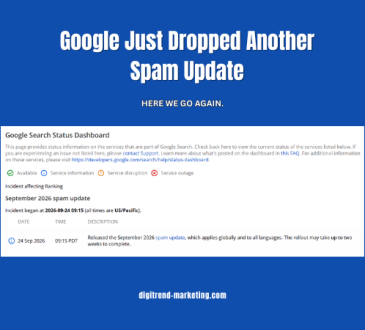
Google Search Status Dashboard Link – https://status.search.google.com/incidents/LEubPCm2octf2uMqCFKE
What Is the Google August 2026 Spam Update?
The August 2026 Spam Update represents a modification to the automated spam-detection systems of Google.
Google frequently updates these systems in order to detect websites which try to manipulate their position in the Search results by using practices that breach its spam policies. Once the systems are better at picking out such practices, the websites in question may find themselves losing visibility in Google’s search results.
This update is not a Google core update. A core update makes general changes to the way in which Google assesses and ranks content, whereas a spam update is aimed at detecting and correcting behavior that is in violation of Google’s spam policies.
Google has confirmed that the August update is global and covers all languages and locations; the rollout began on August 18 and is expected to last several days.
What Does Google Say the Update Targets?
SEOs should be careful here.
Google has not issued a detailed list of the spam techniques that are targeted by the August 2026 update.
The company has merely stated that the update applies to websites which violate its Search spam policies, and Google has also confirmed that this is a typical spam update and not an announcement of new spam rules.
Previously Google has employed spam updates in order to enhance the automated systems which detect practices such as scaled content abuse, cloaking, keyword stuffing, and other types of search manipulation. Yet at present there is no official statement confirming that any of these is the specific aim of the August update.
That distinction matters.
An SEO should not immediately assume that Google has specifically targeted AI content, backlinks, expired domains, or some other individual tactic just because a website has lost traffic this week.
The first thing to do is to work out what actually changed.
This Is the Third Google Spam Update of 2026
Google has not produced its first spam-system update this year with the August release.
Google carried out spam updates in March and June 2026 as well, which makes August the third spam update to be confirmed that year.
The March update was pushed out very quickly, whereas the June update took several days. The speed of an update’s rollout does not necessarily mean that it will be severe for individual websites.
What SEO teams should do is to compare each update with real ranking, traffic, indexing, and page-level data rather than evaluating the update on the basis of how long it took to roll it out.
Should You Be Worried About AI-Generated Content?
Not merely because a website uses AI.
The spam policies of Google are concerned with how content is produced and with the question of whether or not it breaches these policies, rather than considering the use of an AI tool to be an automatic breach.
It is particularly relevant in 2026 since the use of AI to assist with content production has become common on websites.
A website that produces a large number of low-quality pages mainly in order to draw in search traffic could encounter problems if that behaviour breaches Google’s spam policies. Nevertheless, the use of AI as part of a normal editorial process does not in itself mean that a site is committing spam.
Google also broadened its spam policies in early 2026 to include efforts aimed at manipulating the responses of generative AI in Search, such as those in AI Overviews and AI Mode. Nevertheless, Google has not stated that the August Spam Update is specifically designed to target this kind of behaviour.
What About Link Spam?
The August announcement does not name link spam as the particular focus of this update.
Another reason why you should not immediately begin removing backlinks or start a disavow campaign is that rankings tend to fluctuate during the rollout.
A backlink audit may still be of use when looking into an SEO decline, but it must be based on evidence and not on the assumption that the August update was a link-related update.
The principle holds true in the case of all other SEO modifications as well: before rewriting hundreds of pages, removing content, or altering the site’s architecture, you must have a sound reason for the decline.
How to Check Whether Your Website Was Affected
If your organic traffic or rankings start changing around August 18, use the rollout as a reference point when reviewing your data.
Start with Google Search Console.
1. Compare clicks and impressions
Compare the period immediately before the update with the days following August 18.
Look for:
- Organic clicks
- Search impressions
- Average position
- Click-through rate
- Number of queries generating traffic
Do not rely on total organic traffic alone. A traffic decline can come from seasonal changes, demand fluctuations, tracking problems, or changes to a small number of high-traffic queries.
2. Check which pages lost visibility
Page-level analysis can tell you much more than a site-wide traffic number.
Look for patterns such as:
- Blog pages losing visibility
- Location pages dropping together
- Programmatic pages declining
- Product or service pages being affected
- A specific content category losing rankings
If only one page declines, the cause may have nothing to do with the spam update.
If hundreds of similar pages decline at roughly the same time, the pattern deserves a deeper technical and content review.
3. Check your indexing
Review whether important pages remain indexed.
A sudden decline in indexed URLs can indicate a separate technical problem rather than an algorithmic change.
Check:
- Indexing reports in Google Search Console
- Robots.txt
- Canonical tags
- Noindex directives
- XML sitemaps
- Server response codes
- Internal links
4. Review your site’s content practices
If the site experienced a substantial decline, review the pages that lost the most visibility against Google’s spam policies.
Pay particular attention to content that may be:
- Created at large scale without sufficient value
- Repetitive across many URLs
- Designed mainly to capture search traffic
- Overloaded with keywords
- Automatically generated without meaningful editorial review
- Created for similar search queries without providing distinct information
- Published primarily to manipulate search visibility
The goal is not to remove content simply because it performs poorly. The goal is to identify whether the site has practices that could conflict with Google’s policies.
Don’t Make Major SEO Changes During the First Few Days
A major error when introducing an algorithm is to respond too swiftly.
Google states that the August Spam Update might take a few days to finish.
It therefore does not follow that the changes in ranking during the rollout will represent the final outcome.
For example, if a website suffers a drop in its rankings on August 19th, it wouldn’t be very worthwhile to immediately rewrite the entire blog section. The rankings could still keep on changing as Google’s systems finish the rollout.
A better process is:
Monitor → Identify patterns → Investigate → Make changes → Monitor again
This gives you a much better chance of connecting a ranking change with an actual SEO issue.
What Should Businesses Do Right Now?
For most legitimate businesses, there is no reason to panic.
Instead, use the rollout as an opportunity to review the site’s SEO practices.
A useful checklist includes:
- Monitor Google Search Console daily during the rollout
- Track important commercial keywords
- Compare organic clicks and impressions with previous periods
- Review pages experiencing significant ranking losses
- Check for unusual indexing changes
- Review content produced at scale
- Look for duplicate or near-duplicate pages
- Check for keyword stuffing and other manipulative practices
- Review internal redirects and canonicalization
- Check the site against Google’s current spam policies
- Avoid making large-scale changes until a clear pattern emerges
For businesses that have consistently followed Google’s guidelines and invested in useful content, the update may have little negative impact.
In some cases, websites that lose visibility may also create opportunities for competitors to gain rankings.
What Happens After the Update?
The August 2026 Spam Update is expected to be fully rolled out within a few days, but its effects might still become more apparent afterwards.
That means even if the problems on a site are corrected, Google will not necessarily restore the site immediately.
Google has in the past made it clear that its systems may require some time to reevaluate a website after modifications have been made; in certain cases, recovery can take months instead of days.
Prevention is therefore a lot more useful than attempting a response after a major loss of visibility.
Final Thoughts
The global rollout of the Google August 2026 Spam Update is taking place, and the company has stated that it covers all languages and locations. Since Google has not singled out any one spamming technique as the focus of the update, SEO professionals should refrain from speculating about which practices Google is targeting.
At this stage, the best course of action is to carry out careful monitoring.
When the rankings change, check which pages have changed, which queries have changed, when the change began, and whether there is a clear link to a possible spam-policy issue.
Most important of all, do not regard an algorithm update as an automatic penalty. Search visibility may vary for a number of reasons.
The August update once again shows that sustainable SEO requires adhering to Google’s policies, producing content that meets users’ needs, and avoiding techniques which are mainly designed to manipulate search rankings.